
Concert Review: Amy Beach’s Piano Concerto Revived on the Esplanade
By Aaron Keebaugh
Music by Amy Beach, Leonard Bernstein, Florence Price, John Harbison, and John Williams: this Boston Landmarks Orchestra concert had a little something for everyone.
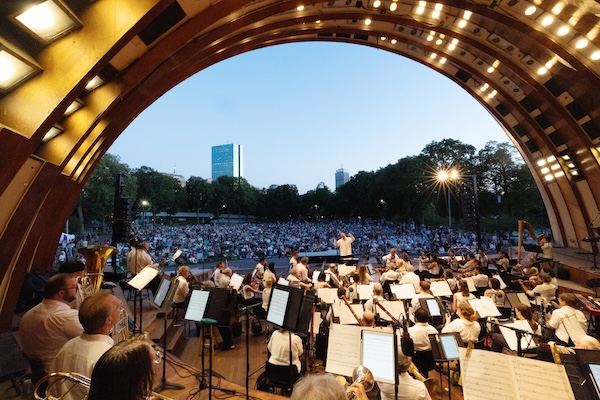
The Boston Landmarks Orchestra in action at the DCR Hatch Shell. Photo: Michael Dwyer
Few genres were more personal to Amy Beach than the piano concerto. She knew many standard works inside and out. In Boston alone, she treated listeners to concertos by Chopin, Mozart, Beethoven, and Saint-Saëns as a soloist with the Boston Symphony Orchestra before her marriage to a prominent Harvard physician quelled her concert career.
Given her breadth and self-guided talent, it seemed only natural that Beach would compose her own Piano Concerto in C-sharp minor, which she premiered in April 1900 with the BSO under the direction of Wilhelm Gericke. But, due to its mixed reception, pianists other than Beach herself rarely championed the concerto. She remained an advocate for this exercise in brooding drama, performing the score around Europe and the United States following her husband’s death. The concerto was last heard in a BSO concert in March 1917, with the composer once again as soloist. Performances since have been relatively few and far between.
That said, the score is sometimes programmed for its symbolic tokenism. Yes, the piano concerto was the first composed by an American woman and to be performed by a major orchestra. But, aside from those historical and political merits, the piece offers plenty of musical rewards on its own, intriguing to this day because of its blazing difficulty and its heroic dramatic journey from darkness to light.
Those compelling elements were more than evident in pianist Asiya Korepanova and the Boston Landmarks Orchestra’s performance of Beach’s concerto at the DCR Hatch Shell Wednesday night. Infused with technical finesse and expressive elan, the rendition suggested (strongly) that the score is an overlooked American classic.
Beach’s concerto has just about everything you could ask for from a Romantic tour de force. There’s show-stopping bravura, riveting give and take between soloist and larger forces, and moments of intimate dialogue that thread all the pyrotechnics together. Korepanova caught, with masterful panache, its commanding theatricality: tumultuous depth slowly turns toward the light. The Russian pianist worked like an expert landscape painter, shaping the harmonies in her opening barrage with enough force to undergird the dreamy stasis that follows. This score never quite settles into an emotional equilibrium; Beach herself described the piece’s atmosphere as combative, the piano part vying for supremacy against sizable orchestral forces. And Korepanova had a worthy musical adversary in conductor Christopher Wilkins, who led the counterattacks with fire and grit. His tempos were broad but well judged, leaving ample room for the pianist to pose her opposing dynamics.
The concerto provides any soloist with all the makings for an energetic romp. Korepanova’s passages both clashed with and complemented the orchestra, pushing against the musical currents, as well as letting them carry her along. Still, making the inner moments work called for more of a unified effort.
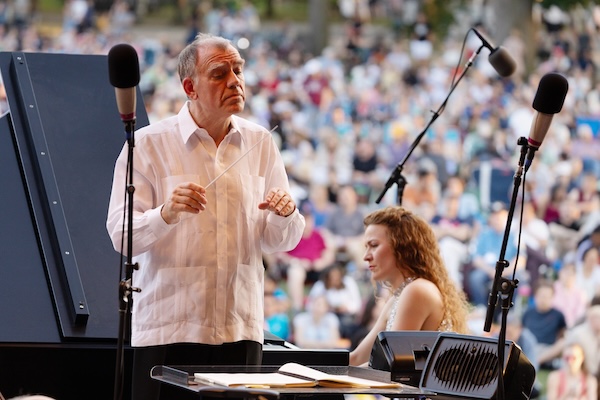
Christopher Wilkins conducting the Boston Landmarks Orchestra and pianist Asiya Korepanova in a performance of Amy Beach’s Piano Concerto in C-sharp minor. Photo: Michael Dwyer
In the Scherzo, Korepanova and Wilkins teased out a playful vitality. Languid tempos in the Largo lend the music some distinctly dark colors. The conductor and pianist dove into the witty and whimsical finale, where turbulence reasserts itself. Yet the ending offers a moving valediction to both soloist and orchestra. Like a wave breaking on the shore, Korepanova rode the musical crest to the triumphant final bars. It turns out that, despite the squabbling, Beach’s Piano Concerto is less a soloist’s journey than a victory lap for all parties involved. It is music of power and confidence, and Korepanova, Wilkins, and the BLO rendered it with conviction.
The rest of the program featured music by other composers associated with Boston.
None of these choices were as visible as Leonard Bernstein, who shared a long and fruitful relationship with the Boston Symphony Orchestra. His most welcoming compositional efforts, such as the selections from Candide heard on Wednesday, never fail to generate festive wit. Wilkins opted for a pensive tempo in the overture, but the musicians still displayed plenty of verve. The battle music crackled; the French horn lines in “Oh Happy We” soared beautifully. The “Old Lady’s Tango” swaggered zestfully, while the stellar BLO brass thrust “Make Our Garden Grow” up to radiant heights. “The Best of All Possible Worlds” bounced with fitting Panglossian assurance.
Florence Price may have received part of her musical training from the New England Conservatory, but her more memorable scores frequently drew from her African-American heritage. The performance of “Juba Dance” from her Symphony No. 1, showcasing the young performers of the Boston String Academy, danced to its ragtime rhythm.
John Harbison, a composer long associated with Boston’s most elite ensembles, explored similarly jazzy idioms in Ruby, inspired by Thelonious Monk’s “Ruby, My Dear.” This love letter to symphonic jazz unfolds in lush harmonies that are sprinkled with dissonance. Wilkins’s reading conveyed the gossamer splendor of classic Hollywood.
Few composers capture the sweep and glamor of Tinsel Town like John Williams. Wednesday’s concert concluded with selections from some of his most beloved film and television scores. In a performance driven by Wilkins’s bold and sweeping gestures, the theme from NBC News coursed nobly. Themes from Harry Potter cackled with elfin glee. The menacing strains of JAWS were offset (a bit) by a violinist’s humorous and well-placed scream. The Irish folk songs of Far and Away set toes tapping. So too did the familiar cliffhanger lines from Raiders of the Lost Ark, which put the finishing touches on a concert that had a little something for everyone.
The audience rewarded the BLO with enthusiastic applause. Wilkins returned the favor with a crowd-pleasing encore: the final scene and credits from Star Wars: A New Hope.
Aaron Keebaugh has been a classical music critic in Boston since 2012. His work has been featured in the Musical Times, Corymbus, Boston Classical Review, Early Music America, and BBC Radio 3. A musicologist, he teaches at North Shore Community College in both Danvers and Lynn.
Tagged: Asiya Korepanova, Boston Landmarks Orchestra
Thank you so very much for this detailed appraisal both of Beach’s Concerto and of the performance by Korepanova and the Landmarks Orchestra. It was truly a very moving experience to hear this work be brought to life so brilliantly, and only steps away from Beach’s own Commonwealth Ave. home where she composed it. Your vivid writing captures the excitement of so many aspects of this beautiful evening.