
Classical Album Reviews: Jordi Savall Conducts Schumann and Bruckner and Melbourne Symphony Orchestra’s “The Planets & Earth”
By Jonathan Blumhofer
What business has a period orchestra got playing the music of Anton Bruckner? And why can’t conductors and orchestras just leave Gustav Holst’s The Planets alone?
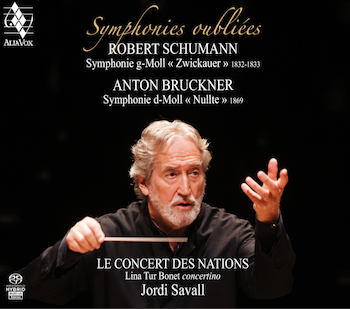
What business does a period orchestra have playing the music of Anton Bruckner? Depending on how much of a purist you are in such matters, the answer will probably lie along the spectrum of “none” to “not much.” You’d be correct on both counts: As eye-catching as it might be for Jordi Savall and Le Concert des Nations to investigate this fare, the results are middling.
Part of the problem — a big part of it, in fact — lies with the program. Bruckner’s Symphony No. 0 is misleadingly labeled (he wrote it between Nos. 1 and 2). But his ultimate rejection of the effort was for the best: it’s architecturally choppy, thematically uninspired, and expressively pedantic.
All three of those qualities emerge across this performance, thanks in large part to the ensemble’s anemic string tone and lean textures (the last quality is remarkable, since lean textures in modern-orchestra Bruckner interpretation can be thrilling). To his credit, Savall has a good sense of how to move this music right along, especially in the outer movements. Yet, despite this — or perhaps because of it — the Symphony’s fragmented structure and dearth of compelling musical ideas come to the fore.
Robert Schumann’s early G-minor Symphony, which fills out the album, is similarly abrupt and sketchy, though parts of it point to the later 19th century (its Adagio introduction periodically suggests what Bruckner, in his numbered symphonic installments, would do). Here, Savall and his band are on firmer footing — Schumann doesn’t always require the warm, Romantic tone Bruckner does — and their take on this “Zwickauer” Symphony’s tempestuous Andantino is well directed and clean.
But the Bruckner is the album’s main item. That the finished product doesn’t upend the composer’s verdict is, in a way, a tribute to Bruckner, who often lacked confidence in his own efforts and revised better works extensively — not always to their benefit. In this instance, though, his personal judgment was spot-on.
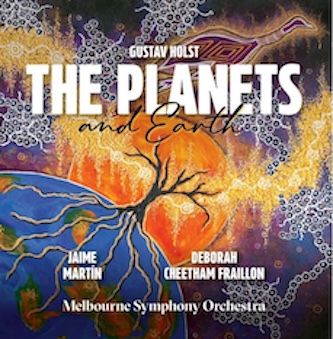 Why can’t conductors and orchestras just leave Gustav Holst’s The Planets alone? A few decades ago, Simon Rattle asked Colin Matthews to add a “Pluto” movement to the heptalogy (Holst had the temerity to premiere his magnum opus in 1918, a dozen years before the dwarf planet was discovered). Now the Melbourne Symphony Orchestra has invited Deborah Cheetham Fraillon to contribute an “Earth” section.
Never mind that Holst’s score operates at a level light years removed from Fraillon’s blandly uplifting opus. Or that there were good reasons why the British composer omitted our one dazed speck from his survey: he was interested in a musical study of planetary character based on astrological and mythological significance.
Without those, well…he’d probably have ended up in the same place as “Earth” does. Which is to say, meandering, accessible, and generically hopeful. Also, inoffensive and forgettable (though given Holst’s later ambivalence about the success of The Planets, maybe he would have been happier with that outcome).
Be that as it may, the performance that Jamie Martin and the MSO deliver of their commission is never short of assured. Fraillon, who’s an accomplished soprano with a fine voice, joins the extravaganza near the end to sing a poem of her own creation, which she does with soaring confidence.
The collective’s account of Holst’s original is rather more satisfying. Though the score’s been recorded ad nauseam, the MSO’s take is, by and large, fresh and lean. There’s color, texture, and articulative detail aplenty in “Mars” (not to mention excellent tenor tuba solos). “Venus’s” accompanimental syncopations really dance and “Saturn” is well-shaped. So is “Neptune,” whose harp and celesta writing sparkles.
On the other hand, parts of “Jupiter” feel underpowered and “Mercury’s”are a touch stolid. In “Uranus,” Martin and his forces lack that last degree of swagger. Even so, the low-woodwind part-writing in that section comes across with vitality.
Jonathan Blumhofer is a composer and violist who has been active in the greater Boston area since 2004. His music has received numerous awards and been performed by various ensembles, including the American Composers Orchestra, Kiev Philharmonic, Camerata Chicago, Xanthos Ensemble, and Juventas New Music Group. Since receiving his doctorate from Boston University in 2010, Jon has taught at Clark University, Worcester Polytechnic Institute, and online for the University of Phoenix, in addition to writing music criticism for the Worcester Telegram & Gazette.
Tagged: Alia Vox, Deborah Cheetham Fraillon, Jamie Martin, Jordi Savall