
Arts Appreciation: Ozzy Osbourne — A Pioneer of Heavy Metal Left on His Own Terms
By Jason M. Rubin
It would be hard to name another successful artist so passionately demeaned by the music press.
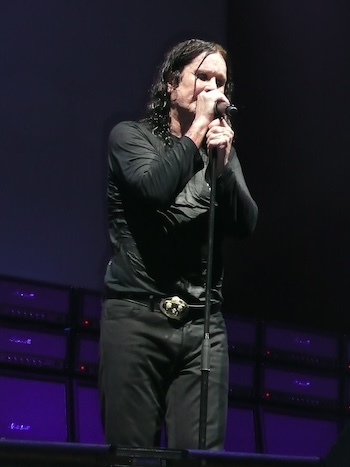
Ozzy Osbourne performing in 2008. Photo: Wikimedia
It was 1980 and I was working as a dishwasher in the restaurant within Filene’s at the Chestnut Hill Mall. I was hanging out with a young assistant cook named Kevin, who asked me if I liked Black Sabbath. I said I’d never heard their music before. He replied that he thought every pothead listened to Black Sabbath. One night, I gave him a ride home from work and he went inside and brought out his copies of their first two albums: Black Sabbath and Paranoid, both released 10 years earlier.
The albums were beat to shit from repeated listenings, scratched by needles clumsily handled by stoners, with covers stained with what I assumed was bong water. None of that mattered. The brutal brilliance of those classic slabs shone through the surface defects. I went out and bought my own copies, free of pops and skips. At the record store, I noticed there was a new Black Sabbath album out, but with a different lead singer. Just my luck, I rued. It was a classic case of getting into a band too late.
Shortly thereafter, I went to a friend’s house to buy weed and he was playing an album that I’d never heard before but it was powerful, especially the vocals. Who’s this, I asked. It was an album by Rainbow called Rainbow Rising. That singer is amazing, I said. My friend agreed and added that he was no longer with Rainbow. (What, again?) No, now he was the new singer in Black Sabbath. So I went back to the record store and bought Black Sabbath’s Heaven and Hell, featuring Ronnie James Dio succeeding beyond all expectations in replacing Ozzy Osbourne, who died yesterday at the age of 76
Of course, Ozzy countered with a solo career that, combined with his outsized, outrageous personality, made him an even bigger star than he was before (and brought the goofy “Crazy Train” to sports stadiums everywhere). It was, in fact, perhaps the greatest rebranding coup in rock and roll history. Throughout the ’70s, rock critics barked at the moon in putting down Ozzy’s voice and his faux-satanic stage buffoonery. It would be hard to name another successful artist so passionately demeaned by the music press. Yet there he was, grabbing headlines and selling out arenas. And though his solo albums did good business, there were bumps in the road: the bat incident, the dove incident, and the plane crash that killed his promising young guitarist Randy Rhoads and two others.
In the 2000s, mainstream America got a better look at Ozzy (and his family) on their MTV reality series, The Osbournes. Once a scary, menacing figure, Ozzy was shown to be a drug-addled clown, if not family-friendly then at least not a serious threat to middle America. While Black Sabbath floundered, Ozzy became more and more popular. And I became less and less interested. I pined for the creepy Ozzy of Master of Reality, the maniacal Ozzy flashing the peace sign in silhouette on the cover of Vol. 4. (Ozzy’s peace sign, by the way, was never as community building as Dio’s devil horns, and even on Sabbath’s final ever live set a few weeks ago, guitarist Tony Iommi and many fans were seen making Dio’s trademark hand gesture.)
In recent years, Ozzy had been less visible, except to paparazzi who managed to shoot pictures of him looking very ill. He was, in fact, diagnosed with Parkinson’s disease, and during the last concert he performed seated. Still, when he was fired from Black Sabbath in 1979 (after the last Sabbath album with the original lineup, Never Say Die!, was released) for being too wasted and unreliable, he could have packed it in, either retiring or offing himself. Instead, he recreated his image and his career and became a global sensation. That in itself is praiseworthy, not to mention difficult. But he did it, and now he’s gone out on his own terms. If he actually does end up in hell, I’m sure Satan and all its inhabitants are welcoming him warmly. But if he somehow manages to make it into heaven, I imagine he’s being greeted with peace signs. Oh, Lord, yeah!
Jason M. Rubin has been a professional writer for 40 years. He has written for The Arts Fuse since 2012. His books include Villainy Ever After (2022), a collection of classic fairy tales told from the villains’ point of view; and Ancient Tales Newly Told (2019), a pairing of two historical romances: The Grave & The Gay, based on a 17th-century English folk ballad, and King of Kings, about King Solomon and the Queen of Sheba, told primarily from the Ethiopian tradition. In addition, Jason teaches journaling workshops and is a member of the New England Indie Authors Collective. He holds a BA in Journalism from the University of Massachusetts Amherst. He can be reached at http://www.jasonmrubin.com.