
Film Review: “Filmlovers!” — A Valentine to the Movies and the Cinema-Going Experience
By Betsy Sherman
This piquantly enjoyable docufiction emphasizes how movie spectatorship encourages empathy and understanding.
Filmlovers! / Spectateurs! Directed by Arnaud Desplechin. Part of the Boston French Film Festival at the Museum of Fine Arts. Playing on July 26 at 11 a.m. In French and English with English subtitles.
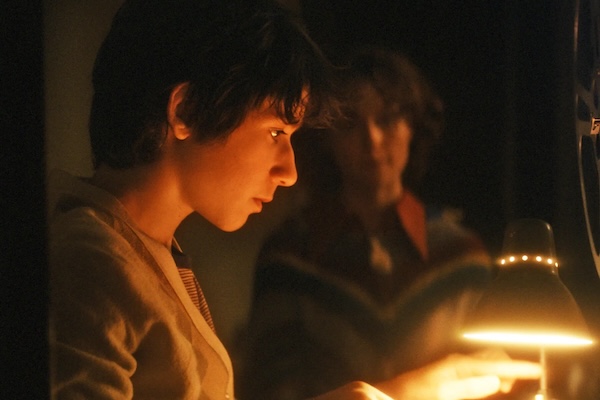
Milo Machado-Graner in a scene from Filmlovers!
I thought of French director Arnaud Desplechin while watching Benicio del Toro reunite with French actor Mathieu Amalric in Wes Anderson’s The Phoenician Scheme. The actors starred in one of my favorite movies of the 2010s, Desplechin’s Jimmy P: Psychotherapy of a Plains Indian. Dry title, yes, but the film is a warmly humanist dramatization of the real-life relationship between a French doctor and a troubled Native American World War II veteran at a hospital in Topeka, Kansas.
Regulars at the MFA’s Boston French Film Festival will be well familiar with the work of writer-director Arnaud Desplechin; as well as having many films screened there, he visited the MFA in 2000 with Esther Kahn. Desplechin, now 64, last year shot a valentine to the movies and the cinema-going experience. In France it’s called Spectateurs! and he narrated it himself; the US release is called Filmlovers! and its voice-over is spoken in English by Amalric. A piquantly enjoyable docufiction, Filmlovers! could provide evidence to support the Gore Vidal quotation, in his 2006 memoir Point to Point Navigation, “As I looked back over my life, I realized that I enjoyed nothing — not art, not sex — more than going to the movies.” But Desplechin’s outlook isn’t as curmudgeonly as Vidal’s sounds; he emphasizes movie spectatorship as encouraging empathy and understanding.
Desplechin’s customary investigations of the complications posed by family and romance are here bundled up in the dreamworld of motion pictures. He reaches back to fetch his autobiographical character Paul Dédalus, who was played by Amalric as a lecturer in philosophy in the comic-drama My Sex Life… or How I Got Into an Argument (1996) and as an anthropologist who looks back at his youth in My Golden Days (2015). Desplechin asserts that he has imagined “different possibilities of Paul Dédalus,” and playfully depicts the character as a young film obsessive through the ’60s, ’70s, and ’80s.
Co-scripted by Desplechin and Fanny Burdino, the film is a hybrid essay and memoir. Its chapters focus not only on Paul’s progress as a cinephile, but also on the family members, friends, lovers, and strangers who share the viewing experience with him. Filmlovers! has interviews with scholars; however, the experts don’t hold more of a privileged position on screen than the regular folks whom the director sets up against a white background and asks about their moviegoing routines and highlights (an important topic is, where do you like to sit?). Fun fact: although this documentary will be consumed via digital projection, within its domain, cinema equals celluloid. Period.

Mathieu Amalric in a scene from Filmlovers!
A preface celebrates pre-cinema’s attempts to make images move (thanks to Eadweard Muybridge and co.). The achievement of “time photographed” was at last accomplished, by pioneers such as Thomas Edison and the Lumière Brothers, in time for the 20th century to dawn. Chapter one follows six-year-old Paul (Louis Birman) and his sister Delphine as they’re taken by their grandmother (the amazing Françoise Lebrun) to a movie theater. As his first film in a theater, Paul sees Fantômas (1964), or kind-of sees it (the visit is truncated). That experience and the viewing on TV of the disturbing dream sequence in Alfred Hitchcock’s Spellbound raise issues about the emotional shocks one can experience when immersed in a motion picture.
The 14-year-old Paul (played by Milo Machado-Graner from Anatomy of a Fall) undoubtedly has been bitten by the bug. He’s determined to see Ingmar Bergman’s Cries and Whispers in a cinema, although the age for admission is 16 and older. The cashier knows he’s lying about his age, but she sells him a ticket anyway to the harrowing but deeply rewarding film. Paul’s adult self remembers his first Bergman on the big screen: “The faces of women were immense, like landscapes. I was at last smaller than the images I was looking at. I had found my home.” As head of his high school ciné-club, he books, unseen, the Czech feminist comedy Daisies. By now he’s all about sharing his mania, not just living it (he and a female classmate bask in the warmth of the projection booth). This scene was shot at Desplechin’s actual high school in the northern city of Roubaix, in which the multimedia auditorium now bears his name.
Sam Chemoul plays Paul as a university student. With the time he spends juggling girlfriends and seeing movies three times each (first time to discover, second time to admire, third time to learn), you’d think school was an afterthought. But we accompany him to a class in which his professor espouses a mind-popping theory positing that each spectator, depending on which seat he or she inhabits in a cinema, is seeing a different movie.
As the film moves on, it’s possible that Paul bifurcates. Black actor Salif Cissé plays Paul at 30. In a restaurant, he explains to his companion that he’s recently had an epiphany that may help him make the leap from film-lover to filmmaker. At the bar his eyes meet those of — Mathieu Amalric, who’s identified in the credits as The Filmmaker.
But Filmlovers! is not The Fabelmans. The portions about Paul’s arc have a symbiotic relationship with meditations on the strengths of the medium, dips into the work of film theorists, and transporting cascades of film clips. It’s a bit of a swervy ride, but the subject matter is worthy. Standout moments include sidebars on figures Desplechin knew and admired who are now deceased. He salutes film theorist Stanley Cavell (a co-founder of the Harvard Film Archive) and stages a scene in which academic Sandra Laugier, Cavell’s French translator, answers questions on the philosophical aspects of film from young people. Gone far too soon is the director’s dear friend, Blackfeet actress Misty Upham, who died at 32. She acted in Desplechin’s Jimmy P., and Frozen River.
Desplechin recounts the profound effect Claude Lanzmann’s Shoah had on him when he attended the nine-hour-plus Holocaust documentary’s initial release in Paris in 1985. His camera pans around the late Lanzmann’s office as he reminisces about their friendship. He cites the writings of Shoshana Felman as helping him to process the testimonies in Shoah, and films his conversation with her in Tel Aviv to discuss Lanzmann’s work.
The clips from around 50 films — ranging from Man with a Movie Camera to Point Break — illustrate concepts that are mused-over in the narration. Some spectators surely won’t like that there’s no text identifying the films. It’s of some help that there’s a list of the movies on the film’s Wikipedia page. But please don’t light up your phone screen in the dark movie theater!
Betsy Sherman has written about movies, old and new, for The Boston Globe, Boston Phoenix, and Improper Bostonian, among others. She holds a degree in archives management from Simmons Graduate School of Library and Information Science. When she grows up, she wants to be Barbara Stanwyck.
Tagged: "Filmlovers!" "Spectateurs!", Arnaud Desplechin, Boston French Film Festival, Fanny Burdino, Mathieu Amalric