
Television Review: “Back to the Frontier” — Living La Vida Antiqua
By Sarah Osman
Watching a historical reality show now takes on a different meaning than it did 20 years ago. Today, our reliance on technology borders on dystopian Ray Bradbury territory, so modern-day folks trying to survive on the frontier looks like an impossibility.
Back to the Frontier on HBO Max
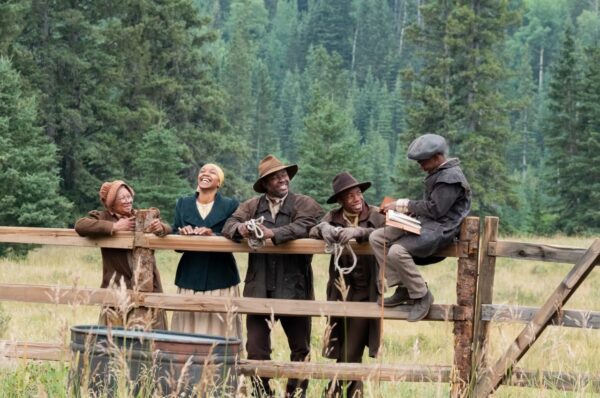
A scene from Back to the Frontier. Photo: HBO Max
I have a morbid fascination with reality shows where modern-day folks go back to live in ye olden days. I revel in their misery and disgust at how miserable life was way back when, even though I doubt seriously I would fare much better. PBS and BBC created an entire genre out of this concept, known as “historic reality series,” where they subjected the “lucky” participants to the most brutal conditions possible. Participants have struggled to survive in Victorian slum houses, have tried to hold their heads above water as either servants or the filthy rich in Edwardian England. Some wannabe pioneers toiled away on farms in the 1800s.
Sadly, the historical reality series craze died out by the late 2000s. Perhaps the shows were lumped in with other tacky reality shows of the early-mid 2000s. Or perhaps people felt life was hard enough. Who needed to go back to the past to suffer?
Fortunately for fans like me, the historical reality show is back, thanks to none other than the king and queen of home renovation fare: Chip and Joanna Gaines. The duo executive-produced Back to the Frontier, where three 2025 American families go, as the title states, back to the 1880s and try their hand at homesteading. Surprisingly, the Gaineses don’t appear in the series (or at least not in the episodes sent to critics). And that might be for the best, considering their problematic background.
The three families include the Lopers, an affluent family from Alabama with a mom who shudders at the idea of domestic work. But grandma grew up on a farm. The Hanna-Riggs from Texas rely on Alexis and Siri for literally everything, and the Halls are Floridians who cry when they’re requested to remove their makeup. Naturally, the participants have been picked because of their diehard love of technology and obvious inability to do anything without it. That mismatch makes for peak entertainment. For example, one of the Hanna-Riggses has trouble determining which vegetable in his garden is a potato. If only he could consult Google. The other families don’t do much better.
The series isn’t a competition, but the families have been given a challenge: to gather enough resources to survive the winter. They’re handed half-finished cabins and an 1880s almanac to help them get along, a guide to everything from cooking to feeding chickens. Early on, the families realize they must help each other for all to survive. But Papa Hall is hesitant to help others, triggering what is sure to be a season-long storyline. Is he the de facto villain? Too soon to tell, but he’s sure to stir up plenty of trouble with his massive ego. Early on Papa Hall manages to anger the other two families and spend half the family’s savings. Not a great start, and winter is a comin’.
Back to the Frontier isn’t 100 percent historically accurate. The Hanna-Riggses are a gay couple, with two twin sons, which wouldn’t have gone over well in the 1880s, and racism doesn’t seem to have been invented yet. Still, the series is filled with fun historical tidbits. The origins of ice cream and ice cream socials are explained (the families have one). Homesteaders weren’t given an opportunity to pick which plot of land they were given, which is why one in three farmers failed. Children were treated as workers — they were given strict instructions and specific chores. The real-life history of the 1880s doesn’t feel shoehorned in —through advice from historians and info from the trusty almanac, we and the families learn what life was really like.
Along with the families’ struggles, Back to the Frontier injects some satiric humor, primarily through notes of skepticism. A sarcastic narrator makes snide remarks, reflecting what watchers are no doubt thinking about the time warp pratfalls. Reactions to the omission of certain essentials, such as the lack of toilet paper, add to the humor quotient. Every expert and real-life homesteader the clans meet up with walks away dubious about their chances for survival — but they brightly wish them good luck.
Watching a historical reality show now takes on a different meaning than it did 20 years ago. Today, our reliance on technology borders on nightmare Ray Bradbury territory, so modern-day folks trying to survive on the frontier looks like an impossibility. Unintentionally or not, the series sheds a warning light on just how debilitatingly dependent we are on modern efficiencies. We would not be able to function without our beloved devices and, with AI on the horizon, it is scary to see just where this helplessness is taking us. That said, giving up running water and electricity is a little … extreme. Still, I’m grateful to watch those who did — may historical reality shows live on.
Sarah Mina Osman is based in Los Angeles. In addition to the Arts Fuse, her writing can be found in The Huffington Post, Success Magazine, Matador Network, HelloGiggles, Business Insider, and WatchMojo. She has an MFA in Creative Writing from the University of North Carolina Wilmington and is working on her first novel. She has a deep appreciation for sloths and tacos. You can keep up with her on Instagram @SarahMinaOsman and at Bluesky @sarahminaosman.bsky.social.
Lots of ‘holes’ per se, but so much fun to watch and escape into whilst gaining an appreciation for our own century
Love this show!! Makes you really appreciate what we have. Love the transformation in all the cast members but especially the children. Hope this series returns for many seasons to cone!