
Doc Talk: MAGA Mirrored in “Apocalypse in the Tropics”
By Peter Keough
In her new documentary about the crises in Brazilian democracy, Petra Costa examines a factor involved in the election of Jair Bolsonaro that was largely overlooked in the first film — the toxic power of the evangelical movement.
Apocalypse in the Tropics, directed by Petra Costa. Available on Netflix.
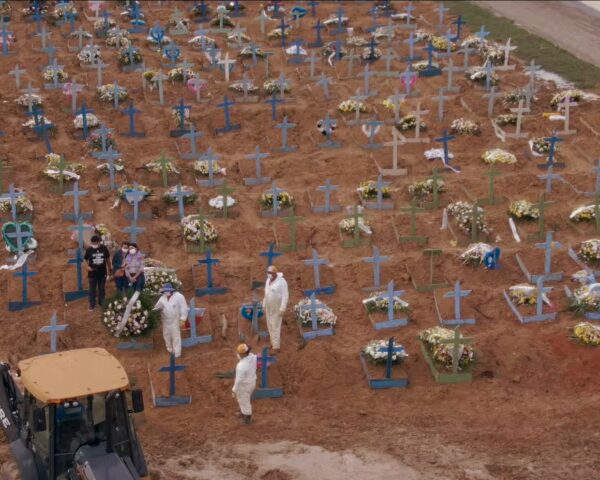
A scene from Apocalypse in the Tropics. Photo: Netflix
For over a decade, the US and Brazil have mirrored their mutual misadventures in imperiled democracy.
Brazilian filmmaker Petra Costa has been recording this dysfunctional entanglement from the Brazilian side in two compelling and personal documentaries. They are personal because, as Costa explains in the first film, The Edge of Democracy (2019), her activist parents had been fighting against the military dictatorship that usurped the country’s democratic ideals in 1964. Thanks to their courageous struggle, and that of countless others, Brazil overthrew the junta, ushering in a restoration of democracy in 1985.
But as the film demonstrates, the enemies of democracy were not done. In 2018, they employed dirty tricks to win the presidency for right-wing demagogue and Trump protégé Jair Bolsonaro.
In Apocalypse in the Tropics, her new look at the crises in Brazilian democracy, Costa examines a factor involved in the election of Bolsonaro that was largely overlooked in the first film — the toxic power of the evangelical movement.
Over archival footage from 1960 of the Brutalist buildings in the just constructed capital of Brasilia, Costa explains how the newly constructed capital represented the country’s decision to forego the Catholic traditions of the past and instead pursue the secular ideals of freedom, equality, and justice.
But, within a few decades, the evangelical movement would reverse that course as it exploded from less than 3 percent of the population to more than 30 percent. And these religious groups were not restricting their activism to saving souls — they were openly seeking to take over the country. Their reasoning: Brazil, like all nations, belongs to Jesus Christ, a theological position known as dominion theology.
How did this happen? Costa traces it back to the Nixon administration, which had grown concerned by the increased popularity of liberation theology. This doctrine, preached by socially conscious Catholic clergy and other socially engaged leaders, emphasized the Church’s responsibility to care for the poor and confront the powers responsible for their plight. To counteract this development, Henry Kissinger advised the President to flood the country with evangelical missionaries. Their interpretation of the Gospel didn’t focus on a socialistic reading of the Sermon on the Mount; it was a fundamentalist, chiliastic interpretation of the Book of Revelation. They were comfortable overlooking such New Testament pieties as empathy, charity, and forgiveness. Instead, they preached the harsher values of cutthroat capitalism. These efforts bore enormous fruit. By 1974, Billy Graham was able to draw nearly a quarter of a million people to a soccer stadium in Rio de Janeiro, the largest gathering of evangelicals in Brazilian history.

A scene from Apocalypse in the Tropics featuring Jair Bolsonaro. Photo: Netflix
Meanwhile, Pastor Silas Malafaia, Brazil’s most powerful and popular televangelist, had determined that the proper occupation for preachers was to manipulate the electorate for the sake of creating a government that imposed his church’s strictures on the country. Costa manages to draw Malafaia into bursts of candor that are not always flattering to the blustering, bumptious, and decidedly un-Christian subversive. Interviewed while driving, he explodes into a fit of road rage when a vehicle cuts him off. He notes with satisfaction that his bodyguard in a tailing vehicle is pulling the errant driver over. “People think because I’m a pastor they can step on my neck,” he fumes. Malafaia points out that Christ himself was “no walk in the park” and that “Jesus grabbed a whip!”
One of Malafaia’s most effective whips has been Bolsonaro, who, as seen in The Edge of Democracy, won the election in 2018 after his most powerful potential opponent, Luiz Inácio Lula da Silva (known popularly as “Lula”), had been imprisoned on bogus corruption charges by a compromised judge. In the new film, Costa focuses on how Malafaia and the evangelists contributed to that victory for autocracy and how Bolsonaro opportunistically converted to Malafaia’s sect. He embraced the motto “Brazil above everything, God above everyone” as a campaign slogan. She then follows the ongoing 2023 presidential campaign in which Bolsonaro faces Lula — who had been exonerated by the Supreme Court of all charges — in a down-to-the-wire contest that uncannily resembles the 2020 US presidential election.
There are some significant differences, not least being the refusal of the Brazilian Supreme Court to bend the knee to the right-wing candidate. When, as in the US version, Bolsonaro does not concede after his loss but promotes violent nationwide demonstrations that fail to overthrow the legitimately elected President, he is not granted impunity as was Trump. Instead, Bolsonaro and his “co-conspirators” now face charges of plotting to overthrow the government and assassinate Lula and other government figures. (Trump recently threatened to impose 50 percent tariffs on Brazil if they do not dismiss the charge against Bolsonaro, a move that some think may backfire to Lula’s advantage.)
Though employing a more objective tone and approach than in the previous film, Costa intensifies Apocalypse with ingenious and inventive effects. As seen with her scenes featuring Malafaia, she is an expert at getting access to all sides, including impoverished Bolsonaro supporters whose unquestioning allegiance to their messiah is reminiscent of the attitudes of some US voters. Her mix of on-the-spot reporting, archival footage, and news broadcasts is illuminated by striking images from eschatological paintings by Hieronymus Bosch and Pieter Bruegel, backed by music ranging from Bach to Brazilian pop. Such bold cinematic touches evoke a mood of dread, of hope, of imminent reckoning, and of a final unveiling of the truth, which, as Costa points out, is what the word “apocalypse” really means.
Peter Keough writes about film and other topics and has contributed to numerous publications. He was the film editor of the Boston Phoenix from 1989 to its demise in 2013 and has edited three books on film, most recently For Kids of All Ages: The National Society of Film Critics on Children’s Movies (Rowman & Littlefield, 2019).