
Book Review: “The Slip” — An Epic Exploration of the Elasticity of Identity
By Clea Simon
The Slip raises issues of race and entitlement, as well as the malleability of identity, all in one big, sloppy, and occasionally gorgeous package.
The Slip by Lucas Schaefer. Simon & Schuster, 496 pp., $29.99
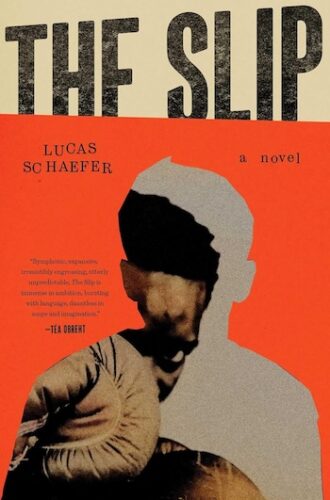 “Where do we come from? What are we? Where are we going?” These questions about our place in the world, famously asked in an 1897–98 painting by French artist Paul Gauguin, are as relevant today as they were at the turn of the last century. And, in the ambitious spirit of Gauguin’s beautiful and controversial masterpiece, Lucas Schaefer’s much vaunted debut novel The Slip raises issues of race and entitlement, as well as the malleability of identity, all in one big, sloppy, and occasionally gorgeous package.
At the heart of this sprawling 496-page novel is a mystery. In the summer of 1998, a teenager goes missing. Nathaniel Rothstein has been staying with his uncle in Austin, Texas, following an altercation in his Newton, Massachusetts, hometown that has his single mother at wit’s end. That summer, under the benevolently negligent care of his stoner uncle Bob Alexander and David Dalice, the Haitian supervisor at the nursing home where he is forced to volunteer, Nathaniel will discover boxing and, perhaps, his true self. Before he disappears.
The book opens 10 years after Nathaniel’s disappearance. The scene is Terry Tucker’s boxing gym, the rundown neighborhood hang where his boss and his uncle work out. Someone has tucked an intriguing note under Bob Alexander’s windshield wiper, possibly reviving the missing-person case. However, before Bob can begin to investigate – which he does, more or less, throughout the novel — readers are introduced to Ed Hooley, a formerly homeless man who lives at the gym and who appears to have discovered a coyote hiding under the ring.
“Appears” is key here, because Ed, the gym’s “squatter-in-residence,” often has trouble distinguishing reality from his imaginings. But, as Ed gears up to face the truth about what he may have seen, his narrative is interrupted by that of gym owner Terry, who is preparing a young fighter, Alex Cepeda, to turn professional. And, as we soon learn, Alex is also about to embark on a relationship with an insecure rookie cop, Miriam Lopez, who will face a momentous decision when she stumbles on a key piece of Alex’s immigration saga.
If that sounds like a lot, it is — and this is only the half of it. Schaefer’s exuberant debut overlaps (and sometimes overloads) characters, digressing into their backstories with a love of detail and wit that recalls James McBride. At times, his writing is electric, the sense of place — of motion, of time — gorgeously specific.
At the very moment Ed’s right glove hit Terry’s left focus mitt, the coyote, curled under a truck tire lying flat on the weight room floor, awoke to the whoosh of a jump rope swinging so fast that the cable never once smacked against the rubber flooring.
When the action shifts back to that fated summer, even more characters are introduced. David, who becomes Nathaniel’s mentor, has a complicated history, centered on his compulsion to act as a sexual guide to his young charges (“a standard part of the How to Please Your Woman seminar he’d been presenting to his teenage male underlings for decades”). This leads to the tale of David’s marriage and his wife’s history, as well as that of one of his geriatric patients. And that’s all before the book gets to Charles Rex, aka X, a gender-confused youth exploring his sexuality.
What soon becomes clear is that every character will trigger a digression — every backstory playing a role in the larger theme of identity and self-determination (even the coyote has her moment). It’s an impressive feat, one that Schaefer mostly pulls off.
X’s first plotline, for example, centers on the youth’s burgeoning romance with classmate Jesse. “’You can be anything you want to be, my little man,’ his mama always told him.” Of course, X’s mama — a hairstylist who doubles as a phone sex worker — meant that his possibilities were limitless as long as he remains a man. What she didn’t tell him is that those choices can be dangerous, and Jesse and X’s climactic encounter is the brutal, visceral high point of the book.
It also marks a turning point, not only for X but for Nathaniel and several other characters who are on their way to becoming who they will be. Not that this is straightforward: Even as he rambles into every character’s story, Schaefer also explores possible futures, alternatives for what may have happened to Nathaniel and the larger crew. These possibilities are red herrings in the larger mystery, touching on the author’s secondary themes of race and privilege, as when he has David imagining being the adult Nathaniel’s token Black friend.
These detours are certainly illuminating, and Schaefer’s prose often delights. But they can also be exhausting, and the author’s overweening aspiration isn’t helped by his authorial asides. “Here’s a dirty secret: you can always find a way to give yourself permission,” he writes. “People don’t go to boxing gyms to stay the same. We are not static. The world is not static,” Schaefer writes. “Stories that start as one thing sometimes become another.”
Yes, after 400-some pages, we have figured this out.
Also, for such a big, munificent book, The Slip makes some unfortunate slips into little meannesses. The reveal behind the mystery, for example, depends on two nasty acts that don’t entirely fit into the character of those who perform them. In addition, a key case of misidentification — or, rather, unintentional self-re-creation — pushes credulity to its limits. That Schaefer pulls everything together in an emotionally satisfying conclusion is impressive. Of course, for a work of this scope and ambition, it is the least the author could do.
Clea Simon is the Somerville-based author most recently of the novel The Butterfly Trap.