
Film Review: “40 Acres” Tills an Apocalyptic Landscape
By Peter Keough
This is an auspicious feature debut, a doomsday thriller that touches on resonant topical issues.
40 Acres. Directed by R.T. Thorne. At the Boston Common and in the suburbs.
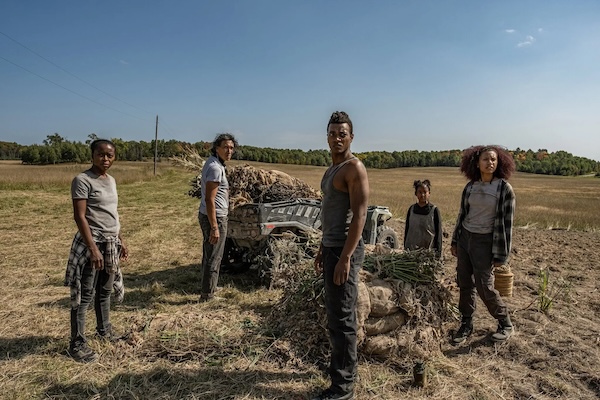
From left, Danielle Deadwyler, Michael Greyeyes, Kataem O’Connor, Haile Amare and Jaeda LeBlanc in 40 Acres. Photo: Magnolia Pictures
Post-apocalypse movies usually have something to say about the times in which they are made. Though today we are in a potentially pre-apocalyptic age, high profile outings such as 28 Years Later don’t end up shedding much light on the current situation. An exception is Canadian filmmaker R.T. Thorne’s auspicious feature debut, a doomsday thriller that touches on resonant topical issues, starting with its title, which ironically refers to an unfulfilled Civil War promise: that every formerly enslaved Black farmer would be given 40 acres and a mule to set them up for a life of freedom.
Back then, the members of the Freeman family managed to rebound from that betrayal. They found a refuge farther north, establishing a homestead in Canada. Some two centuries later, their farm endures as a bastion against the end of civilization. The culprit is not a rage virus or nuclear war or an alien invasion. An unexplained fungus has wiped out all animal life – a stand-in for the human-induced, slower, but probably no less certain mass extinctions that are pending in the real world. Since meat or dairy is no longer on the table, arable land is the most valuable commodity in the world — everyone has been forced into becoming de facto vegans.
Or, as in John Hillcoat’s adaptation of Cormac McCarthy’s The Road (2009), there is an alternative. Cannibals – savage renegades labeled “animals” by the more genteel survivors in an undeserved slight to their extinct fellow species. Though calling them extreme capitalists would probably be more appropriate. In this perilous environment Harriet Freeman (a tiny, mean, and lethal Danielle Deadwyler), a hardened veteran and the reigning matriarch of the family farm, has kept everyone alive with her unsparing, spartan discipline. Along with her partner Galen (Michael Greyeyes), a proud Indigenous warrior, they have turned the farm and their extended family of children and stepchildren into a fortress.
In the film’s tense opening a band of armed raiders straight from the Proud Boys playbook tries to lay siege to the seemingly undefended freehold. Big mistake. The Freeman contingent dispatches the invaders with ruthless efficiency. One tries to escape, but Harriet’s eldest son Emanuel (Kataem O’Connor) cuts the fugitive off. He is dismayed to discover that, beneath the mask, she is a terrified young woman begging for her life. Henriette, disgusted by her son’s weakness, orders him to deliver the coup de grâce.
Pity might have had something to do with Emanuel’s hesitation. But loneliness and sexual deprivation no doubt played a part as well. As he complains to Harriet later, he doesn’t even know how to talk to a girl because she has not allowed anyone in the family to have contact with outsiders. Experience has taught Harriet to trust no one and, except for radio communication with other family outposts and a grudging, distant friendship with Augusta (Elizabeth Saunders), another equally tough matriarch on a neighboring farm, she won’t risk going out of her way to help others. This is a policy that has worked up to now, but what happens when Emanuel encounters another young woman, not an invader but a naiad swimming in the river? What happens when a young man falls in love or just wants to get laid?
Could this breach of Freeman solidarity be fatal? It almost is for the movie. It leads both Emanuel and Thorne into a potentially disastrous escapade culminating in a sometimes thrilling, sometimes muddled zomboid donnybrook. High points include a botched crucifixion, multiple rescues and attempted rescues, and a savage shootout and knife fight waged in total darkness, set pieces that surpass some of those in similar films with far bigger budgets and suggest a promising future for the filmmaker.
While 40 Acres explores, with some success, the limitations of family bonds and of parental authority, the film falters in its handling of some of the other themes it touches on, such as the conflict between isolation and community, the problematic nature of ownership, the value of empathy and, most crucially, the origins and legacy of slavery and racism.
It also raises, but does not answer, the question of what constitutes a just human society. At one point, a cannibal leader confronts Harriet with the withered cliché that there really is not much difference between the two of them – they will both do anything to survive. Harriet dismisses the idea perfunctorily, but the similarities might be worth considering. True, Harriet will do anything for survival – the survival of her family, that is, and not her own. But the cannibals are also a kind of family and a much larger (though less diverse, consisting, it seems, entirely of hairy white men and an occasional woman) one to boot. Politically the two “families” are not that far removed – the cannibals practice a kind of predatory fascism while the Freemans maintain a rigidly structured, if ostensibly benevolent, agrarian feudalism. Neither aspires to any kind of democracy.
Bromides about family values aside, how are the Freemans superior to the anthropophagous “animals?” Indeed, are people superior to the real animals that our mishandling of resources has consigned to doom? (Darwin would offer a trenchant response.) In some ways the “family” in Flow, survivors of an apocalypse of an inverse kind, seems closer to the human ideal.
Peter Keough writes about film and other topics and has contributed to numerous publications. He was the film editor of the Boston Phoenix from 1989 to its demise in 2013 and has edited three books on film, most recently For Kids of All Ages: The National Society of Film Critics on Children’s Movies (Rowman & Littlefield, 2019).
Tagged: "40 Acres", Danielle Deadwyler, Haile Amar, Kataem O’Connor, Michael Greyeyes, black film, post-Apocalyptic