
Poetry Review: Words into Truth — Henri Cole’s “The Other Love”
By Michael Londra
There are reassuring lyrics here that suggest that, no matter what terror comes along, our noble charge is to fight to the end, joyously.
The Other Love by Henri Cole, Farrar, Straus and Giroux, 80 pp, $16
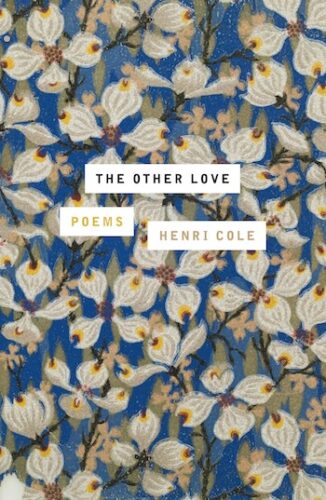 Characterizing the history of poetry in a single aphorism is a fool’s errand, but nothing hits closer to the mark than Marianne Moore’s “The cure for loneliness is solitude.” In other words, poets are paradoxes—alienated by society’s cruelty and vulgarity while also inspired by love and beauty. Unable to completely reject or fully embrace the social order, poetry grapples for détente between two rival psychological states. It is an unresolvable internal wrenching that Robert Frost called his “lover’s quarrel with the world.” Because the stuff of life is poetry’s subject, writing in isolation never amounts to a rejection of the wider community. Instead, poets are most joined to others when they are alone, advancing culture by rejuvenating the human spirit in the face of catastrophes. Moore’s career, in fact, best proves this point. Sharing a reclusive existence with her domineering mother, Moore wrote poetry that refines disparate images—katydid wings, church steeples, baseball players, electricity bills—into high art, that, in turn, constitutes an irreplaceable contribution to the great chain of being.
Likewise, Henri Cole. In interviews, he has spoken of Moore as one of his influences, so it is not surprising that there are lines in his newest collection of verse, The Other Love, that praise her (“I still prefer Marianne Moore, who created a marvelous new idiom” from “Young Tom’s Room”). And there are poems that follow her example, drawing on personal experience to enter darker philosophical terrain: “Why do the world’s shadows / come so close / as its wonders beckon?” (“Figs”). Reckoning with Trump’s autocratic post-Obama America—“the world makes no sense to me, / and sometimes it’s as if I am wearing / the wrong eyeglasses” (“Wild Type”)—Cole comments on a variety of objects and events in his collection: the pandemic, flowers, smartphones, mushroom soup, active-shooter drills, war, porn, funerals of friends, cats that transform into men, watching himself dancing in a mirror, and Amtrak’s ‘quiet car,’ among others. There are also fun instances of clever wordplay, such as “Elf-Storage,” an unrhymed sonnet (a form Cole is renowned for) inspired by his noticing a self-storage sign missing its first letter: “A warehouse is not a good place / for an elf of prominence.”
Cole’s observational poems reflect his diverse life experiences. Born in Japan in 1956 to a French father and American mother, he has lived in Paris and Berlin, taught at Harvard and Yale, and is currently a Professor of Literature at Claremont McKenna College in California. Equating himself to a “mouse in the grocery,” Cole sees himself fulfilling the role of witness scuttling at the margins, playing a small part in what looks to be a larger, more complex moral enterprise: “assembling / words into music and truth” (“Winter Solstice”). “Guns” is an elegy that feels as if it was written by a loiterer in the shadows, yet speaks for everyone at the memorial service:
Stick in the mud, old fart, what are you doing
to get the guns off the streets? I am not here to pick
on anyone. But now that they have shot Yosi,
who ground my meat in Hingham, and his shiny pink
meat truck is for sale, I feel desolate. A gun is
a vengeful machine exacting a price. A gun rejects
stillness…[r]un, hide, evacuate; don’t fire, duck, take cover.
At Yosi’s ceremony, his family put a gold cloth on his face.
Self-reliant, autonomous, tough, he lay in a shroud of silk.
Cole regards his poetry as a promoter of the good, a defender of the values represented by a civilized democracy that are being threatened by a second Trump regime. Recalling the aftermath of the January 6th insurrection, days before President-elect Biden’s inaugural, Cole writes of the National Guard members called into service in “Three Vultures in a Birdbath:”
Now soldiers sleep in the pink granite corridors of the Capitol, soldiers
who must carry around seventy pounds…soldiers whose best friend is a rifle
with detachable magazine…and only want to get back to some kind of order.
The practice of poetry involves a debt to those who have enabled its composition by maintaining freedom of expression. Cole’s poems pay homage to those who have sacrificed. Modern societies are “sheltered / under the corpses of others” and, to obtain our daily bread, we “climb over the backs / of the dead and dying” (“Brother Adam Bees”).
But along with politics, sensuality and humor are also important to Cole. His twinning of art and food is deliberate: “food and poetry being / nourishment that shares a syntax” (“Lament for the Maker”). Comically, there is a quick hint of a possible porn addiction (“Sometimes I watch smut” from “The Other Love”), but the real scandal is that Cole is more of a homebody than a hedonist: “I dig home cooking more than threesomes” (“Komorebi”). Unfortunately, there are moments when playfully ironic insight devolves into silliness, as in a didactic aside on Marvel movies and coronavirus that over-explains the obvious: “Lately, mutants have been in the news a lot, with the South African variant and X-Men (superheroes led by Professor X, a telepath)” (“Wild Type”).
Rounding out this collection are tributes to Seamus Heaney (“At the museum of his life, / his leather duffle coat is behind glass” in “Lament for the Maker”), James Merrill (“September is the time to feel the light, / write, scratch out, write, nap, walk, begin again” from “107 Water Street”) and T.S. Eliot (“I’m sorry you were not my favorite,” in “Young Tom’s Room”). Cole’s verdicts on these distinguished poets possibly reflect uncertainty about his own legacy, though it is also a defiant declaration against the ruthless passage of time: “For all I know, the rest of my life is taking flight” (“Young Tom’s Room”). Unlike some older poets who scale back their ambition in later years — rejecting the supposed youthful pretension of style in favor of clear expression — Cole has not compromised any of the principles established in his work from early on. Continuing to write with brio, the desire found in his first published poems is still palpable, proving that solitude is never lonely: “All my life, reading has made me feel on the verge of something, / like a bird turning into the wind…before going higher” (“My Identity”). This inspirational uplift is at the heart of The Other Love, and is epitomized in “Ode to Hearing” (“I never, / never want to leave this world I so love”) and “’No One over Fifty, Please,’” whose reassuring lyrics suggest that no matter what terror comes along, our noble charge is to fight to the end, joyously:
In the world of things—somnambulistic and blunt—
we are but tumbles of flesh seeking definition,
like sterile florets awaiting daybreak.
Michael Londra’s Art Fuse review “Life in a State of Sparkle—The Writings of David Shapiro” was selected for the Best American Poetry blog. His poetry, fiction, and reviews have appeared, or soon will, in Asian Review of Books, The Fortnightly Review, DarkWinter Literary Magazine, Cha: An Asian Literary Journal, and The Blue Mountain Review, among others. He contributed six essays and the introduction to New Studies in Delmore Schwartz, coming next year from MadHat Press; and is the author of the forthcoming Delmore&Lou: A Novel of Delmore Schwartz and Lou Reed. He lives in Manhattan.
You made my publication day bearable. God bless.