
Book Review: “Via Ápia” — Life in Brazil’s Lower Depths
By David Mehegan
Hearing the novel’s poignant voices, we can’t help but think that in many respects the plight of poor young men in the ’hood is everywhere alike.
Via Ápia: A Novel by Geovani Martins. Translated, from the Portuguese, by Julia Sanches. Farrar Straus & Giroux, 352 pp, Paper, $18.
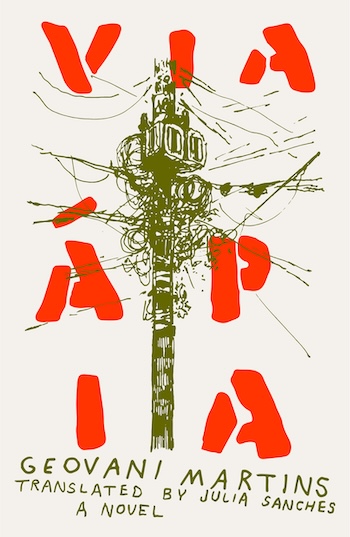 This sad, funny, and moving novel of Brazil by a gifted young (age 34) writer presents the world of favelas, the relatively lawless, semi-governed squatter-built shanty towns within the huge metropolises of São Paulo and Rio de Janeiro. With our assumptions about urban slums, we might expect a lurid tale of nonstop misery and violence, which doubtless would attract Hollywood. There is some violence, but mostly we find a story of normal young people wanting little more than to get by and be left alone.
Via Ápia is the main street of Rocinha, in southern Rio, not far from the beaches of Ipanema and São Conrado. While a part of the city, Rocinha’s de facto ruling power appears to be the drug regime. Kingpins are mentioned by the characters, though not negatively; they never appear and don’t seem to be masters of massacre like those of Mexico. Most of the time, the state and federal governments leave things alone. An ordinary corrupt understanding between law enforcement, the army, and the favela kingpins maintains control, while all sorts of normal business and social life proceed unmolested.
In this world live brothers Wesley and Washington (their mother’s favorite movie actors when they were born were Denzel Washington and Wesley Snipes), school dropouts who work marginal jobs in a restaurant catering to kids’ birthday parties. Sharing the same social stratum are three friends and roommates, Douglas, Biel, and Murilo, who are also dropouts. The five, in their early twenties, are preoccupied with making enough money through low-skill jobs (or in Biel’s case with drug sales) to keep themselves in beer, cigarettes, and marijuana. Cocaine increases its sinister grip as the story progresses.
They have other, small ambitions – Douglas to be a tattoo artist, Wesley to buy a motorbike and have a taxi business – but for the most part, they cannot envision any world beyond Rocinha. None has an available father figure, and their mothers, when they appear, are themselves so burdened that they have little influence over, and provide little inspiration for, their sons.
The main outside event is an invasion in 2011 by the UPP, the semi-military state police, to “clean up” the drug-ridden favelas before the approaching World Cup and Olympics. But the cops are, unsurprisingly, violent and corrupt: when they clamp down on the neighborhood, the arrests and shootouts occur day and night, keeping Wesley, Washington, and everyone else on edge. Complicating the political situation, the regular army also has a presence in town (Murilo is in the army, though it seems to be just a job: he lives with his friends), which sets up conflict among three armed groups.
We never meet the UPP leaders; their minions are nameless bullies who pop up without warning, arbitrarily grabbing people they suspect of drug dealing. If the occupation has any coherent plan or policy, there is no evidence of it. As with our current ICE — trying to grab at least 3,000 people a day — they’re responding to political pressure. Everyone in the novel knows that the heat will be off eventually and the UPP will leave, as they do.
While the occupation is the novel’s background, as in any war novel the real interest is the lives of the people who live under and through it, focusing on individual, everyday life. And here might be the novel’s shakiest aspect. Small actions principally provide color: quitting jobs, complaining about bosses, efforts to make it with women of interest, climbing nearby Pedra da Gávea mountain, stalling the landlord’s effort to evict Biel, Douglas, and Murilo. But this stuff does not move the story forward. What fills most of it is talking and drugs.

Geovani Martins. Photo: Ana Alexandrino
Virtually every page, in places it seems almost every paragraph, is taken up with going to the boca (the local drug market) to get weed or blow (cocaine), with the rolling, smoking, and passing of joints or sniffing of lines, and descriptions of how the drugs make the users feel. And they talk about it incessantly. It’s clear that Martins knows a great deal about this (he grew up in Vidigal, a favela near Rocinha) and is telling us what he knows, but it wears thin and makes the novel seem like a 225-page story stuffed into 352 pages. Just now opening it at random, I come to Wesley’s seven-page account to his brother of getting busted and the cops’ behavior at the station:
“The dude who put the weed plant [from a separate drug bust] on the table stands in front of it, touches one of the leaves and says to his buddy: Man these guys must be out of their minds to be smoking leaves off this shit. I swear I couldn’t help myself, Menó. I said to them: Nobody smokes the leaves, man. What we smoke is the bud, which is like the fruit, right? That plant y’all got is worthless. I can tell from over here that it’s male, meaning it’s no good for smoking. The other cop, the one who’d made that quip at me, started cracking up: Well, hell. Male, female, bud. These days you gotta be a professional if you want to smoke cannabis….
What really pisses me off is that we were around the corner from the boca where I’d bought the weed they’d caught me with. Like, a block away. You know the precinct across from the mall? That’s the one. Dudes deal as usual right there in Cruzada while I’m sitting inside like a dumbass waiting for them to finish the investigation.”
The book is loaded, I would say weighed down, with similar discourse. As in the excerpt above, Martins is careful to let his characters tell the story, with a minimum of omniscient narration. Even the narrative voice usually reflects the street patois of the book’s characters. This lends verisimilitude, but also in spots makes it hard to understand who is speaking and what is going on. One thing is clear: in these young men’s lives, getting and staying high is consistently equal to, or greater than, any other focus of daily life.
Despite what appears to be a pathetic, repressive environment, the boys love their town, can’t imagine living anywhere else, and have no trace of political consciousness. Their imagination and ambitions are painfully limited. Although a couple of young women (the women are the most percipient characters) strive to improve their prospects with education, none of the guys do so. Getting an education, finding a career, getting out of the favela, getting married and having a family are all apparently as far out of reach as a trip to the moon. To them, Rocinha is what it always has been and will be, and so are they. Only after a police shooting does an unnamed parish priest, in a eulogy, speak openly about their entrapment:
“I can guarantee that this boy’s death was not a part of God’s plan. What is happening today in Rocinha is a political plan. Those of us who live here are exposed to poor sanitation, blackouts, cramped living conditions. We have the highest concentration of tuberculosis cases in the entire state. Our school system is a disgrace. And what does government do? It sends in hundreds of inexperienced police officers. Countless guns. … When we are faced with death, our only recourse is to pray and put our faith in Jesus Christ. Meanwhile, to those of us who are still here, I say, We must fight for justice.”
I’m not qualified to assess Julia Sanches’s translation, but she leaves in enough undefined Brazilian slang words (menó, neguim, spliff, churrasco, boca), and the occasional song lyrics are all untranslated, that we never forget, despite the profusion of English profanity, that we’re in America but not North America, not Miami or Los Angeles. Reading her rendering of these poignant voices, we can’t help but think that in many respects the plight of poor young men in the ’hood is everywhere alike.
David Mehegan is the former Book Editor of the Boston Globe. He can be reached at djmehegan@comcast.net.
Thanks for reading to the end, and reviewing! Having read the first third–initially with high hopes–I can attest to the novel’s repetitiveness, lack of character delineation (all the boys sound the same), occasional wobbly syntax and–though not mentioned here–pages of suffocating detail about futbol matches. Never found the ‘sad, funny, and moving’ bits. Maybe I didn’t read far enough. That said, the review doesn’t offer any example, other than the universal dreary sadness of impoverished young men without dreams.