
Concert Review: Boston Camerata’s “Gallery of Kings” — Uses and Abuses of Power, ca. 1300
By Aaron Keebaugh
Through story, song, missives, and popular gibes at authority, the Boston Camerata program looked at kings remembered for their great deeds and those commemorated for their bumbling idiocy.
Boston Camerata’s A Gallery of Kings: Uses and Abuses of Power, ca. 1300, at Jordan Hall, Boston, June 10
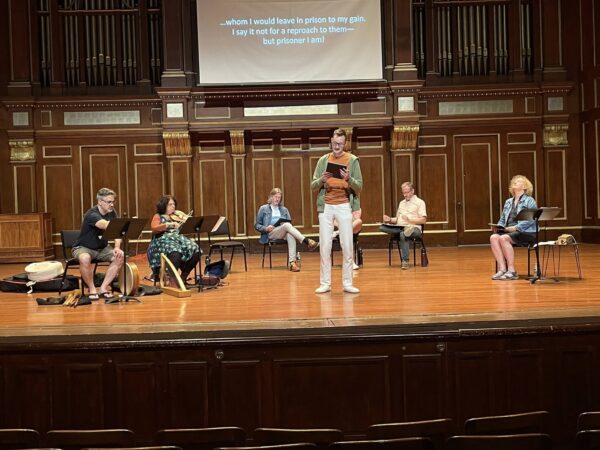
A look at Boston Camerata rehearsing Gallery of Kings: Uses and Abuses of Power, ca. 1300. Photo: Facebook
In a clearing by an old road sits a man on a rock, legs crossed, elbow on knee, and head on hand. He is pondering the inescapable paradoxes posed by royal power. Maintaining peace and prosperity, he wonders aloud, will mean upholding honor, respecting earthly possessions, and concentrating on divine grace. Yet, given human limitations–even for the most absolute of monarchs–these ideas are mutually exclusive.
This predicament is a stanza in one of the few surviving songs by Walther von der Vogelweide, a minnesinger and wandering poet/composer who probed the contradictions presented by love and power. “Ich saz ȗf einem steine,” the title of this song, speaks with universal, timeless force. When the song opened Boston Camerata’s Gallery of Kings: Uses and Abuses of Power, ca. 1300 at the Boston Early Music Festival, the performance had special resonance–sometime history can be an antidote to the hubris of the present.
Camerata’s program, which received its U.S. premiere at Jordan Hall, was commissioned by France’s Reims Festival to honor the 800th anniversary of the city’s cathedral. Through story, song, missives, and popular gibes at authority, the program looked at kings remembered for their great deeds and others commemorated for their bumbling idiocy. The reassurance this performance provided came from how it showed good and bad leaders to be as ubiquitous to human experience as the sunrise.
Directed by Anne Azema, Camerata’s ensemble of vocalists and instrumentalists delivered vitality and pathos in tandem. Singers Michael Barrett, Joel Frederiksen, Ryan Lustgarten, and John Taylor Ward split the various chants, songs, and motets among themselves, each singing with a blend of cool conviction and stately presence. Shira Kammen played vielle and harp with matching assurance. Dan Meyers’s combination of bagpipes, slide trumpet, shawm, and side drum heaped crackle into what was a supple sonic mix.
The history of medieval Europe recorded several noble kings, but the majority of clunkers were joyously heralded in song for their unironic buffoonery. As in our time, subjects never held back their complaints about errant royals. “En talent ai ke je die,” performed with swaggering braggadocio by Camerata, asks listeners if the king is legitimate. The anonymous “A toi rois Artus” inquires, with investigative interest, in the kind of court he holds.
Few rulers were as outright infuriating as King Rudolf I of Germany, personified in “Der kuninc Rodolp” as a beery oaf who preferred to pay his entertainers in booze rather than hard cash. Camerata’s performance, exuding the irreverence of an angry dissident, slung more than a little mud in the crown’s direction.
Other monarchs, like Israel’s King David, are remembered for more thoughtfulness and reflection. Pierre Abelard’s “Planctus David” depicted David before he assumed his high position, alone in a moment of vulnerability. King Saul had just been defeated by the Philistines, who had snuffed out the life of Saul’s son, Jonathan. Text and music combine to express a deep anguish. John Taylor Ward sang the song like a man who had lost everything, his voice full and heavy. In response, Kammen’s harp wrapped him in golden strands of sound.
Letters read between King Richard of England and Egyptian Sultan Salah ad-Din over how to wage the war for Jerusalem revealed minds deeply grounded in stubbornness. The accompanying music ranged from snarky to outright defiant — each side was convinced of its own virtue. “Quare fremuerunt” is a portrait of a conflict backed by biblical certainty. “Seignor, sachiés qui or ne s’en ira,” composed by Thibault de Champagne, blared forth with arresting joie de vivre. King Richard’s own “Ja nus hons pris” reflected more of an inward focus. War engenders feelings of sensitivity, the music suggested, at least for those who are fighting on your side.
Excerpts from Alfonso el Sabio’s Cantigas, placed between these kingly yarns, supplied plenty of jovial fervor. Kammen and Meyers let each selection dance with down-home exuberance. They did the same with songs that celebrated the lives of new monarchs and the deaths of kings many in the populace were anxious to forget. “Ecce rex Darius” was as commanding as a Sunday sermon. “Jubilemus regi nostro” praised royal strength through an evocation of raw rustic power.
The irony of Gallery of Kings is that it showed that bad monarchs can provide inspiration for probing thoughts and lasting art. Yet the music still issued a crucial warning: never underestimate the strength of a tyrant’s grip on power–over time, he can snuff out resistance. “Artless nobles end up with artless subjects,” one singer asserts. Think of the evening as art’s homage to the artlessness of autocracy.
Aaron Keebaugh has been a classical music critic in Boston since 2012. His work has been featured in the Musical Times, Corymbus, Boston Classical Review, Early Music America, and BBC Radio 3. A musicologist, he teaches at North Shore Community College in both Danvers and Lynn.
Tagged: Anne Azéma, Boston Camerata, Boston Early Music Festival, “Gallery of Kings: Uses and Abuses of Power