
Theater Review: “Our Class” — A Powerful Visual History Lesson
By Bill Marx
The strongest element in this Arlekin production is the indelible stage images of loss and love, death and despair, memory and resilience, dreamed up by director Igor Golyak and his talented production team.
Our Class by Tadeusz Słobodzianek. Adapted by Norman Allen. Directed by Igor Golyak. Staged by Arlekin at the Calderwood Pavilion at Boston Center for the Arts, Boston, through June 22.
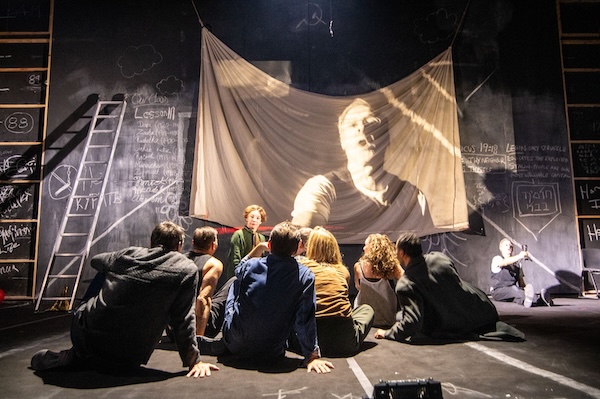
The cast of the Arlekin production of Our Class at Boston’s Calderwood Pavilion. Photo: Irina Danilova
Spanning from the 1930s to the early 2000s, Our Class focuses on a group of ten classmates, five Catholic Poles and five Jews, who are initially close, but over the course of the drama their relationships turn sour and then murderous with the arrival of WWII. First Soviet, then Nazi forces occupy the Polish town, each power exploiting the homegrown antisemitism of the Poles, who undertake, sometimes joyously, a series of rapes, homicides, and beatings that culminate in a mass pogrom in which most of the area’s Jews are burnt alive in a barn. (It is based on a real life incident, memorably chronicled in Jan T. Gross’s Neighbors: The Destruction of the Jewish Community in Jedwabne, Poland.) The Polish townspeople concoct a cover-up afterwards; they blame the atrocity on Nazi troops. But, decades later, the perpetrators are revealed. Tadeusz Słobodzianek’s epic play — the fates of all ten of its characters are covered — is a tale of crime that raises disturbing questions about punishment.
I didn’t see the much-admired production in New York of Our Class. There is no question in my mind that the critical accolades for director Igor Golyak’s direction, particularly his pictorial imagination, were well earned. The blackboard backdrop, outfitted with doors that open up, the adroit use of mini-screens for projections, the agile integration of pictures and sound, are a masterclass in treating the stage as a canvas, in this case a giant Etch A Sketch. In the past, Golyak’s panache could come off as a bit show-offish, spectacle for spectacle’s sake. Here, he has seamlessly integrated emotionally striking visuals with dramatic impact. As for the performances, two actors from the New York staging are present — Richard Topol as the Jewish rabbi, Abram, and Ilia Volok as the Catholic mill owner, Wladek — and the arrival of new blood might explain some of the evening’s awkwardness. Granted, there were blocking issues on press night. Deborah Martin, cast as a Catholic, Zocha, had to perform in a wheelchair because of a recent knee injury. (Yet, miraculously, Martin climbed up on a ladder and did some kicks!) But, even given that challenge, the acting came off as strident — there was an irritating lack of vocal nuance. As one of the pivotal figures, Rachelka, a Jewish woman who marries a Pole, Chulpan Khamatova sounded garbled at times, her words difficult to understand.
Golyak’s imaginative visuals are smooth and razor-sharp, mesmerizing as they cut and slash across the stage, at times surrounded by ghostly clouds of chalk particles that signify both a blessing and a curse. Słobodzianek’s drama, for all of its powerful moments, is also a mixed bag. The script is overstuffed and jumbled, intent on packing in the trials and tribulations of its ten characters. The first act builds to a fierce, emotionally terrifying climax: the mass death of the village’s Jews, burned in a barn, is viscerally staged with aptly distancing surreal accents. (Those white balloons!) But the second half of Our Class lacks narrative propulsion: it is a succession of anecdotes in search of a dramatic goal. Once the act of heinous collective violence transpires, what is this script about? Survival? Revenge? Repression of the Truth? It is definitely not about its characters grappling with the moral responsibility for their inhuman acts. None of its figures look back and try to make sense of their actions on either a personal or a political level. (Ghost hauntings are easy outs, tired melodramatic devices.)
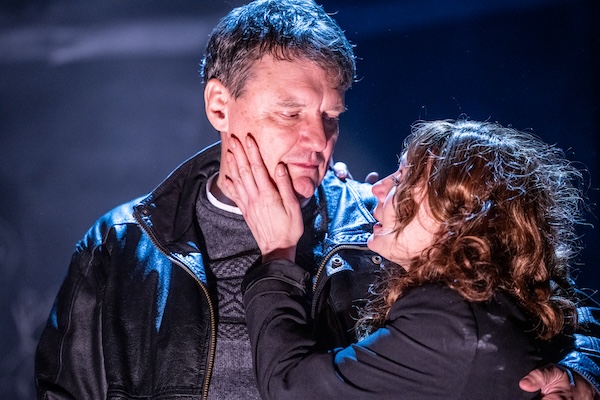
Ilia Volok and Chulpan Khamatova in the Arlekin production of Our Class at Boston’s Calderwood Pavilion. Photo: Irina Danilova
One source for this limitation: Słobodzianek’s ultimately wearying storytelling technique. His characters tell us what is happening to and around them: they spend as much time addressing the audience as they do each other. But they don’t (or won’t) tell us much about what they are thinking or feeling. Perhaps that is the message the dramatist wants to send: there is no moral price to be paid. The enthusiastic perpetrators follow the antisemitic dictates of the authorities (Soviet or Nazi) and never see beyond their opportunistic, self-protective horizons. But, if so, that point — amorality reigns — is made early on, and it doesn’t grow any more resonant with repetition. Hannah Arendt’s “banality of evil” has by now become a cliché. When she coined the phrase in 1963, its emphasis on people’s thoughtlessness rather than their malevolence set off considerable Cold War controversy.
Słobodzianek appears to be reluctant to go beyond that ‘banal’ conclusion. For example, Abram leaves the village in the early ’30s for America, where he prospers (only one line notes our country’s indifference to the fate of the Jews in WWII) and lives into the early 2000’s. By the end of the evening, he has no doubt learned something about the betrayal of his Polish classmates and the official cover-up of the barbarity. But Abram has nothing to say about these revelations, aside from mourning the many relatives he lost in the conflagration, which gives way to a Schindler’s List inspired finale that begs elemental questions about how justice can be arrived at, collective guilt accepted.
Shouldn’t there be more to be learned here than to “be fruitful and multiply”? Shouldn’t theater be a place where those difficult lessons can be articulated? (As George Orwell wrote in 1984: “Who controls the past controls the future: who controls the present controls the past.”) The play is certainly relevant to today’s chaotic world: fascism is on the rise in the West; hatred of “the other” is inspiring an increasing number of war crimes; immigrants and protesters are being “disappeared” without due process; instances of islamophobia and antisemitism are on the rise. The most illuminating element in this production of Our Class turns out to be the indelible stage images of loss and love, death and despair, memory and resilience, dreamed up by Golyak and his talented production team.
Bill Marx is the editor-in-chief of The Arts Fuse. For over four decades, he has written about arts and culture for print, broadcast, and online. He has regularly reviewed theater for National Public Radio Station WBUR and The Boston Globe. He created and edited WBUR Online Arts, a cultural webzine that in 2004 won an Online Journalism Award for Specialty Journalism. In 2007 he created The Arts Fuse, an online magazine dedicated to covering arts and culture in Boston and throughout New England.
Tagged: "Our Class", Arlekin, Igor Golyak, Norman Allen, Poland, Tadeusz Slobodzianek, antisemitism
I left this production after the first act, because I shared the sense that there were no character nuances whose fates were worthy of another hour and a half. It felt like a historical train-wreck devoid of visceral insights. Given the global threats of religious and cultural identities run amuck, it felt unworthy of the moment. Staging was indeed interesting.