
Dance Review: Boston Dance Theater — Inspired by Nature
By Jessica Lockhart
Boston Dance Theater is driven by the belief that a community is strengthened by an exchange of ideas.
Unfurling, presented by the Boston Dance Theater at Casco Bay Artisans, Portland ME, on June 10.
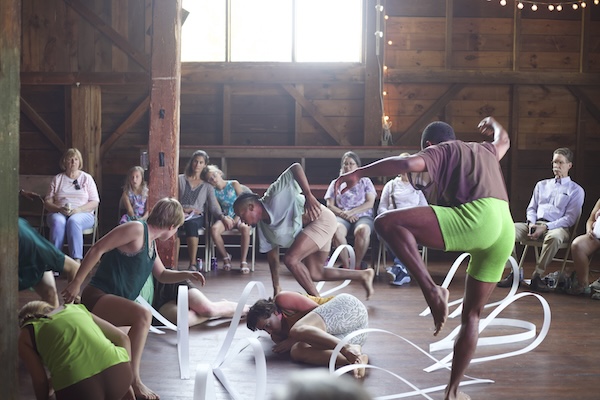
A scene from the Boston Dance Theater production of Unfurling. Photo: Jessie Jeanne Stinnett
This week, the Boston Dance Theater (BDT) brought a very intimate performance to an art gallery situated on the waterfront in Portland, Maine. Why did the group stage a work inside a small shop with no stage and, filled with paintings and sculptures? It is the culmination of an idea the troupe had back in 2020, during the COVID pandemic. Back then, BDT called the piece Sea Rise and it dealt with the plight of the oceans, environmental activism, and the role artists could play working with scientists to make a sustainable future. Years later, after considerable research and creative experimentation, the troupe is touring performances of what is now called Unfurling, getting the word out to audiences gathered in unusual spaces.
The Casco Bay Artisans gallery was selected to host Unfurling because it represents artist Kim Radochia, whose creations were the inspiration for this performance. (Examples of her work, currently hanging in the gallery, could be viewed during the show.) Radochia’s art is inspired by nature and temporality: it is driven by the desire to capture spectacular instances of movement in nature. Her art is fluid in scale: there are large site-specific outdoor sculptures and small intimate assemblages. Radochia was asked by BDT founder and choreographer Jessie Jeanne Stinnett to collaborate with the group, which was interested in Radochia’s portfolio about meadows. For research purposes, Stinnett spent time in an actual meadow as part of an intensive study of “plant emergence.” She examined the science of how plants develop — via cooperation, adaptation, and altruism — and infused those ideas into a creative process shared with her dance company.
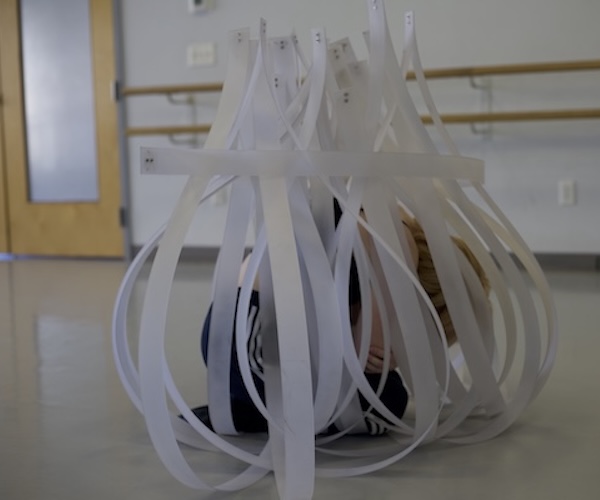
One of Kim Radochia’s teardrop shaped sculptures in Unfurling. Photo: Jessie Jeanne Stinnett
In Unfurling, ten dancers began by placing some of Radochia’s large teardrop shaped plastic sculptures around the floor of the gallery. They walked around them or through them — the result was a lovely mosaic. The teardrops were constantly moved around, and configured into many different shapes. The dancers took turns moving or observing the arrangement. The movement was partially improvised, yet it was based on dramatizing notions of cooperation, adaptation, and altruism. For example, cooperation was displayed when a group of three traveled together — they stayed connected as they twisted and intertwined, moving down to the ground and then back up. All three had to adapt how their bodies were positioned in order to support their fellow dancers. Altruism, “the unselfish concern for other people,” was visualized as a performer letting go of a need to be a solo artist. Achieving unity meant reacting as part of a group, being sensitive to collective needs rather than individual wants or desires. Doing this, while improvising, is a challenge. The dancers performed with a strong sense of their connection to the ground. Their unfurling movements were secure — because they always seemed to be anchored to the floor.
Solos and duets displayed the company’s amazing power and grace. Sitting so close to the dancers reinforced this impression of measured control. In traditional dance theater, performers are placed at a remove on stage, separated from audience members. Here, spectators could talk to the dancers up until the show began and then, throughout the performance, sat inches away as the dancers extended their legs and arms.
The sonic “playlist” for Unfurling featured sounds, spoken words, and music. There were recorded voice-overs of the dancers recalling how they appreciated nature, citing a favorite tree or some house plants. The score was made up of music from Shane Mendonsa, Meredith Monk, Attacca Quartet, Whitney George, Yuji Dogane, and David Lang.
BDT is a repertory group that has decided to perform in non-traditional spaces, including libraries, senior centers, art galleries, and schools. The group is driven by the belief that a community is strengthened by an exchange of ideas. Upcoming BDT shows featuring Unfurled and other ecological inspired work, such as Serge and Interwoven, will be staged at The Barn at the Crate Estate in Ipswich on June 26. On July 18, there will be a show on a lawn around the barn at Alnoba in New Hampshire, and a science walk at Woods Hole on August 9.
Jessica Lockhart is a National Endowment for the Arts Fellow in Dance Criticism and has a BA in Communication from the University of Southern Maine. Lockhart is a Maine Association of Broadcasters award-winning independent journalist. Currently, she also works as program director at WMPG Community Radio.
Tagged: "Unfurling", Boston Dance Theater, Casco Bay Artisans, Climate Crisis, Jessie Jeanne Stinnett