
Classical Music Album Review: Behzod Abduraimov Plays Prokofiev & Shor
By Jonathan Blumhofer
There’s much to recommend in Behzod Abduraimov’s rendition of Prokofiev’s Piano Concerto No. 2, which is both highly characterful and a lot of fun to listen to.
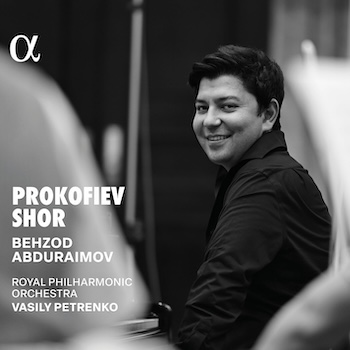 Sergei Prokofiev’s Piano Concerto No. 2 is one of the canon’s most infamously daunting and knuckle-busting entries. It’s also got one of the more interesting histories of a repertoire staple: written as a vehicle for the composer and premiered in 1913, the original copies of the music were subsequently destroyed in a fire. Reconstructed and revised in 1923, the concerto then proved something of a keyboard Mount Everest, with only a relative handful of pianists daring to surmount its challenges.
That’s changed considerably over the last couple of decades. Increasingly, the work seems to be emerging as a calling card, especially among the younger generation of keyboardists. The Tashkent-born Behzod Abduraimov is among the latest to take up the effort, here on a new release on which he’s joined by the Royal Philharmonic Orchestra and Vasily Petrenko.
There’s much to recommend in Abduraimov’s reading, which is both highly characterful and a lot of fun to listen to. The first movement sounds strikingly natural and lyrical, from its dreamy opening to the storm-tossed climax of its gargantuan cadenza. Fleet articulations and droll whimsy mark the middle sections, while the finale’s ferocious energy levels don’t get in the way of the pianist’s good voicings and thoughtful phrasings.
Petrenko is a wonderful Prokofiev conductor and he draws an accompaniment from the RPO that is just as stylish as Abduraimov’s flashier contributions. Woodwind playing in the Scherzo is deliriously spirited and the Intermezzo’s ostinatos move with slashing purpose. Throughout, balances are excellent: soloist and orchestra speak clearly without either party overshadowing the other.
There are good balances to be had, as well, in the disc’s filler, Alexey Shor’s Piano Concerto No. 1. Premiered in Berlin in 2023, the score is pleasant, tonal, and as unchallenging in its content as the Prokofiev is inventive and edgy.
That’s not to say Shor’s writing is uninvolved: Abduraimov and the RPO are put through their paces. There are lots of notes, lots of contrasts of color, and lots of activity to be heard across its 25-minute runtime. The pairing navigates all of that with surety.
Unfortunately, very little of it sticks in the memory. Too often, Shor’s melodic ideas veer into blandness and the music’s lush tonality doesn’t offer a strong harmonic point of view.
Often, the specter of film music (and not always the best kind of that) hovers in the background: some of the first movement’s thick passagework, for instance, calls to mind the faux-Rachmaninoff stylings that James Horner’s assistant might have been called on to craft in the ’80s. Horner, however, was generally freer and more playful with his allusions.
What’s more, despite the expressive purpose the composer suggests in his program note, it’s difficult to identify a melodic line, motivic gesture, harmonic turn, structural idea, or emotional argument in its three movements that suggests a convincing musical imperative. Instead, everything the score seems to say has already been asserted by other composers — more than once, more forcefully, more memorably, and more creatively.
No doubt, the Shor will find an audience. If nothing else, it’s inoffensive stuff that’s idiomatically written and doesn’t make particularly heavy demands on the listener.
Even so, the effort makes for an unflattering companion to the Prokofiev, which is a genuine masterpiece. Though its presence here saves us from a predictable pairing with the latter composer’s Concerto No. 3 (a favorite disc-mate of the Second), the newer work’s shortcomings — and Abduraimov’s engaging ideas about Prokofiev, in general — would have made the tried-and-true formula the preferred one, at least on this occasion.
Jonathan Blumhofer is a composer and violist who has been active in the greater Boston area since 2004. His music has received numerous awards and been performed by various ensembles, including the American Composers Orchestra, Kiev Philharmonic, Camerata Chicago, Xanthos Ensemble, and Juventas New Music Group. Since receiving his doctorate from Boston University in 2010, Jon has taught at Clark University, Worcester Polytechnic Institute, and online for the University of Phoenix, in addition to writing music criticism for the Worcester Telegram & Gazette.
Tagged: Alexey Shor, Alpha, Behzod Abduraimov, Royal Philharmonic Orchestra