
Theater Review: “The Light in the Piazza” — In Love with Love, Ironies Be Damned
By Martin Copenhaver
The lush, lyrical, and demanding score is the main attraction, and the excellent Huntington Theatre Company cast is, for the most part, up to the challenge of singing it.
The Light in the Piazza Book by Craig Lucas. Music & lyrics by Adam Guettel. Based on the novel by Elizabeth Spencer. Directed by Loretta Greco. Staged by the Huntington Theatre Company at 264 Huntington Ave., Boston, through June 15.

Sarah-Anne Martinez (l) and Emily Skinner (r) in the Huntington Theatre Company production of The Light in the Piazza. Photo: Julieta Cervantes
The Light in the Piazza is a paean to the power of love — romantic love of the giddy, love-at-first-sight, head-over-heels variety, to be sure, but also the love of a mother for her daughter.
Margaret (played by Emily Skinner) has come to Florence with her young adult daughter, Clara (played by Sarah-Anne Martinez). It is where Margaret and Clara’s father spent their honeymoon, and it is clear that she is eager to recapture some of the romance she associates with that setting. What Margaret did not bargain for is that Clara almost immediately attracts the ardent attention of a handsome young Italian man, Fabrizio (played by Joshua Grosso). Obviously relishing the attention, Clara is instantly smitten with Fabrizio as well. She does not know any Italian and he does not know any English, so initially they can only communicate in the silent language of love. The philosopher Blaise Pascal could have had this pair in mind when he observed, “Love has its reasons which reason does not know.”
Margaret does everything she can to give the young man the bum’s rush, but he keeps showing up, polite but undeterred. Early in the play there is a hint that there may be more to Margaret’s concern than simple maternal protectiveness. In an aside to the audience, she says, in reference to Clara, “She’s not quite as she seems.” It is only much later in the play that we learn what she is referring to. (Actually, the night I saw this production, we learned about Clara’s condition from Margaret much earlier in the play than in the original script. I do not know if this was by accident or design, but it did lessen the impact of the revelation considerably.)
The score is lush and lyrical, and it is the main attraction here. Adam Guettel, the composer/lyricist, is as close to Broadway royalty as one can get. His mother was Mary Rodgers (who wrote the music for Once Upon a Mattress) and his grandfather was Richard Rodgers (who wrote the music for just about everything else). Guettel’s music, however, is more reminiscent of Stephen Sondheim in its harmonies and unexpected musical intervals. Even a few musical phrases seem to be borrowed from his mentor. One difference between the two, however, is that Sondheim tended to have an ironic and gimlet-eyed view of love, whereas Guettel seems to be in love with love, ironies be damned.
That’s not to say that Guettel and Craig Lucas, who wrote the script, present an entirely rosy picture of romantic love. The three marriages portrayed — Fabrizio’s parents’, his brother’s, as well as Margaret’s — are all flawed and distressed. But even in its absence, romantic love is presented as the driving force of life.
The cast is excellent and, for the most part, up to the challenge of singing this demanding score. Martinez, as Clara, has a real powerhouse of a voice, which is all the more striking coming from such a diminutive person. In that regard, she brings to mind Ariana Grande (there is even some resemblance between the two). Joshua Grosso (Fabrizio) has a sweet tenor voice well-suited to the penultimate song in the score, “Love to Me,” a love song which somehow he is able to sing in English. One might want to complain about the implausibility of his sudden fluency in a language he did not know a few days before. But this is musical theatre, after all. Is there anything more implausible than people suddenly breaking into song in the middle of their day?
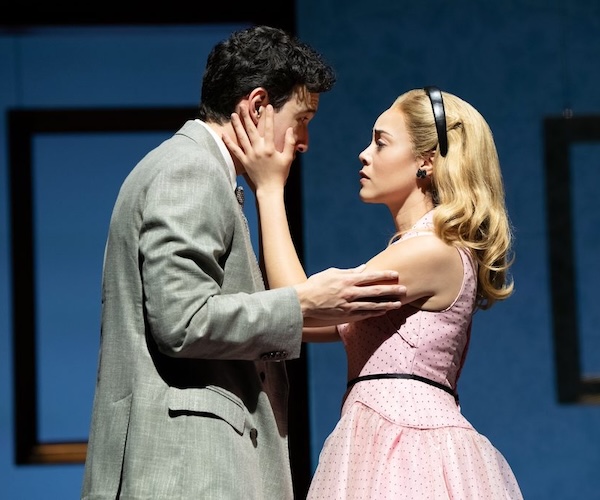
Sarah-Anne Martinez and Joshua Grosso in The Light in the Piazza. Photo: Julieta Cervantes
The final song of the evening — the proverbial 11 o’clock number — is “Fable,” sung by Margaret as she wrestles with her own forceful and often conflicting feelings about love. At one point, she sings, acidly, “Love’s a fake. Love’s a fable.” By the end of the song, however, she is falling into the arms of love with all the hope and expectation of her younger self. In the course of the number, she also releases her daughter from the confinement of a mother’s wishes and expectations.
It is a powerful moment. It brought to mind for me the 11 o’clock number, “Rose’s Turn,” from a very different show — Gypsy — which I saw earlier this year. That show also ends with a controlling mother, in this case Mama Rose (played magnificently by Audra McDonald), forced to let her grown daughter find her own way. But, unlike Margaret, Mama Rose remains defiant and pugnacious to the end. If she must cede control of her daughter, she will now put herself first in all things. It is a bitter turn. The song has been called a nervous breakdown set to music.
There are other points of comparison. Both songs are climactic. In both, the character changes in the course of the number. And, although they reflect different moods, both songs call for showstopping voices. It would be unfair to compare Emily Skinner and Audra McDonald. Actually, it would be unfair to compare anyone to McDonald, but “Fable” was the one number that required more vocal firepower than Skinner possesses.
The accompaniment of the pit orchestra was rich and full, belying its size (only a dozen musicians). As an aside, I can’t remember the last time a pit orchestra included both timpani and harp. The set (designed by Andrew Boyce), while minimal, is wonderfully evocative, while the lighting (designed by Christopher Akerlind) supplies a soft glow to the scene. The combined effect is — and I am choosing this word carefully — enchanting. Oh, and can someone get me the contact info for Alex Jaeger, the costume designer? I would like to be fitted for one of those beautifully tailored Italian suits.
Martin B. Copenhaver is an author and former seminary president who likes to tell people that he once made a television commercial with Larry Bird. Because it’s true.
Tagged: "The Light in the Piazza", Adam Guettel, Craig Lucas, Emily Skinner, Joshua Grosso, Loretta Greco
The story says, “The philosopher Blaise Pascal could have had this pair in mind when he observed, ‘Love has its reasons which reason does not know.’” That is a misquote. He wrote, “The heart has reasons that reason knows nothing of. We know this in many ways.” See the chapter on this statement in my book, Beyond the Wager: The Christian Brilliance of Blaise Pascal (InterVarsity-Academic, 2024).