
Film Review: “Queens of Drama” – Leave Mimi Alone!
By Nicole Veneto
In this film, Alexis Langlois suggests that the diva worship so central to queer cultural production has found new toxicity thanks to social media, where we all feel entitled to a piece of our idols.
Queens of Drama, directed by Alexis Langlois. Coming to VoD this July.
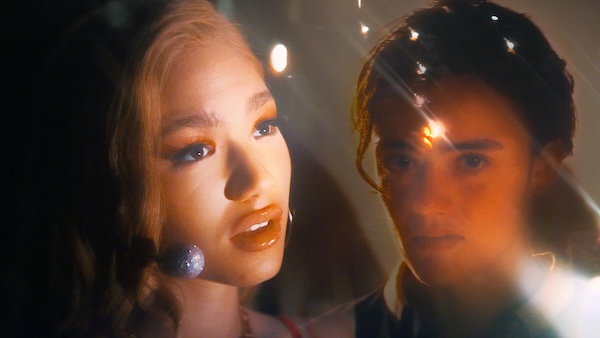
Mimi Madamour (Louiza Aura) and Billie Kohler (Gio Venture) at the precipice of stardom in Queens of Drama. Photo: Altered Innocence
A spectre is haunting modern pop music — the spectre of Britney Spears.
Consider the three biggest breakout stars of 2024. Like Spears, Sabrina Carpenter is a former Disney kid who, in adulthood, has traded in her family-friendly image for that of a flirtatious pop chanteuse, though Carpenter’s cartoonish sexuality has been received much more easily than Britney’s repackaging as barely legal jailbait. Chappell Roan may appear to have more in common with the drag artists who make Britney’s music part of their acts than with the Princess of Pop herself. Still, Roan’s meteoric rise to fame has brought a particularly noxious amount of public scrutiny and invasiveness at times too reminiscent of what we subjected Britney to at the height of her career. And Spears, as a Patron Saint of the Aughts, is invoked throughout Charli xcx’s cultural juggernaut of an album brat, a Y2K pop-sleaze throwback to when partying was a viable way of staving off existential crises and the Bimbo Summit was one of the most important cultural events in history.
Spears paved the way for these three women, yet Britney hasn’t released an album since 2016. (And, as of 2025, the performer has shown no desire to return to the music industry.) Why should she? Even if we’ve technically #FreedBritney, have we really reckoned with the forces that led to her very public breakdown nearly two decades after the fact? If anything, the industry has gotten worse now that the role of the paparazzi has been offloaded onto parasocial internet stans and fan armies, constantly demanding their faves give them more, more, more. We still can’t leave Britney (or any famous woman) alone because we’re always on the lookout for another starlet to fry under the magnifying glass of fame.
If anyone is willing and ready to confront this part of Spears’ legacy, it’s French filmmaker Alexis Langlois. Known for their deliciously queer glittercore shorts Terror, Sisters! and The Demons of Dorothy, Langlois finally makes the jump to features with the aptly-titled pop-opera melodrama Queens of Drama. It’s one of the most effective satires on the star making/grinding process since Josie and the Pussycats — the only one to climax in a love song about fisting.
In 2055, aging vlogger and former biggest bitch on the internet SteevyShady (Eurovision favorite Bilal Hassani) makes a dramatic return to YouTube to set the record straight on their role in the rise and fall of teen pop sensation Mimi Madamour (Louiza Aura). As an act of contrition, SteevyShady recounts the torrid affair between Mimi and punk singer Billie Kohler (Gio Ventura), turning back the clock to 2005, where the two cross paths during an audition for a French singing competition, Starlet’s Factory. The closeted and quiet Mimi is a malleable diamond in the rough who yearns to be Mariah Carey rather than Maria Callas. Billie, an abrasive butch lesbian whose underground act includes pulling a butt plug out of her ass, gets thrown out by security for calling the judges fascists. Yet their shared admiration for the all-but-forgotten, and possibly queer, ’80s singer Elie Moore (Asia Argento) sparks an immediate connection that quickly blossoms into love.
But as Mimi’s star rises — first by winning Starlet’s Factory, then soaring to chart-topping success with her europop hit “Don’t Touch” — Billie gets left by the wayside. Queerness has no place in Mimi’s squeaky-clean, patently heterosexual public image. To Billie, this betrays both their relationship and any semblance of authenticity in Mimi’s music. To Mimi, it’s the price to pay for pop stardom in 2005. Britney’s entire cohort was sold as virginal girls next door; their sexuality was up for public consumption, but not their own personal pleasure. The inevitable fallout curdles until a surgically enhanced Billie finally breaks into the mainstream ten years later; she publicly outs Mimi (now a has-been struggling to reinvent her image) as the inspiration for her own hit song. Labelled a flop and a fraud by her once adoring fans, Mimi is publicly pitted against her old paramour, setting the stage for a dramatic reunion that sees both women come to terms with their authentic selves.
True to SteevyShady’s promises, Queens of Drama delivers on “explosive emotions, unbridled romanticism, and runny makeup.” Langlois’ film is an exercise in pop cultural excess, at once reveling in the Y2K nostalgia that’s now the trend du-jour and wryly critical of how the era’s worst tendencies have found their way back into the present moment. That Mimi is modeled so obviously after Spears (and Mariah Carey, whose own public meltdown aired live on TRL) makes Queens of Drama as much an exploration on the fractured identity of the pop star — the divide between public personas and the private self under the spotlight — as it is a big gay ode to diva worship. In fact, Langlois suggests that the diva worship so central to queer cultural production has found new toxicity thanks to social media, where we all feel entitled to a piece of our idols.
It’s in the aftermath of Mimi’s outing that Langlois understands what happened to Britney was not just a uniquely ugly media circus, but a horror film we all delighted in watching. After fleeing a nightmarish television interview, Mimi is chased through the streets of Paris and into an empty hair salon by aggrieved fans brandishing cellphones as if they were sharpened pitchforks. We know exactly where this is going before she picks up the clippers. Granted, Britney didn’t have the added pressure of suppressing or sustaining queerness, but in restaging Britney’s moment of crisis as Mimi’s breaking point, Langlois suggests that both were responding to a prolonged and public deprivation of personal agency. When asked by the salon’s employees why she shaved her head, Britney allegedly told them, “I don’t want anyone touching me. I’m tired of everybody touching me.” To the cellphone-wielding mob chasing her down, a sobbing Mimi echoes Cara Cunningham’s viral defense of Spears: “Leave me alone!”
All this might make Queens of Drama sound like a much more dour film than it actually is. The dramatic throughline is played seriously, but Langlois’ bubble-gum aesthetics and heightened, campy artifice are perfectly suited for a tale about two star-crossed divas who desperately need to work it out on the remix. The director’s stylistic inclinations are comparable only to Bertrand Mandico’s, which means France’s domestic glitter budget must be out of control. Queens of Drama is as tight and shiny as a latex glove ready for fisting, made for — and destined to be recreated by — drag queens the world over. That Langlois also manages to sneak in a biting satire of how we build up our pop stars only to tear them down is all the better, given that we’re still living under Britney’s shadow.
Nicole Veneto graduated from Brandeis University with an MA in Women’s, Gender, and Sexuality Studies, concentrating on feminist media studies. Her writing has been featured in MAI Feminism & Visual Culture, Film Matters Magazine, and Boston University’s Hoochie Reader. She’s the co-host of the podcast Marvelous! Or, the Death of Cinema. You can follow her on Letterboxd and her podcast on Twitter @MarvelousDeath.