
Film Review: “Marcella” — A Celebration of a Master of Italian Cuisine
By Gerald Peary
A charming and deeply entertaining documentary about Marcella Hazan and her transformation into a world-famous cookbook author and influencer.
Marcella, directed by Peter Miller. Screening at the West Newton Cinema
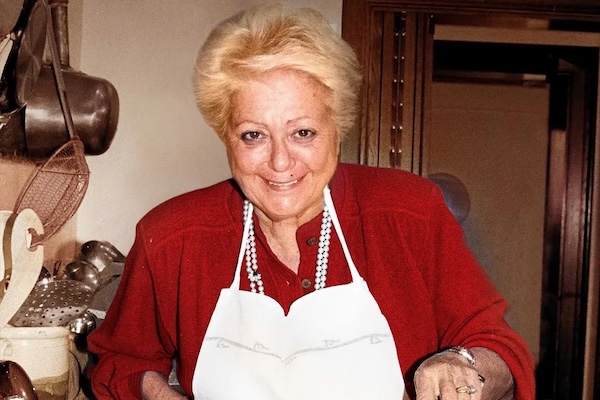
A scene from Marcella. Photo: Greenwich Entertainment
Long before Marcella Hazan (1924-2013) became a world-famous cookbook author and influencer, she was a lonely Long Island housewife, a college graduate transplanted from Italy because her husband Victor had a job in New York City. In their home country, the world stopped for a midday meal. Would Marcella be able to satisfy her Italian husband when he traveled back from work in Manhattan for a homemade lunch? Hazan, who did not cook, began learning from Italian cookbooks because she was horrified by what passed for Italian cuisine in 1950s America: spaghetti and meatballs, eggplant Parmesan, Chef Boyardee’s canned products.
She found to her surprise that she had some atavistic talent in the kitchen. Maybe, she wondered, did things remain in her brain and blood from her mother and grandmother in the fishing town of Cesenatico? But how could her culinary efforts seriously improve? Speaking little English, she taught herself to take trains into the city and shop at ethnic Italian grocery stores.
As we learn in Peter Miller’s charming and deeply entertaining documentary, Marcella, Hazan really elevated her cooking when she and her husband returned to Italy for several years of living in Milan and then Rome. Home in Europe, she shopped at the finest outdoor markets and refined her recipes with the best and freshest ingredients. And then it was back again to New York, where Hazan, now seasoned in the kitchen, offered cooking classes in her apartment. And where her temperament showed: she could be gruff with her students, annoyed by their stupid questions, and unforgiving if they dared be late.
And then in her early 40s a kind of overnight success for Hazan: Craig Claiborne, the estimable New York Times food critic, had a multicourse lunch one afternoon at her apartment. He wrote a rave half-page Times article about the wonderful authentic things he’d been served. She was contracted to write one cookbook and then a sequel, The Classic Italian Cookbook (1973) and More Classic Italian Cooking (1978). Julia Child raved about them, and Hazan gained a reputation in the restaurant world with these definitive works. Finally, she became a well-known best-selling author with Essentials of Italian Classic Cooking (1992), an updated and improved single volume of the recipes in her first two books.
With her celebrity, Hazan was a frequent guest on American TV shows. Unlike Child, she never requested her own program, probably because of language insecurity. Her books were all written in Italian and translated into English by her husband. As the movie of Marcella shows, Victor played the role usually taken by the woman with the artistic husband. He was uncredited and stayed in the background, but theirs was undeniably a true love story. Victor was Marcella’s muse.
The Hazans moved back again to Italy, first to Bologna and then to Victor’s favorite city, Venice. For two decades there, Marcella had few complaints because Venice had the Rialto, maybe the best food market in the world. She had an in-demand private cooking school with a client list of actors, directors, and the very rich. But finally when she was in her 70s, the need to walk everywhere in the city got too much for her. The Hazans emigrated to western Florida, residing near Sarasota from 1998 until 2013, when the heavy-smoking Marcella died there from emphysema.
So what was the essence of her famous cooking? Simple, simple fresh ingredients, though Hazan warned those attempting her recipes, “Simple doesn’t mean easy.” Several of the most delightful scenes in Marcella feature young chefs, Hazan acolytes, making her most iconic dishes. Baked chicken done with salt and two lemons sewn inside. That’s all. Her world-famous tomato sauce, just vine-ripe tomatoes simmered with salt, pepper, some onion slices but — most important — the onion slices removed from the dish before eating. Did I mention that Hazan brought sun-dried tomatoes to America? And also balsamic vinegar? And that she never measured her ingredients and never tasted her dishes before serving them? She was that self-assured.
My favorite scene in Marcella, which had me laughing joyously: Hazan is a guest on a TV program and is preparing a leg of lamb. She asks the television host to lift the lid on the pot. Hazan leans down and takes a deep sniff. “It needs salt!” she announces.
Gerald Peary is a professor emeritus at Suffolk University, Boston; ex-curator of the Boston University Cinematheque. A critic for the late Boston Phoenix, he is the author of nine books on cinema; writer-director of the documentaries For the Love of Movies: The Story of American Film Criticism and Archie’s Betty; and a featured actor in the 2013 independent narrative Computer Chess. His last documentary, The Rabbi Goes West, co-directed by Amy Geller, played at film festivals around the world, and is available for free on YouTube. His latest book, Mavericks: Interviews with the World’s Iconoclast Filmmakers, was published by the University Press of Kentucky. With Amy Geller, he is the co-creator and co-host of a seven-episode podcast, The Rabbis Go South, available wherever you listen to podcasts.
I have used her recipes for years and love her cook book, my go to when I need to be reminded of recipes that were perfect. How do I get to watch Marcella?
In cinemas, video-on-demand, and DVD May 9, 2025. Premiering on PBS American Masters this summer. Currently screening at the West Newton Cinema.