
Classical Music Commentary: Making Sense of the BSO’s “Decoding Shostakovich”
By Aaron Keebaugh
Russian composer Dmitri Shostakovich was both a rebel and a conformist, a fascinating hybrid of courage and cowardice.
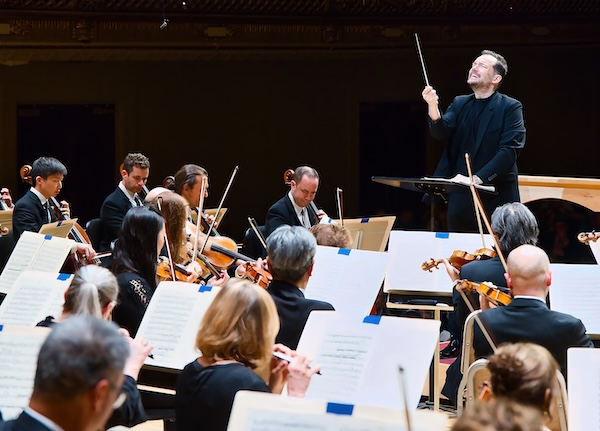
Andris Nelsons leads Shostakovich Symphony No. 8 with the Boston Symphony Orchestra. Photo: Hilary Scott
Even when mired in perpetual crisis, Russian composer Dmitri Shostakovich tried to look on the bright side. “Life is beautiful,” he said of his Eighth Symphony, a work that ends in a glimmer of light. His words, much like this music, written during the summer of 1943, conveyed a forlorn hope: “All that is dark and depressing will disappear, depart, and the beautiful will reign.”
In the fall, just as the Eighth Symphony was being performed for the first time, hope among Soviet citizens was in short supply. Still, the tides of WWII were turning. The Red Army was making significant advances against the Nazis at Stalingrad as well as elsewhere along the Eastern front. Energized by this positive news, listeners were most likely expecting that Shostakovich’s latest symphony would convey resolution and assurance, and suggest that things would turn out for the best. Instead, the music reflected the composer’s lingering doubts. Gloomy and despairing — at least until its end — Shostakovich’s Eighth Symphony was as much a surprising rumination as it was the expected valediction.
That makes the piece difficult to interpret, to grasp emotionally, both for the performers and listeners. But the Boston Symphony Orchestra has made it its mission over the last month to try to come to grips with this infamously elusive composer, whose nip-and-tuck relationship with an authoritarian regime still leaves baffling questions. Was he a secret dissident or servile toady? Or both at the same time? Given the rapt performances that made up the Decoding Shostakovich series, the answer is that he was a complicated combination, interweaving rebellion and obedience, a fascinating hybrid of courage and cowardice.
I heard three of the orchestra’s performances dedicated to symphonies that don’t typically grace programs of the composer’s music. By most critical measures, the Sixth, Eighth, and Eleventh Symphonies stand well in the shadows cast by the more universally admired Fifth and Seventh. But it could be argued that the works in between the giants record, in a visceral way, the heightened anxieties of Shostakovich’s time and place.
Oppression was omnipresent. As the ink of the Sixth Symphony was still drying, Stalin’s regime arrested some of the composer’s closest friends and associates. The music, as relayed by Andris Nelsons and the BSO last month, came across with funereal gravitas — glimmers of hope were swallowed into the maw of tragedy. Nelsons approached this score as he does his Mahler: time was spent highlighting beguiling details, but there was always a clear sense of where the music was driving. The Allegro conveyed every ounce of Shostakovich’s sarcastic angst — the music became downright smarmy, then sharply acerbic when it was kicked up to raucous heights. The symphony concluded with pompous guffaws, its nervy, sardonic irreverence asserted with unapologetic furor.
That sense of an artist daring to thumb his nose at authority provided the subtext for Shostakovich’s Symphony No. 11, “The Year 1905.” Composed in 1957, ostensibly to honor the victims of the failed Russian revolution at the turn of the century, the music suggests that the composer was actually criticizing the Soviet government for its brutal putdown of the 1956 Hungarian revolt. Encryption is a necessary tool for artists when making art in an authoritarian society. As Wendy Lesser argues in her illuminating book Music of Silenced Voices, “Nothing that emerged from [the Soviet] world … can be taken at face value. People learned to speak in code, but the codes themselves were ambiguous and incomplete.”
Nelsons’s bold reading of the piece lent credence to the belief that Shostakovich’s vision of insurrection went well beyond the massacre of workers in the Winter Palace square. The spare harmonies that open the symphony painted a compelling scene of cold detachment. The lines of the second movement wailed, shrieked, and then cried out for vengeance. Fugal statements coursed with fervent agitation. Hulking sonorities broke through strings wildly rushing about. Segments of the coursing texture were jabbed at before the opening serenity eventually returned. Could it be that little in the revolutionary struggle had changed? But the work’s powerful ending underlined the uplift demanded by Soviet propaganda: the present may be troubling, but the future, as it must be in collective utopian thinking, looks perpetually bright.
Of these pieces, the Eighth Symphony received the most government criticism. It was condemned as being out of touch with official Soviet concerns. Its determined melancholy suggests that the composer was deeply skeptical about a regime that commanded, for millions, a forced march to supposed perfection. Listeners called the symphony a “Poem of Suffering” following its 1943 premiere, though there is little evidence that the composer ever approved of the label.
The work’s opening bars recall the astringent lyricism of the Fifth Symphony. But here the sonic roughness conveys greater — again, almost Mahlerian — despondency. Nelsons opted for broad tempos. Still, he gave the occasional bright lines enough force to break through the crunching harmonies, the latter building up to a din. String octaves blared out. French horn lines burst forth with crass assurance. The second movement’s march bounded with an impish glee. The third charged forward with abandon, highlighted by principal trumpeter Thomas Rolfs’s rapt and radiant treatment of his solo.
Nelsons shaped the string lines of the fourth movement into a net of lyrical arcs. Sustaining pitches cast a faint glow, though they bore enough kinetic energy to push the phrase forward. Prickly energy reemerged in the finale, though some of the passages felt strained, even overwrought. Despite this emotional overkill, Nelsons shaped each phrase with careful attention to its rise and fall. That paid off at the ending, which in this performance achieved a warm serenity — the concluding moments cast a gentle light.
The result is that, at least in the Eighth Symphony, the Soviet ideal of the future came across as human and immediate. The horrors of war are overwhelming, but a belief that humane comforts will endure needn’t be registered with bold, bombastic assurances to be effective. Shostakovich suggests here that quiet certainty about the endurance of beauty may be enough.
Aaron Keebaugh has been a classical music critic in Boston since 2012. His work has been featured in the Musical Times, Corymbus, Boston Classical Review, Early Music America, and BBC Radio 3. A musicologist, he teaches at North Shore Community College in both Danvers and Lynn.