
Music Commentary: New Orleans Jazz & Heritage Festival — The More Things Change …
By Jon Garelick
At the New Orleans Jazz & Heritage Festival we tend to gravitate to the locals and other “regional acts” from around the world and hope, most of all, for those surprises — artists unlike any we’ve seen before, anywhere.
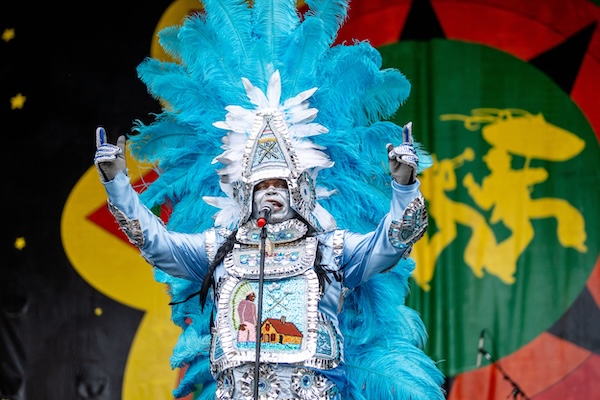
Flagboy Giz commanding the stage. Photo: Joshua Brasted
Rituals reassure. That’s part of the reason my wife and I return to the New Orleans Jazz & Heritage Festival presented by Shell year after year. And this year, when a health crisis (now under control) was compounded by political upheaval, we needed it more than ever. But inherent in the need for reassurance is the need for fresh surprises.
So we came back to the Fest this year to see old favorites we never — or rarely — see touring north of I-10 — Irma Thomas, John Boutté, Alex McMurray, Paul Sanchez, Aurora Nealand, Tom McDermott, and any number of Mardi Gras Indian tribes. There are also big-name acts that anchor this annual two-weekend event (this year, April 24-27 and May 1-4). The first weekend (the one we attended), it was the Dave Matthews Band, Lil Wayne & the Roots, John Fogerty, and Kacey Musgraves. The second weekend would bring Pearl Jam. But we tend to gravitate to the locals and other “regional acts” from around the world and hope, most of all, for those surprises — artists unlike any we’ve seen before, anywhere. Usually this comes from a sound that draws us off our designated path — we’re on our way to the Louis Armstrong commemoration at Economy Hall or Bill Frisell in the Jazz Tent or any other of the 12 stages on the Fair Grounds Race Course, or a softshell crab po’boy, and something draws our ear.
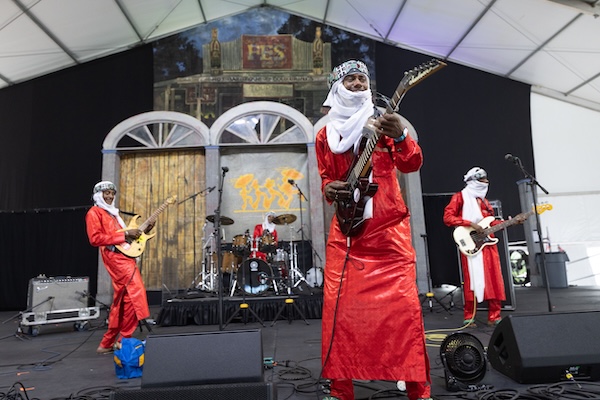
Etran de l’Aïr of Niger in action at the New Orleans Jazz & Heritage Festival. Photo: Douglas Martin
In this case it was a high-pitched racket of guitar and rhythm coming from the Expedia Cultural Exchange Pavilion in the Fair Grounds infield. Inside, two guitarists and a bassist, dressed in desert threads — white Arabic headdresses and floor-length tunics — were bobbing to a heavy beat, unleashing unearthly screams from their instruments, diamond-like glittering cascades of overlapping patterns, super trebly, with a square four-to-the bar rhythm, driven by the hard, flat clatter of snare, bass drum, and splashing cymbals, occasionally accelerated by a vicious single-stroke roll or broken by a quick pattern of quarter-note triplets.
The band was Etran de l’Aïr of Niger. Program notes cited their hometown, Agadez, “the capital city of Saharan desert rock.” So yes, maybe you could draw comparisons to other manifestations of the “desert blues” of Mali and the Tuareg rhythms. (The band’s name translates, roughly, as “stars of the Aïr region.”) But this was punk rock by any other name. The confined space just seemed to compress the sound — a glittery cloud, originating notes atomized in overtones, and always the insane drive of those drums. Occasionally one of the guitarists would approach a mike to deliver barely audible vocals. Outside the tent, in the open air, the vocals came across in a high muezzin wail. But inside, this was a whole other kind of trance music — driven, ecstatic, profound.
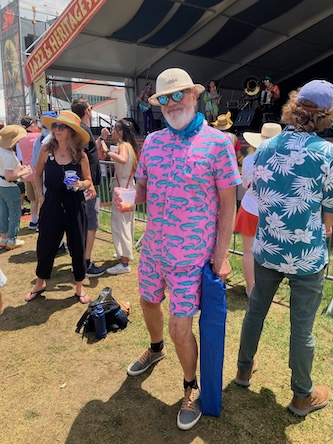
Robert Blanche, 70, Baton Rouge, psychiatrist. “I’ve been coming since 1979, my second year of medical school…. It’s the last vestige of the great American pop festival.” Photo: Jon Garelick
Etran de l’Aïr were the outliers in the Cultural Exchange Pavilion, which every year focuses on a particular country — usually somewhere in the Americas. This year it was Mexico, with all manner of mariachi and Tex-Mex bands, including the Oaxaca-born crossover star Lila Downs. The Cultural Exchange Pavilion, when it debuted at Jazz Fest in 1996, seemed almost redundant. Wasn’t the whole event a big “cultural exchange,” with bands from all over the country, all over the world? One took it for granted. (This year’s appearance by the Senegalese “world music” superstar Youssou N’Dour was typical.) But now these artistic choices seem downright defiant — subversive, even. Our first night in town, it took me a minute to realize that a “Gulf of Mexico” T-shirt wasn’t a tourist T-shirt — it was a protest T-shirt.
We spotted no MAGA hats among the throngs, and most signs of protest amid the celebration and joy and noise on the Fair Grounds were muted, with the exception perhaps of the wonderful singer John Boutté.
“You know what? All of us are migrants!,” Boutté declaimed early in his Saturday set at the packed Jazz Tent. “People migrate! That’s what we do!” This came after a particularly tender a cappella rendition of “You’ve Got to Be Carefully Taught,” the antiracism ode from South Pacific. (“You’ve got to be taught to hate and fear / You’ve got to be taught from year to year.”) Later in the set he told the crowd, “You better get out and vote in the midterms!” But it’s difficult to describe any set by Boutté as less than affirmation — with numbers like “Smile,” “Nature Boy,” Little Queenie’s “My Darling New Orleans,” even the ambiguously aggrieved “Louisiana, 1927” by Randy Newman, and Boutté’s traditional closer, the rousing “Treme.” When, on “Nature Boy,” his voice floated up to the high notes on the line “They say he wandered very far,” art itself was the affirmation.
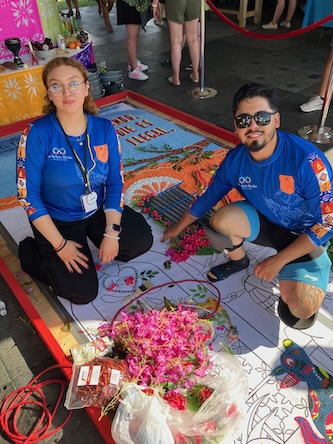
Cultural Exchange Demonstration Tent: Mariana Guzmán, 22, graphic designer, and Jesus Gauiña, 23, artist, Guanajuato, Mexico. They are creating an alformbrista, or carpet, a traditional Mexican street art. The finished alformbrista read, “En este mundo, nadie es ilegal” (“In this world, no one is illegal”). Photo: Jon Garelick
There were other places to find a bit of subversion and the strange in the familiar. The Mardi Gras Indians (these days also called Black Masking Indians) are super-familiar. Almost every day at Jazz Fest starts with a different Indian tribe on the small Jazz & Heritage Stage (the Fest runs from 11 a.m. to 7 p.m.). Our preference is for the stripped-down performances of these neighborhood tribes such as Creole Wild West and the Comanche Hunters — nothing but massed percussion and a variety of call-and-response chants delivered by the beautifully be-feathered members (“Indian Red,” “Ho Na Nae,” “Hold ’Em Joe,” Shoo Fly”). But since the 1976 breakthrough of the Wild Tchoupitoulas’ self-titled album (produced by Allen Toussaint, with help from the Neville Brothers and the Meters), there has also been a tendency toward fully tricked-out bands, with a backline of electric guitars and keyboards supporting the Big Chief (or Big Queen) and their crew.
This year that tradition was carried forward by Flagboy Giz, who appeared with the Wild Tchoupitoulas on the big Congo Square stage. Giz, a local producer and MC, joined the Wild Tchoupitoulas as Flagboy in 2015, combining the traditional cadences of the Mardi Gras Indian chants with his own take on the syncopated flow of New Orleans bounce, and addressing topical issues in songs like “We Outside,” with its refrain of “There’s only one Super Sunday, it ain’t the Super Bowl,” a reference to an annual Black Masked Indian confab. Another song slagged gentrification (“There goes the neighborhood when you see the bike lane”). The music was backed by an electric band and horn section, giving the gritty street raps a brassy gleam. But there was plenty of darkness in the light, in songs like Saint Joe (“We tried to kill ’em that night on Saint Joe”), with an especially chilling refrain (“St. Joe!”), delivered high and loud by 9-year-old Spyboy T3.
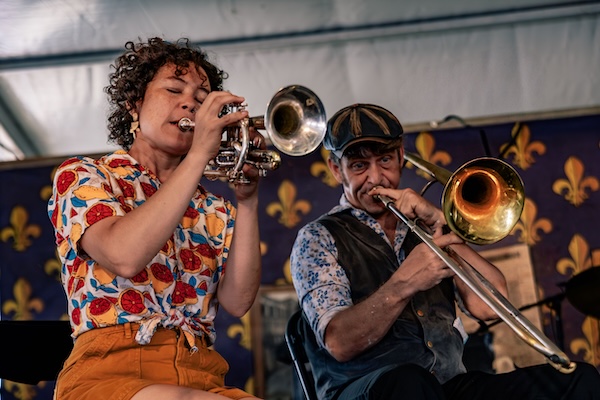
Shaye Cohn (cornet) and Barnabus Jones (trombone) of Tuba Skinny. Photo: Katie LaRocca
Some bands can make the old sound new, or at least make you hear it in different ways. Tuba Skinny, who began as buskers on Royal Street about 20 years ago and now tour worldwide, are one of those bands. The core of their repertoire is jazz and blues from the ’20s and ’30s, played by cornet, clarinet, trombone, guitar, banjo, sousaphone, washboard, and the occasional bass drum.
Sunday’s show in Economy Hall was typical — Jelly Roll Morton, early Ellington, Willie “the Lion” Smith, Bessie Smith, Bo Carter. But they also played a pair of tunes from the ’50s team of Tarheel Slim and Little Ann, as well as one original. (A compilation of the band’s vintage-sounding original tunes, Magnolia Stroll, came out in 2022.) But even among the well-known names and tunes — Carter’s “Nobody’s Business” and Willie the Lion’s “Harlem Joys” — there were lesser-knowns and downright obscurities. Ellington’s “Red Hot Band” (1927), I dare say, doesn’t get played nearly as often as “hits” from the same era, like “East St. Louis Toodle-Oo” (thanks, Steely Dan), “Black and Tan Fantasy,” or the slightly later “Mood Indigo” (1930). And for the life of me, though Jimmy Noone was a well-recorded and esteemed clarinetist and bandleader, I can find “El Rado Scuffle,” by his Apex Club Orchestra (c. 1928-29), nowhere except in Tuba Skinny performances on YouTube.
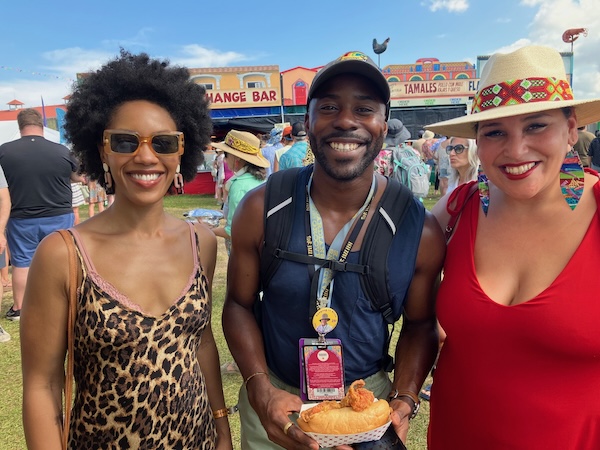
At the Expedia Cultural Exchange Pavilion, left to right: Jessica Gillespie, 39, arts and culture publicist, Chicago; Blake-Anthony Johnson, 34, CEO, Jazz & Heritage Foundation, New Orleans; and Leslé Honore, 49, tech company CEO, Chicago. Had you heard Etran de L’Aïr before? Blake-Anthony: “No. Quint Davis found them. He’s a great producer. He finds artists from all over the world.” Leslé: “I’ve never heard anything like them in my life. That’s what’s great about JazzFest.” Photo: Jon Garelick
The band has settled into a fixed personnel of seven or eight, depending on the availability of singer/bass drum player Erika Lewis, who now lives out of state. What impressed me this time out was not only the tunes and individual solos, and the tasty vocals from Lewis and guitarist Greg Sherman, but the blend of instruments, the constant weave of contrapuntal and harmony lines, the sensitivity to dynamics and timbre. Ellington’s “Red Hot Band” was not just an uptempo “killer diller,” as they used to say, but an intricate, buoyant structure, with hip-swiveling transitional phrases from section to section, and beautiful moments of contrasting colors, as when clarinetist Craig Flory dropped from the singing melody line into a warm lower register. And yes, they get out the swing dancers.
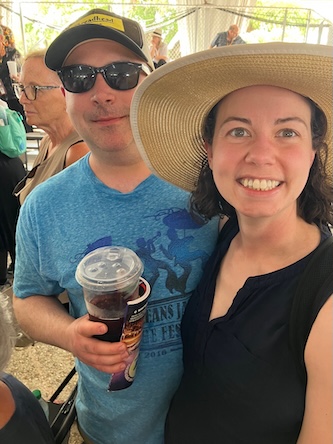
Matthew Walsh, 40, state Department of Transportation administrator, and Alison M. Seidl, 40, pediatric dentist, Anchorage, Alaska. Matthew: “I told her I wasn’t moving to Anchorage unless we could get a house with a two-car garage and we could come to Jazz Fest.” Alison: “We have four kids.” Photo: Jon Garelick
The freedom to be found in the blend of skilled, sensitive individual voices is what makes Tuba Skinny’s music special — another counterweight to the bloviating, bullying temper of our times. Of course, you could say the same about any band that clicks — whether the similarly trad-jazz-inclined all-women sextet the Shake ’Em Up Jazz Band, the modern jazz duo of pianist Bill Charlap and singer Dee Dee Bridgewater, Tex-Mex veterans like the Iguanas or Los Texmaniacs (singing in Spanish and English), or any number of Cajun bands playing fiddles and accordions (singing in French and English).
One of those band was Amis du Teche, out of Breaux Bridge. They have pedigree: guitarist/fiddler Amelia Powell is a granddaughter of the great modern Cajun music and culture bearer Dewey Balfa. Balfa’s generation was not allowed to speak French in the region’s public schools. Singer Adeline Miller introduced the song “1755/Attakapas Trail” as commemorating the year les Acadiens were exiled from Nova Scotia and found their way to Louisiana. “We’re still here,” she said. Migrants.
As for the ongoing health of the festival and this tourist-dependent city, in the United States’s current high tariff, isolationist mode: The owner of Mahogany Jazz Hall, our favorite French Quarter jazz club, said that her colleagues in the restaurant and bar business were reporting that the first weekend had been “light.” And she was concerned about the summer months, when business depends on European tourists. As for the Fest itself, this year’s total attendance of approximately 460,000 was off from last year’s 500,000 (inflated perhaps by a Rolling Stones performance). For now, however, it seems Jazz Fest is holding its own, as bellwether and ritual.
Jon Garelick is a former arts editor at The Boston Phoenix and an editorial board member at The Boston Globe. He can be reached at garelickjon@gmail.com.
Tagged: Amis du Teche, Barnabus Jones, Cultural Exchange Pavilion, Etran de l’Aïr of Niger, Flagboy Giz, New Orleans Jazz & Heritage Festival, Shaye Cohn
1 Comment
Leave a Comment

This was a wonderful survey of the wonders that a weekend at JazzFest can provide. The fact that the festival continues to evolve makes it even more culturally vital. One small note: Etran de l’Air’s discovery can’t really be claimed by Quint Davis, they were featured by Wilco at last summer’s Solid Sound Festival in North Adams, Mass. You were so on mark on your description of their hypnotic sound.