
Book Review: “Horace: Poet on a Volcano” — A Writer Who Advised We Live Life to the Max
By Thomas Filbin
Horace advocated seizing the immediate with existential zest.
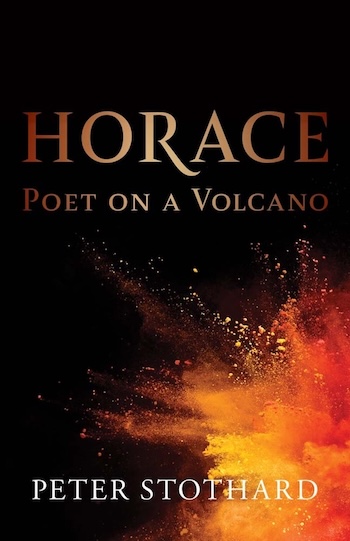
Horace: Poet on a Volcano by Peter Stothard. Yale University Press, 328pp., $28
For those of us who were encouraged or forced to study Latin in our youth (quinque anni in vita mea), the torments of the ablative absolute and the hortatory subjunctive were washed away by visits to Rome, imagining the ruins as they once stood in their glory. Roman civilization might have collapsed as an empire, but its language, law, and literature remained deeply embedded in Western culture. It would be glorious to assume that the classics will survive modernity. My hope was reinforced when, decades ago, I was a student teacher at Boston Latin School and was asked to instruct seventh graders who had failed their Latin course during the school year and were required to retake it in summer school. Their plentiful grammatical errors in composition were as painful to them as they were to me, but I never saw them doubting the importance of studying the language.
The poet Horace (Quintus Horatius Flaccus, 65-8 BCE) lived at the high-water mark of Rome, and classicist Peter Stothard has written a detailed — but readable — chronicle of the man who was born the son of a slave but became a noted poet as well as a darling of the rich and powerful.
“Horace was a wild poet as well as a wise and mellow one,” Stothard writes, supplying a (partial) list of the names of those who translated him: Jonathan Swift, William Wordsworth, John Quincy Adams, and Ezra Pound.
One of the most influential events in Horace’s life was the assassination of Julius Caesar, stabbed in full view of the Senate by Brutus, Cassius, and the other solons. Horace was in Greece at the time, savoring the literature and ideas of the wise men of what was at that time a fallen state. He felt safe from the upheaval at home — far from the revenge and subsequent proscriptions that followed Caesar’s death. The end of Caesar meant the beginning of a new Rome — the age of emperors had begun. Little by little, Horace became acclaimed for his provocative poems, even though appreciating them required erudition, a knowledge of history and the philosophical thought of Athens and Alexandria. He seized the moment, a time when superior verse was allowed, by the authorities, to undercut society. Stothard observes that “Horace was not afraid to be a satirist of the old school, discursive, shamelessly sexist, dismissive, his pen dipped in the contemptuous ink of writers who had come before him.”
Horace’s style entranced the high and mighty, including emperor Gaius Julius Caesar Augustus. He offered to make Horace his secretary; his duties would have been to write personal letters to friends and supporters. Horace declined, citing ill-health. Octavian knew it was a lie but he took no offense. He called Horace a purissimum penem, an “amusing little fucker” in the military slang of the time. Stothard notes that Horace knew that his license to write depended on his praising the emperor: the poet lavished mountains of laudatory verse. Heaping praise on the emperor was de rigueur for social climbers (and artists who wanted to survive), a demand for shameless sycophancy that might be supercharged in the age of Trump.
Stothard sums up the magnitude of Horace’s reputation: “Forty years after the fall of the first dynasty of Caesars, Horace remained famous enough for inclusion among the biographical subjects for the courtier and author Suetonius, secretary to the Emperor Trajan, who had catalogued the lives not only of emperors, but orators, grammarians, and poets.” Of course, literature, not flattery, transcends its time and speaks to a future audience. Horace’s best work outlasted the fall of Rome. His poetry resurfaced in the Middle Ages and became increasingly admired internationally. Petrarch took inspiration from his odes, as did Boccaccio. Shakespeare and Alexander Pope were admirers. Horatian phrases such as “in medias res” and “sapere aude” became part of the linguistic air we breathe.
Here’s a taste of Horace, selected from one of his odes (in Stothard’s translation) :
Loosen the chill, Party Master,
pile logs on the fire, and be generous with the wine,
four years old from Sabine jars,
unmixed with water.
Leave all else to the gods for the time when
they’ve calmed those winds that war with each other
over the furious sea, when old oaks and ash have
ceased to tremble.
Avoid asking what will come tomorrow
and see as gain each day that Fortune gives.
While you are young neither set aside sweet love
nor say no to parties.
Closing his portrait, Stothard claims that Horace’s reputation has needlessly suffered “from the rising fashion for the present to disapprove of the past. His art from an age of mass slavery and sexual exploitation was damned with the horrors of its time. Neither his ideas of frankness nor those of freedom fitted the frankness and freedom that men and women required for themselves in our modern age.” Among the valuable takeaways from Horace: Poet on a Volcano: we do ourselves no favor by censoring the past — we need to perceive it in its full, horrifying context. But that does not mean its artists should be condemned, especially those, like Horace, who advocated seizing on the immediate with existential zest. The perils and hazards of life should not nurture gloom, but incentivize living life to the max.
Thomas Filbin’s book reviews have appeared in The New York Times Book Review, The Boston Sunday Globe, and The Hudson Review. His novel The Black Amphora of Halicarnassus was published this year.