
Film Review: “The Ugly Stepsister” — Beauty Is Pain
By Sarah Osman
The Ugly Stepsister emphasizes how fiercely beauty reigns supreme for women of all ages — especially those in the 1700s.
Co-written and directed by Emilie Blichfeldt, The Ugly Stepsister is streaming on AMC+ Roku Premium Channel and will be available on Shudder from May 9.
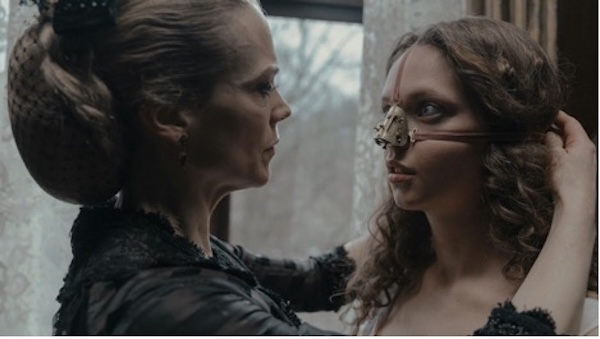
Beauty is pain for Lea Myren in The Ugly Stepsister. Photo: Shudder
The original Grimms’ fairy tales, aka the versions Disney pretends don’t exist, are not dainty, family-friendly stories. Some of the sadistic goings-on: characters are forced to dance in iron-hot shoes until they die, they are blinded by thorns, their toes and heels cut off to fit into a glass slipper. That last operation befalls Cinderella’s ugly stepsisters. But was that the only gruesome act they underwent to capture the prince’s eye?
Emilie Blichfeldt’s film, The Ugly Stepsister, revels in Grimms’ bloody approach to the fairy tale. Described by critics as The Substance meets Bridgerton, the film focuses on Cinderella’s step-family, not the heroine. It explores the lengths her stepsister will go to achieve beauty. Rebekka (Ane Dahl Torp), the evil stepmother, marries Cinderella’s father, believing him to be wealthy. He promptly dies at the dinner table and she promptly learns he was penniless. Since she’s too old to find a new suitor, she focuses her energy on her daughter, Elvira (Lea Myren). Aware that Elvira isn’t what would be called a conventional beauty, Rebekka subjects the young woman to a series of brutal plastic surgeries. If the idea of plastic surgery today gives you pause, wait until you see an 18th-century nose job.
Elvira isn’t ugly. She’s just not as attractive as her step-sister Agnes (Thea Sofie Loch Naess). Elvira is aware of her limits and, initially, she is drawn to Agnes and attempts to befriend her. But, in her grief, Agnes rebuffs her, and that nurtures Elvira’s jealousy later in the film. It doesn’t help that Elvira is made to go to the same stuffy finishing school where Agnes is a star. This segment of the story goes rather Black Swan: the two girls compete for lead roles in a ballet to be presented to the prince. Elvira eventually gets her chance to shine but is outdone, showbiz-wise, by Agnes, who will later become known as Cinderella.
The Ugly Stepsister, much like The Substance, isn’t for the queasy. Gross medical dissection scenes abound. The bodily cutting-and-slashing becomes progressively more dire as the narrative goes on. I must admit I have a fascination with antique (and gross) medical procedures, so I was enraptured by the lengths Elvira goes to be gorgeous. Still, a salient political point is made with considerable power: this is a funhouse mirror of our beauty-obsessed culture, where people inject Ozempic with abandon and women undergo cosmetic procedures as a desperate means to hold onto their youth.The Substance focuses on how older women are dismissed; The Ugly Stepsister emphasizes how fiercely beauty reigns supreme for women of all ages — especially those in the 1700s.
Myren turns in a compelling performance. Her Elvira is convincingly vulnerable, though the character’s obsession with Agnes is downright creepy. Still, it’s hard not to feel pity for our anti-heroine, given that she is essentially the puppet of her ruthless mother, Rebekka. At the same time, Mom is only doing what she can to thrive with the tools available to her in that era. To the film’s credit, there are no easy answers. Every character here is gray, not fairy tale black and white.
At times, The Ugly Stepsister drags in terms of its pacing. Blichfeldt lingers on shots, as if she was as mordantly possessed by the beautiful as the story’s characters. Certain sequences, such as worms and maggots fixing up Cinderella’s dress, are haunting. Others, such as a ballet performance, are needlessly repeated. That said, this is Blichfeldt’s directorial debut, and it’s a strong, stomach-wrenching critique of the things we do to be beautiful.
The Fuse‘s Nicole Veneto on The Ugly Stepsister.
Sarah Mina Osman is based in Los Angeles. In addition to the Arts Fuse, her writing can be found in The Huffington Post, Success Magazine, Matador Network, HelloGiggles, Business Insider, and WatchMojo. She has an MFA in Creative Writing from the University of North Carolina Wilmington and is working on her first novel. She has a deep appreciation for sloths and tacos. You can keep up with her on Instagram @SarahMinaOsman and at Bluesky @sarahminaosman.bsky.social.
2 Comments
Leave a Comment

In the eighteenth century, that white pasty makeup contained lead, which ate away at a woman’s skin. So she had to wear more makeup to cover up the damage. Which ate away at more of the skin…
The Lady’s Dressing Room (1732)
BY JONATHAN SWIFT
Five hours, (and who can do it less in?)
By haughty Celia spent in dressing;
The goddess from her chamber issues,
Arrayed in lace, brocades and tissues.
Strephon, who found the room was void,
And Betty otherwise employed,
Stole in, and took a strict survey,
Of all the litter as it lay;
Whereof, to make the matter clear,
An inventory follows here.
And first a dirty smock appeared,
Beneath the armpits well besmeared.
Strephon, the rogue, displayed it wide,
And turned it round on every side.
On such a point few words are best,
And Strephon bids us guess the rest,
But swears how damnably the men lie,
In calling Celia sweet and cleanly.
Now listen while he next produces
The various combs for various uses,
Filled up with dirt so closely fixt,
No brush could force a way betwixt.
A paste of composition rare,
Sweat, dandruff, powder, lead and hair;
A forehead cloth with oil upon’t
To smooth the wrinkles on her front;
Here alum flower to stop the steams,
Exhaled from sour unsavory streams,
There night-gloves made of Tripsy’s hide,
Bequeathed by Tripsy when she died,
With puppy water, beauty’s help
Distilled from Tripsy’s darling whelp;
Here gallypots and vials placed,
Some filled with washes, some with paste,
Some with pomatum, paints and slops,
And ointments good for scabby chops.
Hard by a filthy basin stands,
Fouled with the scouring of her hands;
The basin takes whatever comes
The scrapings of her teeth and gums,
A nasty compound of all hues,
For here she spits, and here she spews.
But oh! it turned poor Strephon’s bowels,
When he beheld and smelled the towels,
Begummed, bemattered, and beslimed
With dirt, and sweat, and earwax grimed.
No object Strephon’s eye escapes,
Here petticoats in frowzy heaps;
Nor be the handkerchiefs forgot
All varnished o’er with snuff and snot.
The stockings why should I expose,
Stained with the marks of stinking toes;
Or greasy coifs and pinners reeking,
Which Celia slept at least a week in?
A pair of tweezers next he found
To pluck her brows in arches round,
Or hairs that sink the forehead low,
Or on her chin like bristles grow.
The virtues we must not let pass,
Of Celia’s magnifying glass.
When frightened Strephon cast his eye on’t
It showed visage of a giant.
A glass that can to sight disclose,
The smallest worm in Celia’s nose,
And faithfully direct her nail
To squeeze it out from head to tail;
For catch it nicely by the head,
It must come out alive or dead.
Why Strephon will you tell the rest?
And must you needs describe the chest?
That careless wench! no creature warn her
To move it out from yonder corner;
But leave it standing full in sight
For you to exercise your spite.
In vain the workman showed his wit
With rings and hinges counterfeit
To make it seem in this disguise
A cabinet to vulgar eyes;
For Strephon ventured to look in,
Resolved to go through thick and thin;
He lifts the lid, there needs no more,
He smelled it all the time before.
As from within Pandora’s box,
When Epimetheus op’d the locks,
A sudden universal crew
Of human evils upwards flew;
He still was comforted to find
That Hope at last remained behind;
So Strephon lifting up the lid,
To view what in the chest was hid.
The vapors flew from out the vent,
But Strephon cautious never meant
The bottom of the pan to grope,
And foul his hands in search of Hope.
O never may such vile machine
Be once in Celia’s chamber seen!
O may she better learn to keep
Those “secrets of the hoary deep!”
As mutton cutlets, prime of meat,
Which though with art you salt and beat
As laws of cookery require,
And toast them at the clearest fire;
If from adown the hopeful chops
The fat upon a cinder drops,
To stinking smoke it turns the flame
Pois’ning the flesh from whence it came,
And up exhales a greasy stench,
For which you curse the careless wench;
So things, which must not be expressed,
When plumped into the reeking chest,
Send up an excremental smell
To taint the parts from whence they fell.
The petticoats and gown perfume,
Which waft a stink round every room.
Thus finishing his grand survey,
Disgusted Strephon stole away
Repeating in his amorous fits,
Oh! Celia, Celia, Celia shits!
But Vengeance, goddess never sleeping
Soon punished Strephon for his peeping;
His foul imagination links
Each Dame he sees with all her stinks:
And, if unsavory odors fly,
Conceives a lady standing by:
All women his description fits,
And both ideas jump like wits:
But vicious fancy coupled fast,
And still appearing in contrast.
I pity wretched Strephon blind
To all the charms of female kind;
Should I the queen of love refuse,
Because she rose from stinking ooze?
To him that looks behind the scene,
Satira’s but some pocky queen.
When Celia in her glory shows,
If Strephon would but stop his nose
(Who now so impiously blasphemes
Her ointments, daubs, and paints and creams,
Her washes, slops, and every clout,
With which he makes so foul a rout)
He soon would learn to think like me,
And bless his ravished sight to see
Such order from confusion sprung,
Such gaudy tulips raised from dung.