
Film Review: “Rust” – A Horrific Filmmaking Experience Produces an Exceptional Western
By Ed Symkus
Rust is an old-school Western with some fine performances, a violent edge, and a lot of heart.
Rust, written and directed by Joel Souza. It’s available to watch on Apple, Amazon, and Fandango at Home.
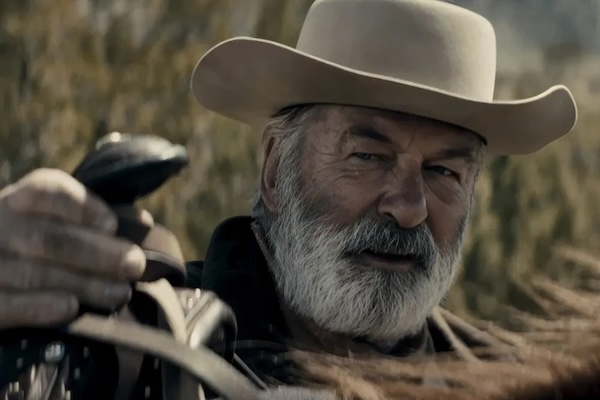
Alec Baldwin in Rust. Photo: courtesy of 42West
Before any critiquing begins, a certain immense elephant in the room needs to be addressed. Yes, this is the film that led to the death of cinematographer Halyna Hutchins (a prop gun discharged a live bullet), the wounding of writer-director Joel Souza (who was standing near her), the shuttering of production for 18 months (lawsuits started taking shape), and the replacement of two lead actors (they had commitments on other projects that couldn’t be delayed). Even before the tragic accident, there were reports of unrest on the set due to lax safety measures, long hours, and distressing working conditions.
But somehow, with enormous odds stacked steeply against it (the sordid details can be Googled), Rust was completed. And, wonder upon wonders, it’s an excellent film. Souza, with only a handful of little-seen, low-budget movies on his résumé, has upped his game here, fashioning an old-school Western that initially looks and feels like it’s been done before. There are extreme close-ups of the sort Sergio Leone presented, vast vistas (in Montana and New Mexico) that have the John Ford stamp on them, bursts of violence in the Sam Peckinpah mold.
But Souza uses most of these ingredients sparingly (though the violence is prominent) as he makes sure the sprawling story he’s telling remains front and center. Maybe it would be more accurate to make it plural — the stories he’s telling. Sequences, by the way, are accompanied by the elegant visual palette, both interior and exterior, day and night, created by Hutchins, who only worked on the first 11 days of the production, and Bianca Cline, who stepped in for her.
In 1882 Wyoming, the remnants of the Hollister family — 13-year-old Lucas (Patrick Scott McDermott) and his younger brother Jacob — are scraping by on their small ranch after their mother succumbed to illness. The fate of their absent father is revealed late in the film. Life is tough for Lucas, whose responsibilities and demanding lot in life have become overwhelming. Then, in an unlucky accident, he kills a neighbor, is charged with murder, and is sentenced to death by hanging. Lucas and his troubles are the central focus of the film, until the script kicks in with other characters and circumstances, all of which, save some brief, unnecessary comic relief, Souza deftly balances.
After Lucas is taken to jail, a stranger appears, shoots the sheriff, knocks out Lucas, and carts him away. The stranger, to whom Lucas will eventually say, “Who are you, what do you want?” is Harland Rust (Alec Baldwin), a man who doesn’t like to share any information about himself, but is known to be an outlaw with a bloody track record. He intends to save Lucas, to bring him — against his will — where no one can find him.
There’s also the local marshal Wood Helm (Josh Hopkins), a man trying to keep the peace in his lawless town, while dealing with a harrowing situation at home. The marshal and his posse are soon on the trail of Lucas and Rust, who are on the run.
Not enough plot development? Say hello to Bible-spouting bounty hunter Fenton “Preacher” Lang (Travis Fimmel), who’s already counting the $1,000 reward on Rust’s head.
Even after Rust confides in the boy and lets him know why he’s trying to help him, it’s clear that these two characters are not going to get along. The performances of both Baldwin and McDermott — especially in their two-hander scenes — are highlights of Rust. McDermott’s forlorn Lucas longs for things to be the way they were. Baldwin’s mysterious Rust plays his cards close to his chest. Also outstanding are Hopkins as Wood — who will earn the audience’s sympathy — and Fimmel’s Preacher, who is quietly menacing.
Souza’s scripting skills establish these — and other — separate stories, then have them slowly converge into a bigger one. Call it a meeting of the minds or, more aptly, a meeting of the guns. The threat of a shoot-’em-up never goes away; its arrival is inevitable. Yet, in the midst of its inevitable brutality, narrative offers an interesting philosophical edge. A number of different characters wonder, “Why are we here? What are we doing? Why do we suffer?” And, despite the ever-present roughness and bleakness, Rust is not only moving, it also exudes an unexpected poetic grace.
Ed Symkus is a Boston native and Emerson College graduate. He went to Woodstock, has interviewed Albert Brooks, Charlie Kaufman, Ellen Burstyn, and Gal Gadot, and has visited the Outer Hebrides, the Lofoten Islands, Anglesey, Mykonos, Nantucket, the Azores, Catalina, Kangaroo Island, Capri, and the Isle of Wight with his wife Lisa.
Tagged: "Rust", Alec Baldwin, Halyna Hutchins, Joel Souza, Patrick Scott McDermott
“Extreme close-ups of the sort Sergio Leone presented” brings to mind Peter Bogdonavich’s written impersonation of the great Italian director outlining a scene: “Two beeg green eyes. Hand on gun. Foots walk, clink clink.”… I’m glad to hear the movie is worth seeing, but the stories about the production give pause. Did someone die because of a grossly irresponsible production team? I know there was a lot of back and forth, and complaints from filmmaking professionals that low-budget films are ALWAYS unsafe to one degree of another. A real mess. I look forward to reading an in-depth examination of the whole mess. In any event, I doubt Alec Baldwin will ever again handle a firearm of any kind on a movie set.