
Concert Review: Radius Ensemble — A Special Occasion
By Aaron Keebaugh
After more than a quarter century, and with an impressive new venue serving as a platform, the Radius Ensemble continues to expand its musical reach.
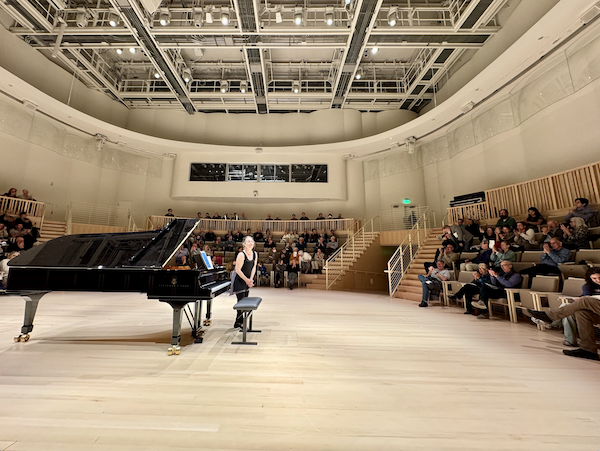
Radius Ensemble in Tull Hall, a theatre-in-the-round in the Edward and Joyce Linde Music Building at MIT. Photo: Sam Brewer
In the world of classical music, seasons bring new faces and new places in which to perform. Yet, even as the current performance lineup in Boston comes to a close, the Radius Ensemble has found a stage on which to celebrate a new beginning.
During a special concert last Thursday, Radius announced its plans to split its concerts next season between its historic home at Pickman Hall and Tull Hall, a beautiful theatre-in-the-round in the Edward and Joyce Linde Music Building at MIT. The space has just about every lover of chamber music talking.
As you enter the hall, the eye is immediately drawn to the performance area, a smoothly constructed circle that offers a bird’s-eye view from any surrounding seat. On top of that, the acoustics are just as clear and clean. The upshot: performances in this space feel as fresh as the scent of the wood used to build the floors and stairs.
Thursday’s program, which featured music by composers associated with MIT’s music program, was also a celebration of the ensemble’s roots. Works by Elena Ruehr and Evan Ziporyn complemented more recent scores by Keeril Makan and Charles Shadle, all composers Radius has featured in past concerts. Played with assurance, these compositions made for a happy homecoming.
Ruehr’s Of Water and Clouds for flute and piano invited deep introspection. This 1986 score opened with faint flute calls. Thumping harmonies in the extreme low register of the piano gave way to chords that rang like a crystal goblet being tapped. The dialogue passed fluently among the players before the eruption of a wild dance. Through it all, flutist Sarah Brady and pianist Sarah Bob ran the gamut with ease between delicacy and power.
“Ghost Song” from Ruehr’s Broadway Boogie Woogie, in contrast, was searching and distant. A combination of woodwinds and strings allowed this music to hover in space with little sense of resolution. Its impact may be simple on the surface — strings created a steady pulse over which oboe and flute took turns floating lyrical lines. But these sounds — played with acute sensitivity by the Radius musicians — tugged at the heartstrings.
Evan Ziporyn’s Be-In for bass clarinet and strings set the air spinning with a propulsive groove. This 1991 work is a collage of tunes from all around the world. Ziporyn treats his varied material in fragmented fashion, layering lines upon each other — they don’t so much mix as grind together. Bluesy passages bring subtle weight to a series of ever-spinning textures, an effect that felt like a mix of Darius Milhaud and Terry Riley. But when played with jam-band verve, as Thursday’s performance was, the music unfolded with the blast of a joyous romp.
Keeril Makan’s Together, composed more recently, was heard in its first public performance. Here, clarinet and strings engaged in conversation — the talk was often quirky, at times fervent, but inevitably stayed polite. A downward rush of the clarinet set off a series of pulses that passed around the string ensemble, gradually coalescing into a steady groove. Little by little, the pulses extended into longer phrases, adding to the chatter before it all ended abruptly. It was all quirky fun; the Radius musicians toyed with the levity.
Charles Shadle’s Choctaw Animals, a set of four pieces for solo piano that offers lessons in musicality, was just as intriguing. Pianist Sarah Bob gently pushed and pulled at the tempos, adeptly tailoring the sonic shapes as she lifted the lines in all the right places. In “Chulhkvn (Spider),” she wove phrases around each other with care. In contrast, “Nvni (Fish)” was searching and infectious, even though clusters of harmonies cast a dark haze over the otherwise bright texture. “Nashoba (Wolf),” a study in parallel motion, took on a mordant ambience. Bob’s smooth touch leaned into the passages of “Issuba (Pony)” that must gallop with abandon.
Shadle’s Catkin for solo oboe opened the concert with warmth and lyricism. Oboist and Radius director Jennifer Montbach let each phrase drift like flower petals in a breeze; the captivating experience was meditative yet free.
These performances suggested that Radius is an ensemble on the move. Next season it will place even more attention on local talent. Its fall concert will spotlight Michael Gandolfi’s Autumn Music. Also on the lineup is a new wind quintet by Elena Ruehr in preparation for an all-Ruehr recording that will be released in 2026. The group promises that this upcoming album will be just like this concert — a love letter to the composers who enable the ensemble to thrive. After more than a quarter century, with an impressive new venue serving as a platform, Radius continues to expand its musical reach.
Aaron Keebaugh has been a classical music critic in Boston since 2012. His work has been featured in the Musical Times, Corymbus, Boston Classical Review, Early Music America, and BBC Radio 3. A musicologist, he teaches at North Shore Community College in both Danvers and Lynn.
Tagged: Jennifer Montbach, Radius Ensemble, Sarah Bob