
Doc Talk — Salem’s lot
By Peter Keough
The best documentaries of 2025 can be seen at the Salem Film Fest.
The Salem Film Festival. March 27-30 at the Cinema Salem, the Peabody Essex Museum, and the National Park Visitor Center.
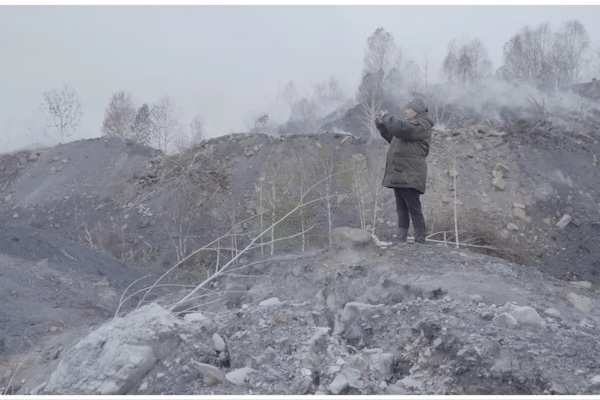
A scene from Black Snow. Photo: Courtesy of Ivan Rechkin
The Salem Film Fest once again offers some of the year’s most innovative, entertaining, and enlightening documentaries. Here are three of the best, but do yourself a favor and make an effort to see them all!! (In the interest of full disclosure, note that I am proudly serving as a festival jury member).
Among other things, Black Snow (2024; screens March 30 at 3 p.m. at the Cinema Salem followed by a Q & A with the director), Alina Simone’s infuriating and frightening four-year report on homemaker-turned-journalist, Natalia Zubkova, might serve as a preview of the future “Putinization” of the United States. The title refers to the day when residents of the Siberian city of Kiselyovsk, in the heart of the biggest coal reserve in Russia and the site of numerous open pit mines, awoke in horror to the titular precipitation. Zubkova posted about it on her site, it went viral, and the international media picked up the story. The local government dismissed the phenomenon as due to “lack of wind.”
It was after posting this story that Zubkova, two of whose children suffer kidney problems apparently caused by the rampant pollution, noticed that the authorities had become interested in her.
Three months later Zubkova got a tip about smoke gushing from a nearby field apparently caused by coal burning underground in an abandoned mine. She filmed it with her trusty cell phone and posted it online, organizing a community meeting where citizens complained about this and other urgent problems. Such as that of a family whom she interviews who had been poisoned by a methane leak and survived only because they were awakened by their heroic cat.
Her dogged reporting compels the mayor of Kiselyovsk and later the governor of the oblast to visit the site and, after initially expressing concerns, both conclude that the smoke was caused by people illegally burning trash.
Though frustrating and almost comical in their stupidity, ineptitude, and venality, the authorities become downright deadly when, instead of responding to the problem, they turned on the person reporting it. It’s a familiar pattern, occurring with increasing frequency now in our own country.
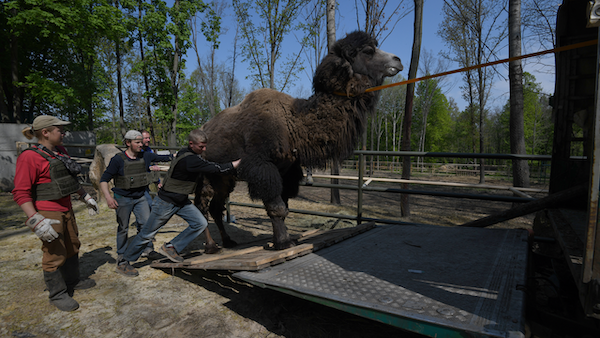
A scene from Checkpoint Zoo. Photo:
More victims of the current Russian regime can be seen in Joshua Zeman’s Checkpoint Zoo (2024; screens March 28 at 4:10 p.m. at the Cinema Salem). Up until February 24, 2022, the Feldman Ecopark was a delightful destination for families, a free-admission wildlife refuge with over 5,000 animals just outside of Kharkiv, Ukraine, 30 kilometers from the Russian border. Then Russia invaded Ukraine and the zoo was in the no man’s land between frontlines where they were targeted by Russian artillery and airstrikes.
The owner, millionaire philanthropist Oleksandr Feldman, told the park employees to leave but many volunteers remained, feeding and caring for the terrified animals as best they could. Efforts began to relocate them, but limited by lack of vehicles and places able to take them in, it went slowly. Many ended up at Feldman’s own nearby, sprawling estate, transforming it into a kind of Dr. Dolittle scenario which Feldman described as a Noah’s Ark. But when an artillery attack targeted the predator exhibit, it became clear it was time to leave. Feldman made an emotional appeal online for help. If he couldn’t relocate the zoo’s collection of big cats, to spare their suffering and for the safety of the community, he’d have to put them down.
Like Zubkova’s reporting in Black Snow, this posting went viral, but with different results. Thousands of individuals and organizations responded and pitched in and, despite the constant peril of Russian attacks, the mission was accomplished, though at a cost. Zeman loosely combines electrifying, sometimes heartbreaking footage taken by the volunteers, media footage, and his own on-location reporting to tell this incredible story. The extraordinary love for their charges shown by those involved in the rescue will remind you how much Ukrainians care for their animals, despite the challenging circumstances of their own lives. This zoo story provides a rare ray of hope in a brutal conflict, though it is darkened in the end by tragedy.
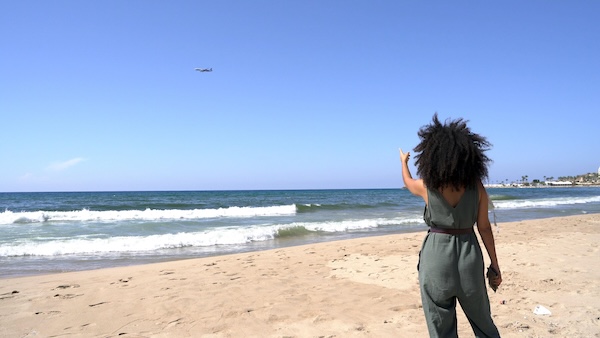
A scene from We Never Left.
You might recall the giant explosion that leveled parts of Beirut, Lebanon on August 4, 2020. Preceding that blast was the slow burn of a revolutionary movement fighting against the entrenched, corrupt powers who were responsible for the disaster and who had been ruining the country for generations. Lebanese-born filmmaker Loulwa Khoury’s immersive and illuminating We Never Left (2024; screens March 30 at 2:45 p.m. at the National Park Visitor Center followed by a Q & A with the director) observes the turmoil from the point of view of three other Beirut expatriates in New York City. All three had left Beirut because they had seen no future for themselves in their native land; they have since built new lives, careers, relationships, and a community in their adopted hometown (but for how long, given the current administration’s immigration policies, is a troubling question). Nonetheless, they felt a need to participate in the struggles faced by their fellow citizens in the streets. So they protested outside the Lebanese embassy in Manhattan and a kind of carnival atmosphere prevailed as they prepared effigies and placards. Finally, they made a return visit to Beirut where they joined fellow revolutionaries at the barricades and experienced for themselves the confrontation with armed police and soldiers and the perils of tear gas and live fire.
But the momentum diminished, and a disappointingly scanty turnout attended a follow-up rally in New York City. The outbreak of COVID-19 presented the authorities in Beirut with an opportunity to suppress public gatherings — the movement was stifled. But, though it was horrifying and deadly, the 2020 explosion galvanized the resistance. The protests are rekindled, in Beirut and New York City and around the world. In the end, the expatriates voted via absentee ballot in the 2022 Lebanese election, joining hundreds of thousands of others in the diaspora. The results were encouraging — putting a dent in the hegemony of the regressive established parties — but they were hardly conclusive. It was only a start, but as one of Khoury’s subjects says, quoting Antonio Gramsci, “I have pessimism of the intellect but optimism of the will.”
Peter Keough writes about film and other topics and has contributed to numerous publications. He had been the film editor of the Boston Phoenix from 1989 to its demise in 2013 and has edited three books on film, most recently For Kids of All Ages: The National Society of Film Critics on Children’s Movies (Rowman & Littlefield, 2019).
Tagged: "Black Snow", "Checkpoint Zoo", "We Never Left", Alina Simone, Joshua Zeman, Loulwa Khoury, Natalia Zubkova
Lovely heartfelt review of films at the excellent Salem Film Festival. I’ve gone in earlier years and been much impressed by the selections.
Thanks!