
Children’s Book Reviews: Accepting and Appreciating Others
By Cyrisse Jaffee
Two picture books explore issues of gender, self-identity, and gender stereotypes for a young audience.
My Sister, Daisy by Adria Karlsson. Illustrated by Linus Curci. Capstone Editions, 2021
Miguel Must Fight! by Jamie Ofelia. Illustrated by Sara Palacios. Little, Brown and Company, 2024
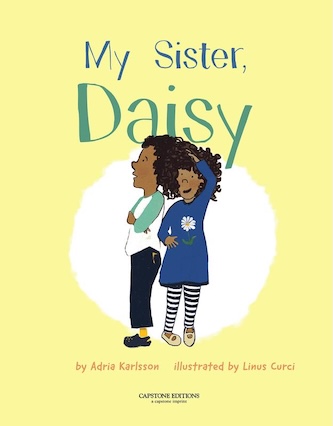 Told from the perspective of an older brother, My Sister Daisy is a sensitive and well-told story about two siblings: an older brother whose younger sibling declares that although she was born a boy, she is actually a girl. Her brother tries to accept his sibling’s new identity but sometimes has trouble. “Are you sure you’re a girl?” he asks. The older brother has a friend who is a girl and a boy and uses the pronouns “they” and “them,” but this is different. Now the person who he has always known as his little brother is his little sister.
The older brother begins to understand that it’s not just the fact that his sibling likes to wear dresses or grow her hair long. “Is it just playing with girls that makes you want to be called a girl?” he wonders. His sibling replies, “Nope. That’s not it.… I don’t want to be called a girl. I am a girl.” She takes on her new name: Daisy.
Their parents are calm and accepting, helping the older brother when he gets frustrated with himself for being jealous of the extra attention (and new clothes) that Daisy gets. Will he ever love his sister the way he loved her when she was his brother?
The siblings learn the word transgender. Mom reassures him that Daisy is the same person inside as she has always been. Dad explains that people will get used to her being Daisy and she won’t always get special attention — and that the older sibling is special, too. Gradually, the older brother is able to enjoy Daisy as his sister and, as they’ve always been, his “best friend.”
In an author’s note, Adria Karlsson explains that the book is based on her own experiences with a son who identified as a girl at an early age. The story is simply told, with appealing illustrations, richly colored spreads, and believable characters.
Obviously, this family, which happens to be multiracial, lives in a very tolerant community (there is a Rainbow Kids lunch at school, where kids may be gender-curious, have gay parents, and so on). Still, the book’s even tone and sympathetic outlook make it a comforting and supportive story that will be useful for families, friends, and relatives — especially in today’s politically volatile times. Sadly, it will no doubt arrive on the “most banned book” list soon.
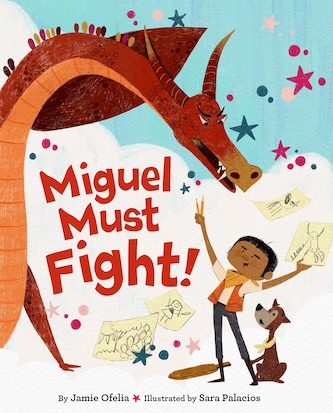
Defying societal expectations is not the same as identifying as a different gender, but Miguel Must Fight! may also be helpful for families whose kids don’t conform to gender stereotypes. It can also be useful in helping kids accept and appreciate people who may be different from themselves.
Miguel comes from a familia — mother, father, and little sister — whose livelihood is sword fighting. Even his abuelitos “sparred when sipping their tea, never spilling a drop.” But Miguel isn’t interested in swords or fighting. He is an artist, preferring to “explore and sketch.”
His father scolds him, and his mother tries to coax him. His abuelitos tell him, “Every boy should learn to defend himself and his family.” The townsfolk disapprove as well. But when El Dragón appears, roaring and spitting fire, the swords of the García family are useless when they are “burnt to a crisp.” It’s Miguel, of course, who saves the day, presenting the fearsome dragon with a hand-drawn portrait that soothes the savage beast. Hailed a hero, the family and the town celebrate Miguel and apologize for misunderstanding him.
Despite the fairy-tale ending and the sometimes silly details, the story manages to convey its message in a clear and entertaining way. The fun illustrations help keep the story light and engaging, and the Spanish sprinkled throughout adds something special to the narrative (a Spanish glossary is included).
Readers may hear echoes of two classic — and still popular — kids’ books: the pacifism of The Story of Ferdinand by Munro Leaf, and the use of art to confront a violent beast in Pete Seeger’s Abiyoyo. While this book may not quite rise to classic status, it’s a nice addition for families or educators who want to help children understand the intrinsic value of each person, even when he or she — or they — don’t fit the traditional mold.
Cyrisse Jaffee is a former children’s and YA librarian, children’s book editor, and a creator of educational materials for WGBH. She holds a master’s degree in Library Science from Simmons College and lives in Newton, MA.
Tagged: "Miguel Must Fight!", "My Sister Daisy", Adria Karlsson, Jamie Ofelia, children's books