
Film Review: “The Rule of Jenny Pen” — Age, I Do Abhor Thee
By Peg Aloi
A provocative commentary on our need to recognize our common humanity, the film is, at its heart, a painfully cautionary tale.
The Rule of Jenny Pen, directed by James Ashcroft. Streaming on Sling
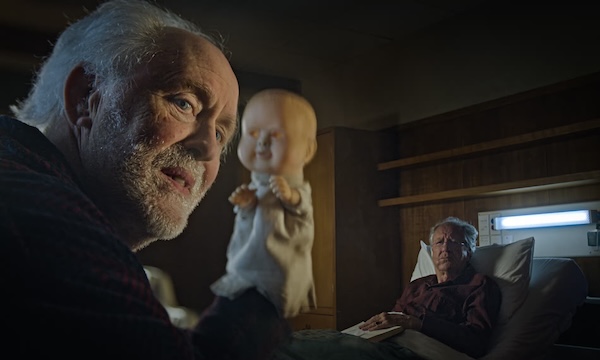
John Lithgow and Geoffrey Rush in The Rule of Jenny Pen. Photo:: IFC Films and Shudder
Growing old has long been a rich source of stories in cinema, but there has been a growing trend to portray decline and infirmity in a dark, disturbing context. Old people are increasingly becoming a source of terror or body horror in cinema. For example, the recent blockbuster hit The Substance stars Demi Moore as a 50 year-old actress who takes an experimental drug that promises to keep her looking young, but eventually makes her age rapidly. (There’s more to it, of course, but hopefully you’ve seen it, and if you haven’t, you should). The recent film franchise from Ti West featuring Mia Goth (X, Pearl, and MaXXXine) also centers on a young woman who is haunted by the specter of aging. Other gimmicky scarefests about aging include M. Night Shyamalan’s Old and David Fincher’s The Curious Case of Benjamin Button (from an F. Scott Fitzgerald short story). There’s even a recently coined subgenre known as hagsploitation, which focuses on older women who become psychotic or otherwise dangerous: the legacy example/progenitor is Whatever Happened to Baby Jane? (1962). As Bette Davis once said, growing old ain’t for sissies, and she ought to know (she continued acting even after suffering a stroke).
Horror films aside, it’s still fairly rare to have elderly characters and the plight of growing old portrayed in a way that is complex, sensitive, or innovative without infusions of the sentimental or the saccharine. A few titles come to mind: Harold and Maude, Hal Ashby’s groundbreaking 1971 social satire starring Ruth Gordon; Mrs. Brown, in which Judi Dench plays an aging Queen Victoria and Billy Connolly her kind footman who, as he grows older, begins to lose his faculties. Children of Nature (1991) is a bittersweet Icelandic film about two friends who decide to escape an old age home and go on an unplanned adventure together. Some films explore the landscape of middle age (a favorite subject of Fellini, certainly), and the regret and acceptance that inevitably arises (Perfect Days is one outstanding example, from 2023). Some recent films deal specifically with old age and dementia. Some of these are not very good, such as The Leisure Seeker, starring Helen Mirren and Donald Sutherland. Others are well done, including The Father starring Anthony Hopkins, Away From Her starring Julie Christie, and The Iron Lady, which portrays an aging Margaret Thatcher played by Meryl Streep. Michael Haneke’s Amour, a moving but brutal story of a once vibrant pianist who suffers a stroke, and her elderly husband’s struggle to care for her, won the Palme d’Or at Cannes. Aging as a cinematic trope has become increasingly multifaceted, a mirror, perhaps, of our evolving challenges: overpopulation, longer human life spans, and the warning cries of a dying planet.
In his second feature film, writer-director James Ashcroft has crafted an eerie, dark, and haunting tale set in an elderly care home in New Zealand. Geoffrey Rush plays Stefan, a career judge who, in the middle of pronouncing a sentence on a serial pedophile, suffers a stroke and is moved to a long-term care facility. A particularly harrowing scene takes place in the first five minutes of the film. Stefan goes outside to take the air: the care home’s grounds are pleasant and green. A fellow resident in a wheelchair offers him a cigarette, which Stefan accepts, and a drink from his (probably forbidden) flask, which the former judge refuses. Moments later, a horrific accident occurs; all Stefan can do is look on, helpless and terrified. This scene sets the stage for a most unusual horror film about the terrors of dependency, here a frightening trifecta of sudden disability from illness or injury, the loss of personal autonomy, and being utterly reliant on strangers for help.
Stefan faces a long road of recovery and rehabilitation, which are suggested through vignettes that don’t seem to flow in linear order. He struggles with physical therapy, to feed himself, and to speak. But perhaps the most challenging struggle is that Stefan is used to being respected as an authority figure, surrounded by people who are his intellectual equals. He doesn’t seem to have any family: certainly no one comes to visit. The film compounds this isolation with reminders of the battles faced by people who are elderly and disabled: loss of physical vitality, loneliness, lack of community support and, in many cases, insufficient social connections and health care options. Stefan is lucky: the care home he lives in is well staffed, clean and modern. But moments that dramatize his radical vulnerability come along: when a carer, in the middle of bathing him, must fetch a towel because her coworker has stepped away, Stefan reassures her he will be fine: “I’m stronger than I look.” But within moments his physical weakness renders him helpless.
Demeaning as this condition might be, Stefan also has a demonic nemesis in the form of Dave Crealey, played brilliantly by John Lithgow. Dave is a tall, imposing man who constantly wears a bald-headed doll puppet on his right hand, who he refers to as Jenny Pen. Though Dave appears to be quiet and calm, he bides his time until staff aren’t watching, then takes these opportunities to terrorize his fellow patients. One of Dave’s favorite victims is Tony (George Henare), a former star football player in New Zealand who is also of Maori ancestry. Tony is Stefan’s roommate, and the former judge, who has repeatedly demanded but been denied a private room, resents Tony’s chatty, friendly ways. But then Stefan notices that Dave’s bullying of Tony is becoming increasingly sadistic, including physical abuse and cruel racist taunts, and he decides he needs to stand up to Dave. His complaints to the care home staff are essentially ignored, and Tony, because of Stefan’s previous rudeness, and because he’s terrified of Dave, chooses not to back him up. This is a textbook example of narcissistic bullying, amplified by Dave’s psychopathic behavior and the relative helplessness of his victims. Ultimately, it will take some crafty teamwork to subdue the psychotic Dave.
The film’s plot, based on the short story of the same name by Owen Marshall, includes a few implausible rough patches. But what compensates for this clumsiness is the film’s absorbing tone, its overarching sense of low-level terror. Lithgow and Rush could not be better; in their hands this is not a conventional game of cat and mouse but an examination of the existential relativity of cruelty. Though The Rule of Jenny Pen does register, first and foremost, as a thriller, it’s also a sobering look at the indignity of aging. A provocative commentary on our common humanity, it is, at its heart, a painfully cautionary tale.
Peg Aloi is a former film critic for the Boston Phoenix and member of the Boston Society of Film Critics, the Critics Choice Awards, and the Alliance for Women Film Journalists. She taught film studies in Boston for over a decade. She has written on film, TV, and culture for web publications like Time, Vice, Polygon, Bustle, Dread Central, Mic, Orlando Weekly, Refinery29, and Bloody Disgusting. Her blog “The Witching Hour” can be found on substack.