
Film Review: “Botticelli’s Primavera” — One of the Great Picture-Puzzles of the Italian Renaissance
By Peter Walsh
The stunning painting is beautifully presented in this documentary, but the flood of references to other works of art and quotations from classical and Renaissance writers might make the film a bit slow going for someone with no background at all in Renaissance cultural history.
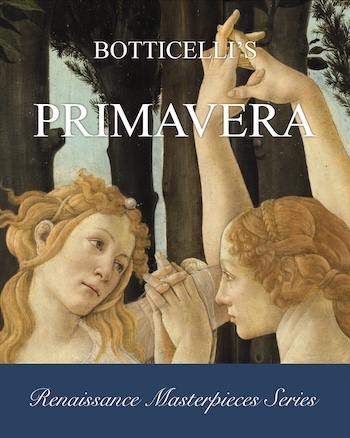 The sixty-minute film, Botticelli’s Primavera (now available on Ideas Roadshow’s App for TV, tablet & phone and VOD and Amazon Prime) opens like a ceremonial lecture on the occasion of an exhibition opening or the start of an academic symposium: a familiar set piece in museums and art historical institutions, delivered by a well-known expert on a major work of art, summarizing and synthesizing current scholarship before presenting his or her own definitive position. Only in this case the Voice of Authority is off-screen and anonymous and the inconsistent delivery style swings from the dry and academic to the colloquial and conversational. As a result the narration never focuses on a single authority but instead wanders among decades of scholarly research and commentary.
Art history documentaries typically use a talking heads-style narration, in which several scholars express their own ideas, often on camera, with perhaps a narrated summary at the end. The sense is of a group of well-known authorities mulling over the evidence and past theories before drawing in on a consensus, even if that consensus is more congenial facade than actual reality.
The present film/lecture chooses as its subject one of the great picture-puzzles of the Italian Renaissance: Sandro Botticelli’s monumental (some six feet, eight inches tall by ten feet, four inches wide) painting, created sometime around the late 1470s or early 1480s, and in Florence’s Uffizi Gallery since 1919. The title Primavera comes not from Botticelli himself but from the later painter, art historian, and artist biographer, Giorgio Vasari, who first saw it in a Medici summer house by around 1550. By its common grand scale and allegorical, classical subject matter, Primavera has long been associated with another famous Botticelli, The Birth of Venus, which also now hangs in the Uffizi. It was once assumed that the two works had been commissioned as a pair, but this is no longer the consensus. It has also been widely assumed that both were Medici commissions, but the precise circumstances remain unknown.
The painting is set in an idealized orange grove and a flower-strewn meadow crowded with figures from classical mythology: Zephyrus, representing the biting March wind, and his future wife, the nymph Chloris; the three Graces; Venus, with Cupid hovering just over her head; Flora, a relatively minor Roman goddess of flowers and spring; and finally, at the extreme right of the painting, Mercury, messenger of the gods and god of commerce, who manages a varied portfolio of divine duties. Just what these figures are doing together and the nature of their clearly allegorical narrative have made Primavera one of the most controversial and discussed paintings in all of art history, something the narrator emphasizes from the outset.
The film sets out to resolve most of these issues with an analysis of the painting’s composition and its roots in classical and Neoplatonic philosophy. It is a stunning painting beautifully presented here, the film often breaking down the cast of characters into distinct groups to make a point. Although it is intended for general audiences, the flood of references to other works of art and quotations from classical and Renaissance writers who could shed light on the work’s complex allegories might make the film a bit slow going for someone with no background at all in Renaissance cultural history. Nevertheless, by the end, the film has apparently resolved all the knotty controversies and tied up the loose ends into a tidy package.
Only in the closing credits is the identity of the lecturer/narrator finally revealed to the audience. It is Howard Burton, a theoretical physicist and philosopher not trained as an art historian. Burton is also the creator of the Ideas Roadshow, producer of the film. Despite the film’s evident erudition and its often compelling narrative, this puts an amateur cast over the entire project, which now comes across as rather the self-promoting project of an interloper from another field. Even amateurs are entitled to their opinions, of course, and this detail is not likely to trouble many of those viewers attracted to the film’s considerable charm.
Peter Walsh has worked as a staff member or consultant to such museums as the Harvard Art Museums, the Museum of Fine Arts, Boston, the Davis Museum at Wellesley College, The Metropolitan Museum of Art, the National Gallery of Art, and the Boston Athenaeum. He has published in American and European newspapers, journals, and in scholarly anthologies and has lectured at MIT, in New York, Milan, London, Los Angeles and many other venues. In recent years, he began a career as an actor and has since worked on more than 100 projects, including theater, national television, and award-winning films. He is completing a novel set in the 1960s.
Tagged: "Botticelli’s Primavera", Howard Burton, Ideas Roadshow, Italian Renaissance