
Book Review: “Plastic” Novel? Musical? Anime?
By Ed Meek
Plastic would have been much more effective if it had taken the form of an anime or a cartoon.
Plastic by Scott Guild. Vintage Books, Penguin Random House, 304 pages, paperback, $19.
— Life is plastic. It’s fantastic. (“Barbie Girl”)
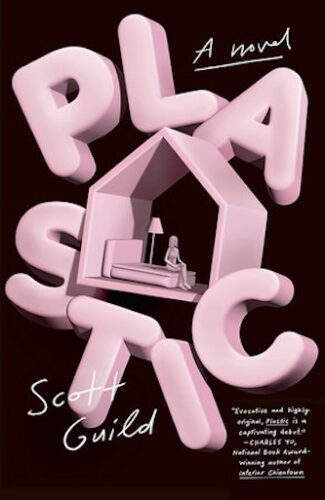 The multi-talented Scott Guild has created both a novel and an accompanying musical version of the novel. The narrative focuses on live plastic figurines who exist sometime in the not-to-distant future after a nuclear war. Guild is nothing if not inventive; he is adept at world-building as he presents us with a bizarro version of our current era of hyper-advertising, the omnipresence of plastics, and terrorist attacks. Yet in this world we are talking about ways to diminish the effusion of plastic. In Guild’s novel, people are plastic. The main character, Erin, works at Tablet Town where she makes Smartbodies that enable the figurines to enter virtual worlds. Erin and the other plastic people in the novel even converse via their own clipped, robotic language.
Erin narrates the action as she was watching a movie: “The next scene opens on a slender kitchen.” As the story begins, we learn that Erin’s boyfriend, Patrick, was murdered and that she is having a hard time dealing with it. Terrorists routinely attack the plastic figurines. Partly to escape her problems, Erin watches a sitcom called “The Nuclear Family”, which revolves around a dysfunctional clan made up of humans and waffles. The parents are always arguing and their son is dealing with his attraction to homosexuality. The show comes with a laugh track which is supposed to bolster its satirical appeal.
Guild has an MFA from U of Texas at Austin and a PhD in English from U of Nebraska Lincoln. He worked on the novel and its accompanying album over the course of ten years. The recording has a New Age sound to it and there is a music video. (You can find the record on Spotify.) This combination of music and a compelling story would see to be a natural fit for either an anime feature or a cartoon series.
Plastic comes across as a kind of cross between Klara and the Sun, Ishiguro’s great novel, and the movie Barbie. Like the film, Guild’s storyline is insistent on making its points. In Barbie’s case, the villain is the patriarchy; in Plastic, baddies are terrorism, the breakdown of the family, and the way texting is degenerating our language. Here is an exchange between Erin and Jacob, a guy she befriends: “You worry she listen at door?” “She prob not. But it small apartment. No want hurt her feeling.” After a while, this send-up of language becomes stilted and annoying — like the way native Americans are made to talk in old Westerns.
On top of that, it is difficult to read an entire novel written in the present tense. Song lyrics are sprinkled throughout the book. This becomes a slog because the words, without music, don’t stand on their own. At one point, Erin sings into the void: “The day I bought a VR suit/to lose myself in dreams, /To flee the sorrows of my youth/Behind a Smarthead screen.” Maybe these lyrics work when they are teamed with a tune. But, as stand-alone lyrics, one is tempted to skim them.
Writer John Gardiner talked about making a novel a fictional dream. When fiction is effective, the reader becomes lost in the dream. Guild never lets the reader forget Plastic‘s unending artifice: the novel is formatted as if it is a movie, the protagonists watch a TV show that functions as a satire that comments on our world, the people in this futuristic farce existence only speak in stilted dialogue. Like Barbie, the novel draws on a promising concept. And Guild is very clever. But, unlike Klara and the Sun, the lives of characters who are plastic — but somehow still have to eat food — are never deeply engaging. And these plastic characters can die as well. Does this set-up make sense in a novel? Plastic would have been much more effective if it had taken the form of an anime or a cartoon.
Ed Meek is the author of High Tide (poems) and Luck (short stories).