
Television Review: Macondo Redux — A Progress Report on Netflix’s “One Hundred Years of Solitude”
By Yulia Pereira
Adapting such a monumental work, a novel that is loved by so many, is both ambitious and risky.
One Hundred Years of Solitude, directed by Alex García López and Laura Mora. Streaming on Netflix
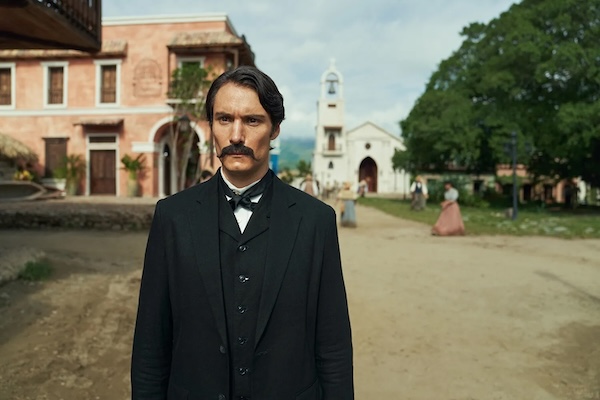
Claudio Cataño as Aureliano in One Hundred Years of Solitude. Mauro González/Netflix
Colombian Nobel laureate Gabriel García Márquez ranks among the most influential modern authors, and One Hundred Years of Solitude, a hallmark of magic realism, is widely deemed to be his masterpiece. Published in 1967, the novel follows seven generations of the Buendía family through the birth, rise, and decline of Macondo — a fictional frontier town central to much of Márquez’s oeuvre. Examining isolation, cyclical history, and the burden of memory, the narrative captures Latin America’s complex social tapestry and its interplay of the earthly and the supernatural. That intermingling of the coarse and the ethereal have long made any adaptation to the screen a daunting task.
Netflix’s 16-episode series takes up the challenge by honoring the intentions of the source. Its first season, which aired last month, was made up of eight episodes under the executive production of Rodrigo García Barcha and Gonzalo García Barcha — Márquez’s sons. They are following the conditions the writer set for any adaptation, including a Colombian production team and the original language. The expectations were immense, particularly in Colombia.
As a Colombian, I approached the presentation with both curiosity and skepticism. Márquez himself was on record doubting that any film could faithfully recreate Macondo’s complexity. Beyond the novel’s scale, the narrative draws an indelibly fine line between the miraculous and the mundane — a balance that is nearly impossible to maintain, even in the world of words. Any adaptation risks either because of a reductively “beautiful” visual take or a caricature of magical-cultural elements. The result of either would be a succession of “exotic” clichés rather than the convincing presence of characters for whom the unknown is a natural part of life. Moreover, the minimal dialogue of Márquez’s people carries profound cultural and emotional weight because of how it is crouched in Márquez’s language — the power of their actions and presence would be very easy to undercut through stereotypical shorthand.
Obviously, the sweeping historical scope of the book demanded a director with a strong résumé in large-scale projects. Álex García López (known for The Witcher and Daredevil) was an apt choice, and he is aided by director/screenwriter Laura Mora (Los Reyes del Mundo), whose deep connection to Colombian storytelling is becoming her trademark. The production was given a significant budget — it is Netflix’s most expensive in Latin America — and it was filmed entirely in Colombia in order to draw on the tropical and Caribbean landscapes that shaped Márquez’s rich imagination. Three versions of Macondo were built, each reflecting the town’s evolution, with meticulous attention to everything from set design to sound.
The performers, selected in different regions of Colombia, convey the emotional and cultural complexity of their characters. The cast members were also concerned about authenticity. Diego Vásquez took Latin classes to play José Arcadio Buendía, while Claudio Cataño learned goldsmithing in order to play the scenes about the making of Colonel Aureliano Buendía’s decorative golden fish. These are two examples, among others, that reflect the intention to faithfully transmit the spirit of the book. A voice-over effectively orients viewers through the various branches of the Buendía family tree because it preserves the lyrical feel of Márquez’s prose. Still, a stronger Caribbean accent — like Márquez’s own — would have enhanced the authenticity of the approach. Choices such as this reflect the inevitable tension between cultural fidelity and Netflix’s commercial realities: in Macondo, fate rules; on Netflix, marketing does. Above all, the book’s magic, regardless of its complexity, has to sell.
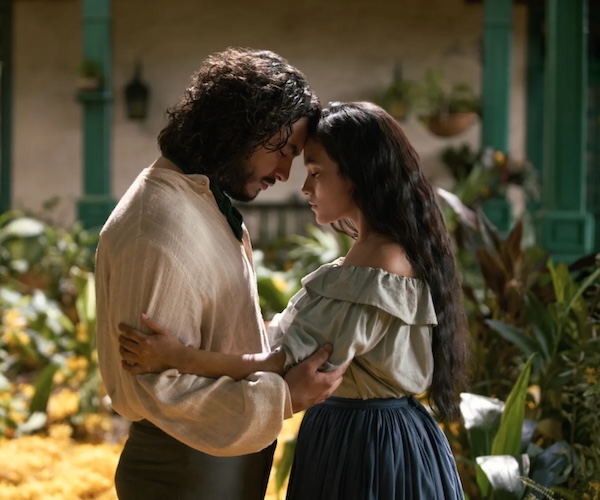
A scene from One Hundred Years of Solitude. Photo: Mauro González/Netflix
A clever touch in the opening scene: we see a later-generation Buendía deciphering prophetic parchments from the family’s earliest days. This metafictional tribute effectively underscores the notion of the novel as a parchment, a scroll that invites viewers to join in unveiling Macondo’s mysteries.
In the first two episodes, audiences see a “foundational Macondo,” representing the town’s unspoiled origins: bahareque houses, a communal spirit, and an honor-based order. These scenes echo the novel’s vivid imagery of “a village of twenty houses made of mud and cane built on the banks of a river with clear waters that rushed down a bed of polished stones, white and enormous like prehistoric eggs.” Yet the very first episode also visualizes a Macondo in ruins, foreshadowing the community’s later collapse and emphasizing the story’s cyclical nature.
From episode three onward, a “splendid Macondo” emerges — its heyday shaped by modernity, social shifts, and increasingly entangled social and domestic relationships. The series focuses on the Buendía family’s unruffled prominence as town founders. Eventually, a “decadent Macondo,” which will arise in the second season, will illustrate the predicted decline of both the town and the Buendías clan, a glimpse of which was seen in the series opening. Despite Netflix’s lavish sets, they pale beside the ways that Márquez transformed physical space into a metaphor for Latin American societies, a drama in which grand dreams often clash with stark realities.
What we see in the series may fall short, but what we hear, in the soundtrack, is a strength. Painstakingly curated by musicologists, anthropologists, and biologists, the music weaves tradition and modernity into a compelling sonic tapestry of Colombian identity. The production also spotlights the Caribbean oral tradition through a deft use of iconic folk musicians — Los Gaiteros de San Jacinto, Totó la Momposina, Carmelo Torres, and Víctor Navarro — whose gaita and drums enliven festivities while classical pieces or an accordion underscore intimate moments.
Bird vocalizations likewise serve as a “leitmotif.” Calls of Pitangus sulphuratus (“bichofué” or “chichafría”) highlight Remedios Moscote’s sweetness, while the near-electronic tones of oropendolas (Psarocolius) herald the gypsy Melquíades’s arrival. These sound elements add layers to the narrative, signaling pivotal shifts without a word. Meanwhile, social stratification — a constant theme in Márquez’s work — is hammered home when Pilar Ternera and other locals are excluded from the Buendía house unveiling, where an elegant pianola plays. By excluding Pilar from this affair the series departs from the novel in order to accentuate that modern hierarchies are encroaching on Macondo’s egalitarian foundations. Here music serves to make a political point.
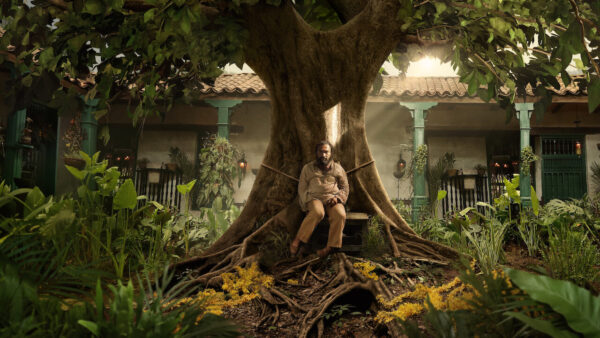
A scene from One Hundred Years of Solitude. Photo: Mauro González/Netflix
On the one hand, the adaptation shifts the original’s cyclical structure toward a more linear narrative. But it preserves key nods to the recurring loop of fate, especially the prolepsis at the novel’s iconic opening lines: “Many years later, facing the firing squad, Colonel Aureliano Buendía was to remember that distant afternoon when his father took him to discover ice.” By circling back to the book’s vision of fate and isolation, the series taps into how themes of solitude resonate in the Buendía saga — José Arcadio’s obsession with alchemy, Amaranta’s emotional seclusion, and Aureliano’s single-minded obsession with war. Úrsula, though retaining her capable, enduring role, loses depth without certain scenes (e.g., that of her giving Aureliano a weapon did not make it from the book to the screen). Incest remains central and confronts viewers with the era’s moral tensions, handled more discreetly while respecting the novel’s critical lens. Rather than supplant the book, the adaptation complements it, introducing García Márquez’s literary richness to new audiences. It also prompts reflection on whether audiovisual media can capture the same emotional intricacies as the written word.
Simultaneously, it grapples with the profound psychological elements in One Hundred Years of Solitude: solitude shapes every member of the Buendía family. José Arcadio Buendía immerses himself in alchemy and other studies, eventually confronting his own limits. The long-lived Úrsula stands for resilience — a healthy way to balance private and public life — but the series has undercut her role, excising many of her appearances in the novel. Amaranta’s solitude is expressed through emotional withdrawal and implied self-harm, and this insulation is reinforced by the series’s visual direction. Aureliano’s seclusion likewise shifts from quiet reserve in youth to embittered resolve in adulthood, a self-hatred absorbed by the futility of war. Incest is the family’s primal sin, propelling its cyclical decline.
Adapting such a monumental work, one that is loved by so many, is both ambitious and risky. In a time when societies are dedicated to progress, technological and otherwise, Márquez’s belief that “time was not passing… it was turning in a circle” is dissident. One has truly returned to Macondo only once one realizes that they have never really left. So far, the series has successfully put across that sobering idea — of characters trapped in a circular dance of time — successfully. Its creators are too smart to think that this effort will replace the novel; the goal appears to be to expand its impact, guiding a new generation of readers toward García Márquez’s literary universe, whose beginning is inevitably found at its end.
Yulia Pereira is a Colombian designer, writer, and educator based in Bogotá.
Tagged: Alex García López, Claudio Cataño, Gabriel García Márquez, Laura Mora
Great analysis. I also felt that, given the limitations of form in the adaptation, they have done a very respectable job. But nothing can replace the original, of course!
Many of the subtitles are not readable because the text is white against a light background.
I felt like the dubbing in those flat, non expressive voices ruined it for me. Subtitles would probably have been better.
I agree. I watched and listened to it in it’s original spanish form. Tried the English dubbing, not the same passion.
Not only the expressionless voices, but also the poor translation from Spanish to English, which is painfully apparent even to a non-Spanish speaker like myself.
It would have been impossible to bring into screen the pure essence the book possesses. I read it as a young teenager as a school project and did not get the best marks on my test. Nonetheless, at my tender age of 64 I still remember the intensity I felt when I first read it. In my view, and eyes now, Ursula remains legendary. She, as the matriarch, carried this series beautifully, and in my humble opinion, more so than Jose Arcadio, who spent the better half tied to a tree.