
Book Review: “There Is a Deep Brooding in Arkansas” — A Painful but Essential History Lesson
By Bill Littlefield
The publication of There Is a Deep Brooding in Arkansas is especially welcome and necessary at this time.
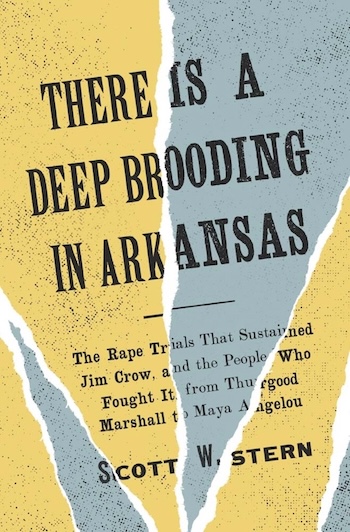
There Is a Deep Brooding in Arkansas: The Rape Trials That Sustained Jim Crow, and People Who Fought It, from Thurgood Marshall to Maya Angelou by Scott W. Stern. Yale University Press, 450 pp., $35.
The title of this extraordinary study comes from the Maya Angelou poem titled “My Arkansas:”
There is a deep brooding
In Arkansas.
Old crimes like moss pend
From poplar trees.
The sullen earth
Is much too
Red for comfort.
 Angelou’s experience is central to Stern’s book. As a child, she was raped. One consequence of that experience is that, for a time, she stopped talking altogether. But, as an adult, Angelou wrote powerfully and at length about her experiences as a Black child in Arkansas, among other places, focusing on the challenge and necessity of healing. Her writing went well beyond what most would call memoir. The truth she spoke was not only personal, but historical and universal. As Stern puts it, “By linking sexual violence to white supremacy, Angelou highlighted the intersection of the systems of oppression that shaped her childhood.”
Thurgood Marshall’s role in the story Stern tells is also enormous. First as attorney and then as a Justice on the Supreme Court, Marshall was instrumental in the long and ongoing fight for justice for minority citizens along with the poor and disadvantaged in general. Part of his achievement was how he altered the way that the crime of rape was understood and then prosecuted in this country. As a progressive attorney, he faced two demands that were difficult to reconcile. He worked to defend Black men accused of rape who were not guilty and he worked to support Black women whose legitimate charges of rape were often dismissed because they were not considered to be credible witnesses to the assaults against them. In each case Marshall was working against a system built to dehumanize the folks he was representing.
But author Scott W. Stern has not limited himself to chronicling the determination and achievements of these two outstanding figures. There Is a Deep Brooding in Arkansas also goes into the historical background of the region where Maya Angelou spent much of her childhood, providing readers with a narrative that goes into the origins of the racism and probes the sometimes murderous brutality that characterized the area. By exploring the circumstances of four men — two of them white, and two of them black — accused of rape in Arkansas during the Jim Crow Era, Stern presents compelling stories that help explain how the system worked — and failed to work — during the days before people like Angelou and Marshall began to change laws, attitudes, and outcomes. As Stern explains, “occurrences such as the Montgomery Bus Boycott and the March on Washington did not emerge out of nowhere; they were the products of a rage and a quest for justice that had been germinating for centuries.” One of the stories that helped fuel that “rage and quest” was the so-called “legal lynching” of two black men, Clear Clayton and Jim X. Carruthers, who, though demonstrably and obviously innocent of the rape of which they were convicted, were put to death in Arkansas in 1939. Stern convincingly claims that the injustice was “one more cobblestone on the blood-soaked road toward freedom.”

Author Scott W. Stern. Photo: courtesy of the artist
The appearance of There Is a Deep Brooding in Arkansas is especially welcome and necessary at this time. In various states there have been successful efforts to ban books that chronicle the outrages that have been perpetrated on people because they are not white, or because they are poor, or because they have stood up for their humanity and their dignity against the power of unjust laws, a bigoted tradition, and a state committed to perpetuating white privilege, discrimination, and even lynching. Stern’s ambitious and compelling narrative goes into the historical change that was necessary to make readers understand why progress had to happen. He probes the background to some of the most shameful currents in the history of this nation; but he also celebrates some of the ways in which extraordinarily brave men and women have battled against those currents. Sometimes, of course, at a terrible cost, battling at a time and in a place where “the possibilities of progress were sharply limited by the durability and adaptability of white supremacy, patriarchy, and capitalism, with all their attendant rationalizations and ramifications.” To his credit, Stern recognizes how the state’s expansive commitment to imprisoning minority citizens serves as a way of blocking “progress,” contending that “an enhanced reliance on human caging — that is, the rise of mass incarceration” cannot be reconciled with what the author references as “a progressive justice-based agenda.”
The episodes Stern writes about in this volume are often painful to read. But stories like these are critical to understanding an uncomfortable reality: many of these inequities continue to fester in this country today. Without comprehending that fact, there is little hope for further progress.
Bill Littlefield works with the Emerson Prison Initiative. His most recent novel is Mercy (Black Rose Writing).
Tagged: "There is a Brooding Deep in Arkansas", Jim Crow America, Scott W. Stern, maya angelou