
Classical Music Commentary: Boston’s Lost Opportunity — How the BSO Board Chose Charles Munch over Leonard Bernstein
By Joseph Horowitz
In Boston, Leonard Bernstein might have sustained Serge Koussevitzky’s bold adventure — and changed the course of American classical music.
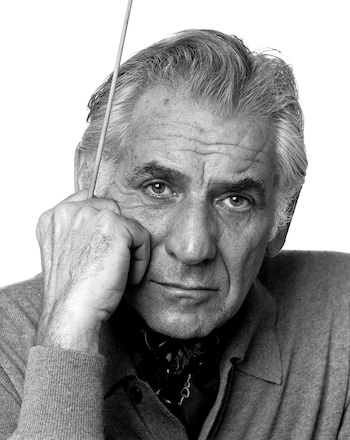
Leonard Bernstein. Photo: Jack Mitchell, Wikimedia
The current controversy over the termination of Andris Nelsons as Music Director of the Boston Symphony Orchestra — an immensely consequential decision — has two components. The first is: why was Nelsons let go? The second concerns the deportment of the orchestra’s administration and board: why was the announcement handled so clumsily that the players themselves — now in an uproar — felt blindsided?
It brings to mind an even more consequential decision by the BSO leadership, one that has never been scrutinized. In 1949, Serge Koussevitzky — who had led the orchestra for 25 years, founded the Tanglewood summer festival as a singular American musical laboratory, and consolidated a mission and identity unique in the symphonic world — wished to pass the baton to his 31-year-old protégé Leonard Bernstein. But the board instead chose Charles Munch, a stranger to American music and a poor fit for Tanglewood as Koussevitzky — a visionary — had envisioned it.
A further perspective on the Nelsons affair is the Chicago Symphony’s much-debated decision to appoint Klaus Mäkelä as its music director beginning in 2027, when he will be 31. Mäkelä will concurrently lead Amsterdam’s Concertgebouw Orchestra. Nelsons, in Boston, is also music director of the Leipzig Gewandhaus Orchestra. Yannick Nézet-Séguin heads both the Philadelphia Orchestra and the Metropolitan Opera, where his conducting responsibilities are therefore relatively limited.
This template of the “jet-set” music director, mainly invented by Ronald Wilford at Columbia Artists Management beginning in the 1960s, is deservedly under fire. Gustavo Dudamel, who becomes music director of the New York Philharmonic next fall, will have no comparable overseas commitments. Had Koussevitzky also been music director of a second orchestra abroad, had Bernstein, during his historic Philharmonic decade, also presided elsewhere, nothing remotely like Koussevitzky’s Boston Symphony or Bernstein’s New York Philharmonic could have transpired. Koussevitzky barely engaged guest conductors. Bernstein scripted and led 53 Young People’s Concerts, many of which were given twice. Both zealously pursued an articulate mission with multiple prongs.
The role of the musicians in this scenario also bears pondering. In Chicago, the players wanted Mäkelä. In New York, there was strong sentiment within the orchestra to engage Lorin Maazel in 2002 and Jaap van Zweden in 2018 —c onductors who failed even to attempt a distinctive institutional mission. Symphonic musicians are prone to view the orchestra as a laboratory for rehearsal and performance. As Koussevitzky and Bernstein showed, an orchestra can transcend that. Today, with classical music in crisis, it matters more than ever.
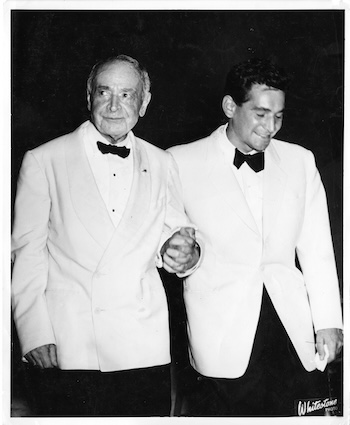
Serge Koussevitzky and Leonard Bernstein. Photo: Heinz Weissenstein, Whitestone Photo, courtesy of BSO Archives
According to Kiki Speyer, who in 1941–42 was Bernstein’s constant companion, Koussevitzky “wanted Leonard to succeed him” by 1942. “He sat us both down and said, ‘Kinder, you must get married.’” She believed that Koussevitzky felt Bernstein needed a wife to “manage” him. She also said she was the first person to inform Koussevitzky that Bernstein sometimes slept with men. In any event, in the seasons to come it seemed self-evident that Bernstein was being groomed by his mentor to take over. Not only was he conducting the Boston Symphony with ever greater frequency; in 1947, his 18 Boston Symphony concerts included two at Carnegie Hall and another two at Tanglewood — an extraordinary imprimatur.
The logic of a Bernstein appointment seemed apparent. With the Boston Symphony already committed to the American composer, Bernstein could pick up where Koussevitzky left off — and in the process add composers like Ives and Gershwin, who were not to Koussevitzky’s taste. Compared to Koussevitzky’s orchestra, the New York Philharmonic — where Bernstein would wind up — was an inferior instrument, defective in polish and morale (and Bernstein was not an orchestra builder). Its eventual hall, at Lincoln Center, was inferior to Boston’s. Its audience was less attentive. Its artistic identity was erratic and vague. And it did not possess a summer home, let alone a Tanglewood.
Why did the Boston trustees opt for Charles Munch? The extant board minutes yield little information. Koussevitzky’s letter of resignation “following the season 1948-49” is dated March 10, 1948 — the day he attended a board meeting to deliver it. It reads: “It will not be possible for me to continue my present strenuous obligations.” Five days later, the trustees resolved “to enter into negotiations with Mr. Charles Munch with a view to engaging him as Conductor and Music Director for a period up to three years beginning with the symphony season of 1949-1950.” Munch accepted the offer two days after that. The official announcement was dated April 9.
Behind the scenes, confidential communications within the board reveal that during the summer of 1945 Koussevitzky was urging that Bernstein be named “principal guest conductor” in 1946–47, with conducting responsibilities split “50/50” between Bernstein and himself. This, he proposed, would become a suitable opportunity to gauge Bernstein’s fitness to take over. He was not in favor of an “abrupt change” in leadership. He advised the board that “among the younger generation there is no one who can match or even approach [Bernstein’s] gift for conducting.”
But the trustees — chaired by Henry B. Cabot, the scion of one of Boston’s oldest families — wanted no part of this or any other Bernstein plan. As early as 1942 they resolved to pick a seasoned conductor, internationally esteemed. And they further insisted, among themselves, that the choice of Koussevitzky’s successor was theirs alone. Negotiating with Koussevitzky, the trustees never budged. Koussevitzky, “when pressed,” was reported (on June 11, 1945) to concede that Bernstein “should have two or three years more of experience in conducting before becoming the regular conductor of the Boston Orchestra.” The same internal board communication states that Koussevitzky “mentioned three other men as the outstanding men in the United States. Mitropoulos he felt was the most talented but did not have quite as complete control of his orchestra as Czell [George Szell]. He also mentioned Rheiner [Fritz Reiner] but thought that he was a bit too old and set in his ways.” Koussevitzky further indicated that, if Bernstein were not engaged as a principal guest, he wished to see a complete break with the past and would not guest-conduct for a music director other than Bernstein. More than a year later, on December 31, 1946, a Cabot memorandum to the trustees stated that Koussevitzky considered Paul Paray (who beginning in 1952 would lead the Detroit Symphony with distinction) “a better conductor” than Munch. Cabot continued:
[Koussevitzky] speaks of Szell as a very excellent drill master but of rather a cold personality. Mitropoulos he considers just the opposite — as a very poor drill master but one who is thinking of the effect on the audience too much. He mentioned the names of a number of foreigners he had heard about as promising but as to whom he had little real knowledge as follows: [Franco] Ferrara, an Italian; Klatsky [i.e., Paul Kletzki], a Czech; Karagan [i.e., Herbert von Karajan], a German; and [Evgeny] Mravinsky, a Russian. As to the latter he thought that there was little possibility of ever getting him as a permanent man for the reason that he thought the Russians would never let him go.
Henry Higginson, who founded the Boston Symphony in 1881, was a trained musician, schooled in Vienna. During his 38 years operating the orchestra (there was no board), Higginson relied on trusted scouts abroad when shopping for conductors. The lists of candidates that he compiled were comprehensive and shrewd. Eavesdropping on the BSO board privately mulling Koussevitzky’s successor, one encounters a startling insularity — Cabot and the others evinced no knowledge of European musical life. They apparently discovered Munch when he guest-conducted in the US, including the Boston Symphony in 1946. What is more, Koussevitzky’s singular significance seemed not to matter to them. They expressed no resistance to Koussevitzky’s insistence on maintaining control of Tanglewood. They seemed indifferent to his advocacy of American composers, to his advocacy of the New World generally as a proud and grateful immigrant. They sought a European pedigree.
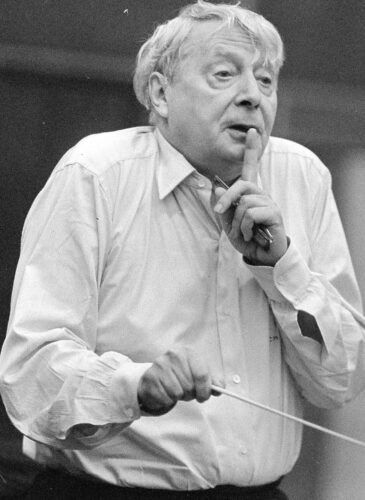
Conductor Charles Munch in 1966. Photo: WikiMedia
What Koussevitzky privately felt is impossible to say. We know from the minutes that when he appeared before the board to resign on March 10, 1948, he fruitlessly “spoke about the choice of his successor, approving the tentative choice of the Trustees if someone were to be engaged from abroad, but advocating that the Trustees seriously consider appointing a young American.” By then, the board had been pursuing Munch since the previous January, when he was conducting in Los Angeles. Certainly Munch represented a sharp break. The Boston Symphony had hired two French conductors — Henri Rabaud and Pierre Monteux — in the wake of World War I. But Koussevitzky had been in charge since 1924. As for Bernstein, he was young, brash, gay, and Jewish — all things Munch was not. Reacting to Munch’s appointment, he sniffed “anti-Semitism.” He also wrote to Koussevitzky: “Everyone in Europe is amazed and upset about Munch coming to Boston. [Otto] Klemperer yesterday was sure it must be a joke!”
For whatever reason, Koussevitzky never confided to Bernstein that the board would not have him. Bernstein was also rejected as a candidate to take over the Rochester Philharmonic, where his homosexuality was a likely issue. In any event, Munch (who was Alsatian) left a different Boston Symphony when he departed in 1962. Though he had gamely programmed American works, he was mainly known as a specialist in French repertoire— and the orchestra’s strings no longer sounded Russian. He had taken over the Tanglewood Music Center, but with nothing like Koussevitzky’s brio and commitment. While remaining a city with a great orchestra, Lukas Foss later wrote, Boston “ceased from one day to the next to be a mecca for young composers, a center of symphonic premieres that made the nation sit up and take notice.”
The magnitude of this abrupt transformation bears stressing. In the world of Russian émigrés to the United States, only George Balanchine achieved anything comparable to Koussevitzky. Balanchine’s New York City Ballet Americanized Russian classical ballet. Balanchine trained a distinctive ensemble, fostered a singular style and repertoire, and cultivated a progressive audience. When it was time for him to retire, the board did whatever it could to serve and preserve his accomplishments. Whether or not Peter Martins was the right person to take over (Balanchine opted not to pick his successor), the intentions of the trustees were never in doubt, and to this day the City Ballet reveres the Balanchine legacy.
What might a Bernstein Boston Symphony have become? Though he publicly vacillated about opting for Boston versus composing, Bernstein could hardly have said no had the position been offered. Though he eventually became a signature New Yorker, his roots were in New England, and Tanglewood was at all times a home to him. With the Philharmonic, he would necessarily undertake a remedial project. When he left after 10 years to dedicate more time to composing, his failure to Americanize the institution was hardly irrelevant.
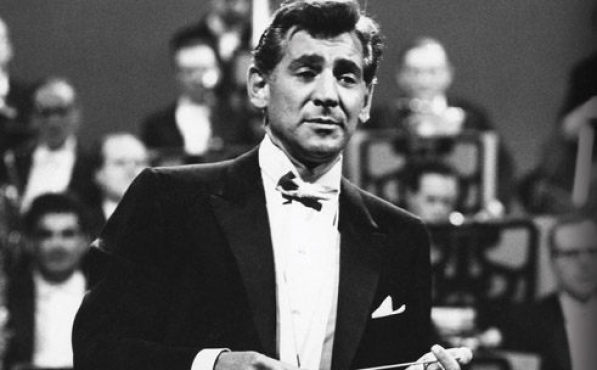
Leonard Bernstein on the 1950s TV program Omnibus. Photo: Wikimedia
If Bernstein in 1949 was not the conductor he would become, the same could be said of Bernstein in 1958 when he took over in New York. His readings of the standard repertoire could sound callow. And if the Philharmonic under Bernstein lacked the finish of George Szell’s Cleveland Orchestra or Fritz Reiner’s Chicago Symphony, in Boston he would have inherited a finished instrument. Charles Munch was no disciplinarian. Michael Steinberg, upon becoming The Boston Globe’s incomparable music critic in 1964, reviewed Munch in his signature piece, Berlioz’s Symphonie fantastique: “He gave it much as he always did, coarse in sonority, frenzied in temper.” (Steinberg’s review provoked a public denunciation from Henry B. Cabot, still president of the BSO.)
In Boston, Leonard Bernstein might have sustained Serge Koussevitzky’s bold adventure — and changed the course of American classical music. Today’s Boston Symphony is adrift.
Joseph Horowitz, author of 14 books dealing with the American musical experience, is most recently the author of two novels: The Marriage: The Mahlers in New York and The Disciple: A Wagnerian Tale of the Gilded Age. He is currently writing a book about Leonard Bernstein and cultural leadership. He is grateful to BSO archivist Bridget Carr for furnishing the correspondence here cited.
Tagged: Andris Nelsons, Boston Symphony Orchestra, Charles Munch
William Trotter’s biography of Mitropoulos, “The Priest of Music,” presents a very unflattering portrait of a very ambitious Bernstein manipulating Koussevitsky to guarantee his appointment in Boston over the favored Mitropoulos. Ultimately Bernstein is “hoisted by his own petard” when he outs Mitropoulos to the homophobic Koussevitsky but is denied Boston by the Board perhaps for the same reason in spite of his lavender marriage to Felicia Montealegre.
Munch’s recorded legacy justifies his eventual appointment. Not just the French repertoire, but Beethoven, Brahms, Schubert, Tchaikovsky et al. And the performances are not overwrought for added effect.
Boston was hardly a better ensemble than the NYPO in the late 40s-esrly 50s….Koussevitsky had made some very questionable appointments, the excellent French flavored woodwinds had been altered, no unanimity in the brass…Munch proved to be no orchestra builder…he didn’t like rehearsing..although he loved spontaneity and excitement, he was not a drill master, disciplinarian….the BSO was in pretty rough shape by the end of his tenure…the BSO needed a Reiner, Monteux or Szell at that time, but all were totally committed elsewhere, and Reiner and Monteux nearing the end of their careers. Leinsdorf was definitely not the man for the job…rough times for BSO…
According to Bernstein, Koussevitzky denigrated Munch as a “frivolous Frenchman”.
IMO, Munch made musical history in Boston, and the recorded record and contemporary accounts seem to confirm that choice.
He (re)shaped the BSO’s sound, successfully advanced modern and French repertoire, and elevated the orchestra’s international profile through recordings and tours. Bernstein was a great musical (and self-promoting) talent, but Munch brought authority and a focused, long-term vision to the BSO; it became recongised as, and still is, one of the world’s best orchestras.
I love Bernstein and Munch, but though Bernstein’s appointment in Boston may have been immediately helpful for him, Bernstein became who he was in part because he was in NYC. There would have been no CBS broadcasts of Young People’s Concerts if he had been in Boston. Also, though musicians came to love Bernstein, and the recording and TV royalties he brought them, his early years with them were rough.
Despite what the people quoted say, the Munch/Boston recorded legacy proves him to have been a major talent, and the criticism he mainly excelled in French repertoire, as much a lie as it was about Monteux.
As far as Nelsons, the way it was handled was awful, but as Horowitz points out when NY followed musicians and hired Maazel and van Zeden, they got indifferent performances and an empty hall.