
Arts Appreciation: Tom Noonan — Remembering the Unforgettable
By Peg Aloi
We’ve lost some fantastic actors in the last few months. Tom Noonan was one of them. He was singularly talented, a commanding presence on stage and screen who leaves behind a remarkable legacy of good work. Seek it out.
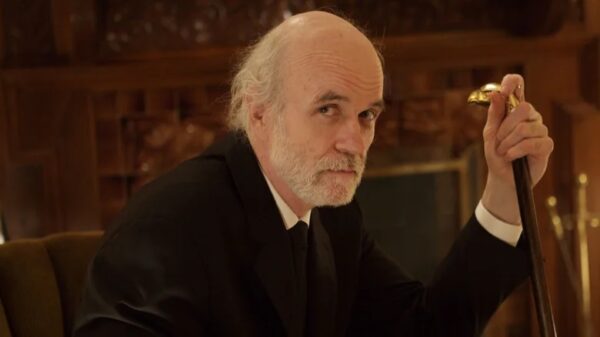
The late Tom Noonan. Photo: MPI Media group
I can’t recall the first time I saw Tom Noonan in a film, but I suppose it must have been Manhunter (1986). He later said it was his first big break, and he did everything wrong. He refused to talk with director Michael Mann after the audition, because he’d been kept waiting for two hours. Mann asked him how he was able to be so scary and Noonan shrugged. Noonan asked for way too much money and got it. His performance as a serial killer who draws from art and literature to defend his fetishistic violence is chilling and unforgettable. This cemented Noonan’s reputation early on as an actor whose presence and demeanor were deeply disturbing. He was tall (6’6”, which is challenging for a film actor given that actors, on average, are about a foot shorter), but his imposing size was not the primary source of his power. It was his eyes. The way he held them steady, unblinking, piercing, catching another character in a lie or challenging you to catch him in one.
I particularly liked his segment in Jim Jarmusch’s Mystery Train (1989): a soft-spoken but creepy guy in a diner who tells a woman he’s never met that he saw the ghost of Elvis. Noonan was best known for playing villains and psychopaths, but his many small, oddball roles were also uniquely memorable — they were inevitably stamped with his patented strangeness, sudden zany humor, and unexpectedly mild manner. He appeared in many TV crime procedurals (like CSI or Law & Order), often as a criminal. He had one short cameo on The X-Files, as a man who very likely did something terrible,and it was electrifying. But Noonan was also effective as a cop. His sharply observant detective in Damages (2007), who interviews suspected murderer William Hurt, subtly but relentlessly puts the guilty man on notice — because he knows he did it but can’t say so. These scenes are well written, but Noonan takes his portrayals to the next level. It is the realm occupied by gifted character actors who steal the limelight from the protagonists because they’ve made their small roles incandescently visible through subtlety and nuance.
Noonan was also a gifted writer and director, and adapted several of his stage plays for the big screen. Two of them in particular, What Happened Was… and The Wife, are well worth seeing. They’re chamber pieces featuring scenes of well-observed human behavior, intimate and achingly real. In 1994’s What Happened Was…, Noonan plays a shy, unremarkable man who goes on a date with an attractive co-worker (Karen Sillas, a fine actress). What unfolds between them is so finely wrought and authentic that it feels like someone turned the camera on two unsuspecting people and just let it run.
Noonan was a New York–based actor and playwright who taught acting at his theater The Paradise Factory in Manhattan’s East Village. The company was founded as the Paradise Theatre in 1983, soon after Noonan graduated from Yale University after studying acting. His brother, John Ford Noonan (who died in 2018 at age 77), was also a playwright: he wrote the acclaimed experimental play A Coupla White Chicks Sitting Around Talking (1981). I walked by The Paradise Factory one day about 20 years ago and saw Noonan’s name and wished, not for the first time, that I had stuck with acting after college. Taking acting classes with Tom Noonan would be the kind of thing any aspiring actor, or indeed a seasoned actor, would leap at the chance to do.
The Paradise Factory Facebook page last posted in December 2024. Noonan himself supplied most of the content and it’s a treasure trove (though, of course, it is rather sad to look at now). Noonan also wrote down some of his thoughts about acting, and they’re fascinating. He said an actor’s job is to be present in the moment. He also thought acting was a talent someone was born with, not something that could be learned. This quote might sum up his all-in approach: There is only one you. Your job as an actor is to be that as much as you possibly can. This can be a very difficult process at times but it is essential. If done with commitment and heart, acting can make you a better person. It is a noble vocation. (from tomnoonan.com)
In The Wife (1995), based on his stage play Wifey, Noonan wrote a great part for himself as a narcissistic New Age guru type. His long-suffering wife (Julia Hagerty) struggles with emotional issues. When a man he has counseled (Wallace Shawn), arrives for an unannounced visit with his wife (Karen Young, who Noonan was married to at the time), the evening becomes increasingly raucous and revelatory. This is a criminally underseen movie (it had a short run at the Harvard Film Archive) and is as brilliantly written, acted, and directed as What Happened Was….
Noonan was widely praised for his compelling performance in Charlie Kaufman’s inimitable opus on mortality, Synechdoche, New York (2008). I saw the film once in the theater, and I found it so intense and upsetting that I have been constitutionally incapable of watching it a second time. But now I want to see it again, because Noonan is so mesmerizing in it. Indeed, Noonan was gifted beyond his superlative skills of acting with his face, body and voice: he embodied characters in all their darkness and light with a mysterious precision that felt almost supernatural.
One of his most widely praised roles was one where Noonan’s face wasn’t even seen: he voiced over a dozen different characters for Charlie Kaufman’s 2015 film Anomalisa (co-directed with Duke Johnson, it won the Grand Jury Prize at the Venice Film Festival). Having Noonan voice all the characters — except the two leads — was a dazzling conceit and he delivers a tour de force of voice acting.
Noonan has no acting credits listed after 2018. He had a recurring role in the TV series 12 Monkeys (2015-18), based on Terry Gilliam’s 1995 film, which was inspired by Chris Marker’s La Jetée. I haven’t watched the series, but I will now. I’m not sure what else to say. We’ve lost some fantastic actors in the last few months. Tom Noonan was one of them. He was singularly talented, a commanding presence on stage and screen who leaves behind a remarkable legacy of good work. Seek it out.
Peg Aloi is a former film critic for the Boston Phoenix and member of the Boston Society of Film Critics, the Critics Choice Awards, and the Alliance for Women Film Journalists. She taught film studies in Boston for over a decade. She has written on film, TV, and culture for web publications like Time, Vice, Polygon, Bustle, Dread Central, Mic, Orlando Weekly, Refinery29, and Bloody Disgusting. Her blog “The Witching Hour” can be found on substack.
What a wonderful, heartfelt, comprehensive memorial to Noonan. I’ve read a bunch of Noonan obits in the last days and this is BY FAR the best. Congratulations, Peg, on such a splendid piece.