
Theater Commentary: Live Theater—An Incomparable Art Form
By Alexis Greene
Protecting live theater, along with the other arts that the NEA has supported, is urgent, and it begins, as it did with me, by loving theater, either as a regular member of the audience or as someone onstage or behind the scenes.
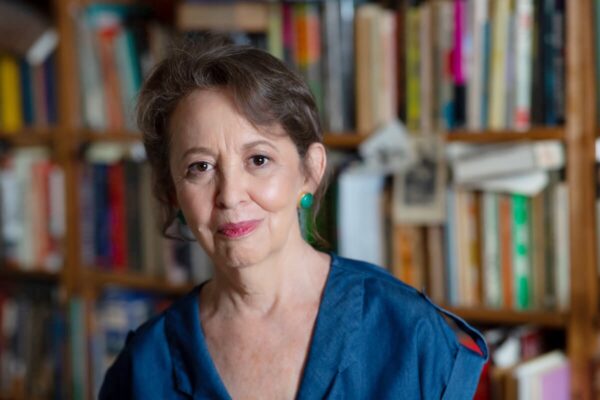
Writer and editor of numerous books about theater, Alexis Greene. Photo: courtesy of the artist
I fell in love with theater when I was nine years old. I was growing up in New York City, and in the fall of 1954, friends of my mother took me to see the Broadway musical Peter Pan, starring Mary Martin as Peter and Cyril Ritchard as the villainous Captain Hook. It was the first time I’d ever been inside a theater, and I loved where we were sitting: in a box on the right side of the magnificent Winter Garden Theatre. I loved the show, and I especially adored Margalo Gillmore, who played Mrs. Darling, the loving mother of the children whom Peter Pan invites to fly with him to Neverland. I was entranced by the gowns that Mrs. Darling wore—I wanted to be an actress.
I acted in productions in high school and college, at Vassar, where I majored in theater. The head of Vassar’s Experimental Theater, William F. Rothwell, Jr., was inspiring, and he believed I was an excellent young character actress. My favorite role was when Rothwell cast me as 13-year-old Willie in This Property Is Condemned, and I remember walking barefoot on the stage, talking to myself and the audience about my deceased older sister. The role was a gift.
After graduating, I was cast in a couple of Off-Broadway productions. But the craft of acting did not love me the way I loved it, so I went back to school to write my Ph.D. dissertation on Off-Off-Broadway theater, and subsequently taught theater at New York University and Hunter College. I became enamored of dramaturgy and cofounded Literary Managers and Dramaturgs of America (now Literary Managers and Dramaturgs of the Americas), and I helped to make live theater as the Literary Manager at the George Street Playhouse in New Brunswick, New Jersey. I traveled the Eastern U.S. for the National Endowment for the Arts (NEA), doing site visits.
Eventually, I found my true calling: writing and editing books about theater companies and theater artists, especially women. All of these vocations intensified my love for live theater.
When I go to the theater and watch a play or a musical, or simply listen to actors reading a play, I often experience a range of emotions roused by the script and the performances: love and anger; pity and sorrow; desire and pleasure. I learn about myself, and I also learn about people who live in the world around me. When I see Shakespeare’s Romeo and Juliet, I relive my own true love. Lorraine Hansberry’s A Raisin in the Sun—in 1959 the first play by a Black woman to be produced on Broadway—taught me about the hatred and fear that African Americans endure in America. For me, it was, and remains, a frightening yet enlightening revelation.
I imagine that when theater began in the Western world—in ancient Greece—audiences watching the plays of Sophocles, Euripides, Aeschylus, and Aristophanes felt the same emotions and experienced the same kinds of awareness as we do today. Indeed, the mostly male audiences reportedly became so involved that sometimes, if they didn’t like what they saw and heard, they threw things at the stage. Women, unfortunately, were usually excluded from these performances in ancient Greece, both from the audiences and as performers.
Live theater continued to grow and thrive in Europe and then in North and South America.
Theater, opera, and dance also came to life in the Far East. Opera emerged in China, and Noh and Kyogen plays developed in Japan. Performances, which often merged music and song, dance and mime, sometimes continued for hours, and audiences stayed and watched, munched food, and talked about what they were seeing.
As the world has changed over the centuries, theater has evolved. Slavery was still rampant in America in the nineteenth century, but as the theater historian Oscar G. Brockett writes, in 1821 there arose in New York City the first known company of African American actors in the United States, performing at the African Grove, an outdoor tea garden, and eventually at an indoor theater. Along with Shakespeare’s plays, they performed what was perhaps the first known play written by a Black man in America: The Drama of King Shotaway.
Women also began to receive attention on America’s stages, and in 1840 Anna Cora Mowatt wrote what became a frequently produced comedy of manners: Fashion. As Joel Hirschhorn told Variety in 2008, “She defied male contempt for femme authors, a species Nathaniel Hawthorne defined at the time as a ‘damned mob of scribbling women.’”
During the 19th century, New York City became a theatrical center, with commercial theaters lining Broadway, and early in the twentieth century Times Square became commercial theater’s most famous location, with a bevy of impressive stages.
But also in the early twentieth century, here in the U.S., the Little Theatre Movement brought to life intimate, independent theaters that in effect challenged Broadway’s commercial ambitions and brought forth new playwrights, most notably Eugene O’Neill. Then, in the 1960s, nonprofit regional theaters, funded by the NEA, began to bloom throughout the United States. And as our country passed new laws recognizing and affirming the rights of women and people of color, more and more women and people of color wrote plays and saw them produced: playwrights like Constance Congdon and Eve Ensler, Pearl Cleage and Tina Howe, Lynn Nottage and Emily Mann, Migdalia Cruz and Beth Henley, Rukhsana Ahmad and Diana Son. Directors also explored so-called “nontraditional” casting in classical plays.
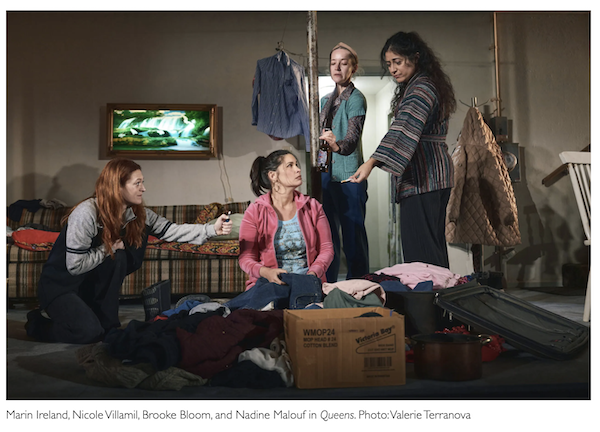
The best plays often reflect the world we are living in. In December 2025, for instance, I saw Martyna Majok’s Queens at Manhattan Theatre Club (MTC). The title might suggest a play that extols women, and the play does do that. But the title actually refers to the borough of Queens in New York City, where a group of immigrant women are living together in a basement apartment. Majok wrote her play in 2018, but she revisited the script for the 2025 production, and we naturally connect the images, the characters, and their situations to the issue of immigration that our current President has brought to the fore with calamitous and tragic consequences.
Our country is a country of immigrants, beginning with those who sailed to this land in the sixteenth and seventeenth centuries. People from practically every country in the world have moved here since. My own grandparents—my mother’s parents—came from Eastern Europe to Dorchester, Massachusetts, in the late nineteenth and early twentieth centuries, and made relatively pleasant and successful lives for themselves there.
The undocumented women in Queens, who live together in an illegal dwelling, are Belarusian, Afghan, Honduran, and Polish. The play particularly involves a young Ukrainian woman named Inna (played beautifully at MTC by Julia Lester). She has come to America looking for her mother, who abandoned Inna and came to America when she was a child. Indeed, as we watch the production and absorb the play, we realize that the women in Majok’s play have come to America because of the deprivation they faced in their home countries. But here in America they are striving to find safe, comforting, and sustaining existences.
The play and this production evoked in me what the best of live theater gives us. It stirs our emotions, awakens memories, and leads us to contemplate what the world around us is like. In the case of Queens, many in the audience and I could not help but connect the play’s content to how America’s current President and administration are treating immigrants—reviling and deporting them.
Because live theater is such a penetrating and unique experience, those of us who have been following the news are especially disheartened by the threats to the National Endowment for the Arts (NEA), which significantly supports nonprofit theaters like MTC. As Nathan Pugh wrote aptly in a Fall 2025 essay for American Theatre, “A political takeover of the arts is more than just symbolic; it’s indicative of a very real takeover of American thought and imagination.” Our current President’s 2026 federal budget proposal would eliminate the NEA, and in May 2025, the agency began slashing hundreds of grants that had already been awarded, including many to theater organizations. Among other new reasons for cuts were rules against funding a theater company that promoted diversity, equity, and inclusion (DEI).
Anne Hamburger, founder and artistic director of En Garde Arts in New York City, wrote to the En Garde Arts community soon after the NEA revoked a $40,000 grant that En Garde Arts had previously been awarded:
To say we’re disappointed is an understatement. En Garde Arts as an organization will survive. But our artists are at risk. As federal arts funding is slashed, the first to suffer are the bold, untested, and extraordinary new voices…. En Garde Arts is launching a campaign to say clearly, loudly, and in no uncertain terms: Art is Not Expendable.
The NEA was established by Congress in 1965, when Lyndon B. Johnson was President. In addition to theater, the NEA supports dance, music, visual arts, literary arts, media arts, folk and traditional arts, and design. President Johnson encouraged the House and Senate to establish both the National Endowment for the Arts and the National Endowment for the Humanities, and when he signed the NEA into existence sixty years ago, on September 29, 1965, he said, “Art is a nation’s most precious heritage. For it is in our works of art that we reveal to ourselves, and to others, the inner vision which guides us as a nation. And where there is no vision, the people perish.”
The NEA has not been eliminated, but hundreds of grants and offers of grants to arts organizations have been. On top of that, the NEA’s future is uncertain.
Protecting live theater, along with the other arts that the NEA has supported, is urgent, and it begins, as it did with me, by loving theater—either as a regular member of the audience or as someone onstage or behind the scenes. The Los Angeles–based playwright Larissa FastHorse put it beautifully in the Winter 2025 issue of American Theatre: “You wanna remember why you do theatre? Do a show full of audiences who have never been to theatre before. Hearing gasps and cheers at the magic of theatre—it’s incredible and addictive.”
Those are words I will remember as I go forth, contemplating a lifetime of theater experiences I have enjoyed.
ALEXIS GREENE is a writer and editor of numerous books about theater, including The Lion King: Pride Rock on Broadway, written with Julie Taymor (Disney Editions, 1998); Lucille Lortel: The Queen of Off Broadway (Limelight Editions, 2004); Emily Mann: Rebel Artist of the American Theater (Applause Books, 2019); and Shakespeare Theatre Company: The History of a Classical Theater (Peter E. Randall Publishers, 2025). In addition to writing books about theater, Greene’s career spans acting, theater criticism, and teaching (she holds a PhD from the Graduate Center of the City University of New York). She is a member of Biographers International Organization, PEN, the Authors Guild, and League of Professional Theatre Women. She is a client of the literary agency Philip Turner Book Productions. Born and raised in New York City, Greene lives there with her husband, Gordon Hough.
1 Comment
Leave a Comment

Lovely essay. A personal note on Margalo Gilmore and that production of Peter Pan. My mother was her couturiere and Margalo took my brother and me onstage afterwards and sprinkled us with fairy dust. I can still sing the whole score and of course we spent days trying to fly off our double decker bed! After that experience I was hooked on theater.