
Book Review: When the Muse Misbehaves — The Absurd Charm of Yun Ko-eun’s “Art on Fire”
By Peter Walsh
Yun Ko-eun’s novel is a good, entertaining read that proceeds by a kind of literary Zeno’s Paradox: forever on the verge of some Big Revelation or vague Deeper Meaning without ever actually reaching them.
Art on Fire by Yun Ko-eun. Translated by Lizzie Buehle. Scribe Publications, 256 pages, $20 (paperback)
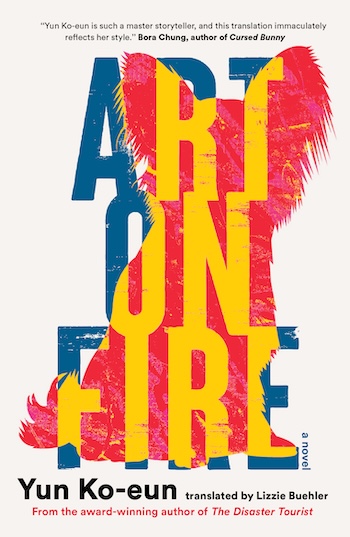 Korean painter An Yiji’s career is at a make-or-break point. She’s closing in on forty; the important art prize she won after college lies years in the past; her art school for children has failed; one by one, her artist friends are settling into their former day jobs as permanent careers; and she moves from place to place in a failed search for affordable housing. To top it all off, her delivery order from Shake Shack for her current employer, the delivery app Bballi, has just received the lowest possible rating from a customer. Then the Robert Foundation calls.
Well-funded and prestigious, the foundation is offering An a four-month, all-expense-paid residency at the Robert Foundation headquarters in the city of Q, somewhere near Palm Springs, California. The residency will include travel, a comfortable room, all meals, and a capacious studio. An $8,000 stipend will be paid in weekly installments. The residency will conclude with a solo exhibition at the Robert Museum of all the work she has completed during her time there. It will be followed by an odd ritual, involving a pizza oven, that all the artists in the program have participated in. These artists, most of them now successful and famous, describe the Robert residency as “seed money, a ladder that had helped them climb down from the edge of a cliff, a turning point, divine intervention, winning the lottery…” An is the first Korean artist to be so honored. How can she turn it down?
It turns out there are a few wrinkles. First of all, the foundation, lavishly funded by a stationery tycoon, now deceased, is run by a precocious, formerly stray, small dog named Robert, whom a pet shelter might describe as a “Papillon mix.” Robert communicates with his subordinates via a mysterious black box and a string of human interpreters ending with a Korean-English translator, who makes hilarious mistakes. Robert, whom An finds to be touchy and quite arrogant — at least in his notes to her — will make the major decisions about her residency.
An arrives in Los Angeles in the midst of encircling wildfires. (These closely resemble the LA wildfires of early 2025, but the novel was first published in Korea in 2023.) The agent she expects to meet her at the airport and drive her to the foundation fails to appear. She has misplaced her credit card so she is forced to check into a downmarket hotel that accepts cash. Days pass while she attempts, without success, to make travel arrangements with the Foundation. Meanwhile, the wildfires continue to burn. The airport has been closed. An eventually hitches a ride to Q with a Korean actor she meets, who is driving to Las Vegas for an important audition.
The cover copy of the novel I am summarizing—Art on Fire, by the Korean novelist Yun Ko-eun— describes it as “a darkly comic and compelling satire of the art world.” I’m not so sure. For one thing, the so-called art world is one of those small, hermetically sealed, largely opaque, and self-referential coteries that defy satire (let me tell you about the distinguished senior art museum curator I once worked with, who painted black dots on the white sneakers he habitually wore to work in honor of his new Dalmatian). Darkly comic the novel is for sure, but its deadpan tone and narrative strategy reminds me of those of the late postmodernist, Paul Auster, whose ironic story lines are propelled, not by murder, drama, or romance, but a peculiar series of events, underlaid with a vague sense of unease. Like Auster’s, Yun’s book is a good, entertaining read that proceeds by a kind of literary Zeno’s Paradox: forever on the verge of some Big Revelation or vague Deeper Meaning without ever actually reaching them.
Yun’s grasp of contemporary American culture is spot on. She is familiar with some of the newer American art parks, rural museums, and artists’ colonies, as well as their eccentric traditions. Her Robert Foundation is a posh paradise of elegantly landscaped grounds, cutting edge architecture, attentive though insecure staff, and luxurious perks (An is given a Lamborghini to use during her stay), and multi-course dinners with Robert. Even the harsh, blast furnace weather is somehow softened in the Foundation’s compound, and the ever-present wildfires are always kept at bay. Only frequent visits from citizens of Q (it’s never quite clear if this is the city’s real name or the old school practice of giving real locations in fiction pseudonyms of their first initial) and Song Yung, the Korean actor, interrupt An’s isolation. The inquisitive Q citizens are so numerous, though, that An refers to them by number.
Yun peppers her pages with indirect references to real-world art events—the use of animal excrement in easel painting, for example, and the decay of Damien Hirst’s embalmed animal sculptures. But her protagonist’s monologue, ever amusing, eventually meanders into not particularly insightful sidebars. Towards the end, the plot twists, which rapidly unravel the foundation’s mythos, pile on so quickly it’s as if Yun is afraid of running through her paper ration. Her characters, with the exception of An, are never etched more deeply than is necessary. Yun has laid out an amusing journey to be sure; I just wish it had finished up in a more interesting place.
Peter Walsh has worked as a staff member or consultant to such museums as the Harvard Art Museums, the Museum of Fine Arts, Boston, the Davis Museum at Wellesley College, The Metropolitan Museum of Art, the National Gallery of Art, and the Boston Athenaeum. He has published in American and European newspapers, journals, and in scholarly anthologies and has lectured at MIT, in New York, Milan, London, Los Angeles, and many other venues. In recent years, he began a career as an actor and has since worked on more than 100 projects, including theater, national television, and award-winning films. He is completing a novel set in the 1960s.