
February Short Fuses — Materia Critica
Each month, our arts critics — music, book, theater, dance, television, film, and visual arts — fire off a few brief reviews.
Books
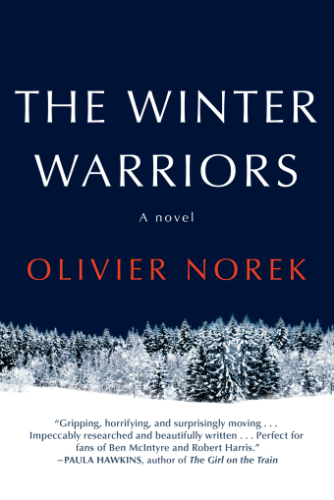
Russia’s invasion of Ukraine four years ago followed a pattern of behavior already established in 1939, when the USSR took a shot at its vulnerable neighbor, Finland. The subsequent “Winter War” proved initially disastrous for the Soviets. The under-equipped and out-manned Finnish forces stopped the Soviet forces cold, thanks largely to legendary figures suchas Simo Häyhä, the so-called “White Death” and hero of French author Olivier Norek’s engaging, uneven, and all too timely The Winter Warriors (translated from the French by Nick Caistor). Norek, a former police officer and veteran crime fiction author, brings the crackling pace of pulp fiction at its best to this incredible true tale. Unfortunately, at times he succumbs to the genre’s weaknesses for cliches and stereotypes.
Both tendencies are at work in his portrayal of Häyhä, a simple farm boy who enlisted when the Soviets invaded and ended up as a legendary sniper who would kill over 500 enemy soldiers. A kind of Finnish Sergeant York, he put aside his reservations about taking human life and did his duty and then some, achieving legendary status as he and his comrades, like Ukrainians over 80 years later, shocked the cocksure Soviet military with their lethal resistance.
Indeed, the parallels to the current conflict are uncanny. A Soviet general involved in plotting the treacherous assault advises Stalin that “ten days will suffice” to crush the Finnish forces. There is also a link with Russia’s strategy for attacking civilians: “While their soldiers are at the front,” the general says, “we will bombard their cities they have left unprotected, their houses, their women and children.” The Finns’ allies also prove unreliable, as French and British promises of aid melt away much like that of the US support for Ukraine under the current administration.
As for examining the psychology of an ordinary, decent man who methodically kills hundreds in defense of his country, Norek doesn’t offer much insight. His Häyhä comes off as a mythic warrior — his legacy is epic but without much depth. The protagonist’s ruthless, drunken, and reckless commanding officer, Aarne Juutilainen, proves more intriguing; unlike Häyhä, he lusts for combat and proves equally expert at the task. Perhaps it takes both types to win a war.
— Peter Keough
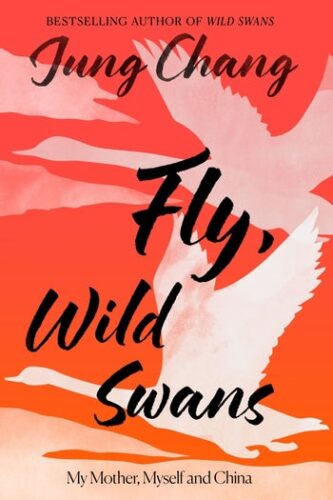 I was looking forward to reading this new memoir, 35 years after its author, Jung Chang, published her stunning Wild Swans: Three Daughters of China. It was one of the first intergenerational maternal histories to be published as nonfiction. The book was enthusiastically reviewed, sold 15 million copies, and was translated into 37 languages. It was banned in China.
Wild Swans inspired other women’s cultural memoirs, including my own Where She Came From: A Daughter’s Search for her Mother’s History, because it focused on a family history within an evolving national and cultural context. Wild Swans follows the lives of three women: Chang’s grandmother, born in 1909, a concubine to a warlord, her feet were bound and she lived to see the Communist take-over; Chang’s mother, born in 1931, became a member of the Chinese Communist Party, a spy, and a party official during The Great Leap Forward; and the author, born in 1952, a Red Guard during the Cultural Revolution, who later became one of the first Chinese students able to study in the UK in 1978, when she was 26 years old.
Fly Wild Swans: My Mother, Myself, and China is disappointing both in content and style. Chang is constrained both by Chinese censorship and her idealization of her mother, whom she is prevented from visiting — even as she is dying. The first memoir was based on 60 hours of audiotapes that her mother recorded when she visited London and was reluctant to venture outside alone. The sequel is largely a hagiography of Chang’s mother whose safety depended — and continues to depend — on her daughter’s discretion. This caution would impose a major constraint on any writer, and it contributes to an often tedious narrative. The vigilance extends to Chang’s descriptions of her relationships with her friends, siblings, and husbands: these include a Singaporean pianist, an Anglo-Irish author with whom Chang co-wrote Mao: The Unknown Story and, above all, with her mother. Given the dramatic subject matter, the writing is pedestrian. I’m sorry to say this, but skip Fly Wild Swans and read or reread Chang’s first memoir.
— Helen Epstein has been reviewing for the Arts Fuse since its inception.
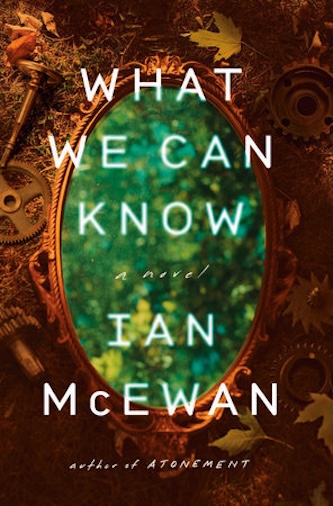 British novelist Ian McEwan followed his early dark wonder, The Cement Garden, with over a dozen successful novels, including Atonement and Amsterdam, along with plays, screenplays, a Booker, and ranking by The Daily Telegraph as “number 19 among the most powerful people in British culture.” (How precise.)
Born in 1948, raised as what we Yanks would call an Army brat in the outposts of Empire—a lucky start for a writer—McEwan is nearing his eighties. Some prolific writers weaken in their later years, like tea in a watered-down pot. Others seem to gain in intensity, as if the teabags have been left to steep for, well, decades.
With a strong cuppa beside me, convalescing from flu and 2025’s glut of YA marketed as adult lit, I opened this much-praised novel, What We Can Know, like a gift I was sure to love.
It’s the year 2119. Mild-mannered lit professor Tom Metcalfe boards a ramshackle ferry, the only way of getting round in the archipelago called, before the climate catastrophe and sea-rise, Great Britain. (Europe is inundated. Nigeria rules the internet and the US has sunk into gangsterism.) Tom is on a life-consuming quest: to find the lost sole copy of a poem penned in 2014 by Francis Blundy, a genius second only to Seamus Heaney.
See me rubbing my hands as I turn these early pages. What surer plot device than a good McGuffin, this masterpiece read once aloud to a birthday party for its dedicatee, Blundy’s wife. Whose journals Tom studies. And who fascinates him, while he carries on in the lusty here and now with colleague Rose.
The title, a quote, refers to the slipperiness of the biographer’s quarry. McEwan’s eighteenth novel bristles with Themes: environmental change and loss, bullying men (no change there), the dwarfing of arts by science, plus smart armchair philosophy and literary opinionating.
But my excitement hit a mid-book sag. The climate change backstory is sketchy, not well-informed. McEwan’s trademark taut plotting delivers turns and twists, with deceit, often self-deception, as the hidden name of the game. But effective plot requires credibility, and even some caring. The McGuffin doesn’t hold up. Why, even in our time, would factions fight rabidly over a single lost poem? Meanwhile, the characters, even when behaving badly, remain flattish, familiar, elite Brits of the early twenty-first century. I didn’t believe. Didn’t much care. But enjoyed the fine writing.
We know who we are, we superannuated lovers of literature. And McEwan mourns us and himself in advance, and imagines a safe nook of survival, in England, of course. His novel is a cry of nostalgia foretold, a paean to Tom’s favorite era. Its excesses, its partygoing, its boisterous, risk-taking, hope for the best.
— Kai Maristed
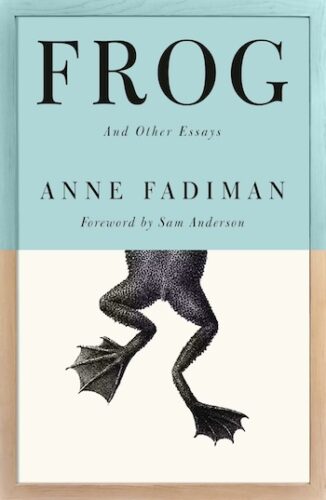 In her latest collection of personal essays, Frog, Anne Fadiman (author of Ex Libris: Confessions of a Common Reader and At Large and At Small: Familiar Essays) displays sleek dexterity galore, excelling at agile gearshifting over a hodgepodge of subjects.
Some are narrowly domestic: the amusing life and fate of Bunky, an African clawed frog the family raised from a tadpole who lived for nearly 17 years in an uncomfortably undersized aquarium, and a chronicle of Fadiman’s unstinting love for a printer as it becomes increasingly antique. Others maneuver through the scholarly: a sympathetic homage to the hapless but accomplished Hartley Coleridge, son of his problematic dad, Samuel Taylor Coleridge, and a rundown of the “South Polar Times,” a very limited-circulation magazine (which included hand-drawn illustrations) published by and for the participants in Robert Falcon Scott’s two major British expeditions to Antarctica at the turn of the 20th century, culminating in his 1910–13 Terra Nova expedition to the South Pole.
And there are the in-between essays: a wryly comic but thoughtful examination in “All My Pronouns” of the use of the pronoun “they”; a rundown of the challenge of having to learn Zoom in a jiffy after Covid hit (Fadiman is a Professor in the Practice of English and the Francis Writer in Residence at Yale University) and, in “Yes to Everything,” an affecting tribute to her precocious student Marina Keegan, a marvel of a writer who was killed in a car accident at the age of 22.
The volume’s sentences clock in with rhythmic precision, paced by a sophisticated sensibility driven by curiosity, affability, and wide-ranging sympathy. Still, Frog‘s hops fall short. What’s missing here is what William Hazlitt demands, somewhat impossibly, of the “animated prose” of a first-rate essayist: that “every word should be a blow: every thought should instantly grapple with its fellow.” Fadiman is unfailingly smooth, elegant, and empathetic — which rules out fisticuffs.
— Bill Marx
Popular Music
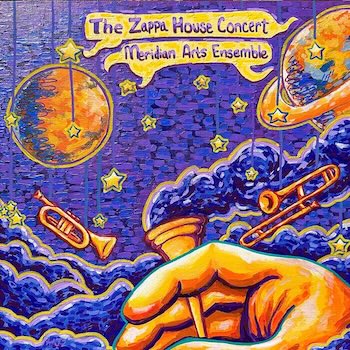
The cover image: a 2025 painting by Hailey Johnson, a horn student at University of Wisconsin – Madison
In 1987, music students in New York City formed the Meridian Arts Ensemble (MAE). Its members were creative omnivores whose passions ranged from the Renaissance to the present. In 1990 they began to explore arrangements of Frank Zappa’s music.
The Zappa House Concert, MAE’s latest release, captures a live performance at the Zappa family residence in Los Angeles in 1996, hosted by Frank’s widow Gail. The ensemble had played there twice before: in March 1993, when Zappa agreed to give feedback on how they performed his compositions; and the following November, when they returned to demonstrate their progress to him. A few weeks later Zappa died from prostate cancer.
The 1996 private concert included seventeen compositions, the last seven by Zappa. It begins with a flourish of Baroque classicism: a Domenico Scarlatti sonata originally performed on the harpsichord, now transmuted into rich brass polyphony. Next comes “Zen Monkey,” a wistful, intricately patterned work by MAE’s horn player Daniel Grabois. In “Vroom,” the group infuses the post-progressive instrumental by King Crimson with a sense of urban menace worthy of a film noir soundtrack. Excellent Latin music, including the mambo classic “Mango del Monte,” is also in the mix.
The set of Zappa compositions begin with “Lumpy Gravy,” a madcap number that sounds as if it is longing to be a goofy TV theme song. “Marqueson’s Chicken” is speedy and complicated, while “King Kong – That’s Not Really Reggae” sets forth a languorous groove that moves into a dreamy drifting midsection. Zappa’s 1966 “Hungry Freaks, Daddy” – his recognition of L.A.’s “freak” subculture as “the left-behinds of the Great Society” – receives a smoking-hot interpretation, with the trombone player singing the lyrics. Last up is a slouching, rakishly unstoppable arrangement of “The Black Page.”
It is clear that personal encounters with Zappa galvanized the musicians’ sense of purpose. By 1996, they had absorbed his palpably exciting performance style and his radical eclecticism. There’s a poignant introduction on this release: a 33-second clip from a June 1993 radio broadcast in which Zappa applauded MAE’s “wonderful intonation” and “excellent rhythm.”
— Trevor Fairbrother
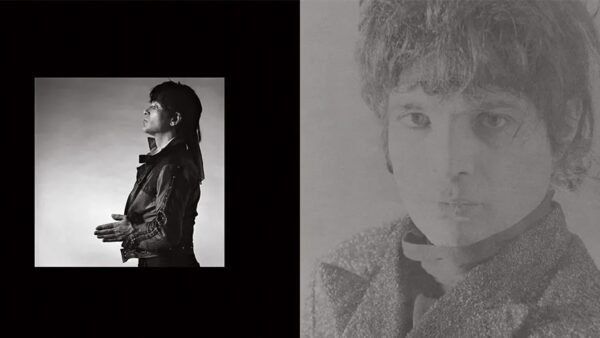
Suicide singer Alan Vega’s solo albums have existed in the shadow of his iconic synth-punk band. New reissues of his first two discs, 1980’s Alan Vega (with a bonus album of demos) and 1981’s Collision Drive (both on Sacred Bones), should remedy that. The self-titled album is a variation on Suicide’s minimalism, trading in the synthesizer for guitarist Phil Hawk’s rockabilly twang. Elvis had always been an influence on Vega’s voice, which is prone to vibrato, small moans, and exclamations. These recordings show that he provided the rock ’n’ roll grounding in Suicide, the yin to keyboardist Martin Rev’s electronic yang.
Throughout Alan Vega, simple guitar riffs snake around hand claps. Vega’s production integrates a drum machine with live percussion, including finger snaps. “Jukebox Babe,” a hit in France, is the most successful at converting Suicide’s ethos into guitar-based music. These songs are set in the recent American past, not far from the world of Suicide fan Bruce Springsteen.
On Collision Drive, where he’s backed by a full band, Vega goes further in transforming ‘50s rock ’n’ roll into an art project. He sings “doo-wop-a-bop” as the chorus of “Magdalena 82,” a small step from his cover of Gene Vincent’s “Be-Bop-A-Lula.” This album offers more varied fare, including the heavy blues-rock of “Outlaw,” the slow, agitated “I Believe,” and the grimy 13-minute dirge “Viet Vet.”
Alan Vega and Collision Drive don’t deserve to languish in obscurity, but they fall short of the heights of Suicide’s first two albums.
If there’s a defect here, it’s Vega’s distance from the wildness of his influences. When he mumbles about being a rock ’n’ roll rebel, it sounds as if he’s merely acting, while his re-recording of Suicide’s “Ghost Rider” tames the original. Still, a singular poetic vision, spotlighting a journey through the troubled backwaters of America, runs through all this music.
— Steve Erickson
The cover art of Ye Vagabonds’ All Tied Together.
On their fourth album, All Tied Together (River Lea), Ye Vagabonds perform a devoutly urban version of Irish folk music. (The group consists of brothers Diarmuid and Brian McGloinn, who both sing and play guitar.) The new recording affirms their music’s capability to evoke an image of a place. As Diarmuid attests, “all these songs have addresses…they’re about specific locations and people.”
While some recent Irish folk musicians (such as the scene’s most popular band, Lankum) have turned toward harsh drones, All Tied Together is quite tuneful and accessible.
Recorded live in a house, with the assistance of other musicians, the mix pushes clean vocals and acoustic guitars to the fore. The McGloinn brothers harmonize beautifully. At times, fainter, more vaporous sounds hover in the background, such as in the tune “Gravity.”
“On Sitric Road” gets All Tied Together off to a rousing start. The lyrics recall nights spent hanging out with drag queens and singing John Prine songs on one of Dublin’s main streets. (The video for the tune was shot around the street; it includes footage of the band performing at Dublin’s The Lilliput Press, an independent publisher). The bohemian arts scene the track describes is vanishing, pushed aside in a neighborhood that has become increasingly gentrified.
Most of All Tied Together relates stories about the lives that progress — and expensive real estate — leave behind. Certain lyrics (like “I thought nothing was that hard to lose/If only I knew,” from “On Sitric Road,” or “I’ll keep singing after you’ve gone”) might be addressed to the city of Dublin itself. “Danny” is an elegy for a long-gone friend who became a drug dealer.
Ye Vagabonds’ earlier albums adapted traditional songs with Gaelic lyrics. The Anglophone All Tied Together is likely to reach a wider international audience, It never pretends to speak about life centuries ago – the recording engages with a history of Ireland that’s still in rapid flux.
— Steve Erickson
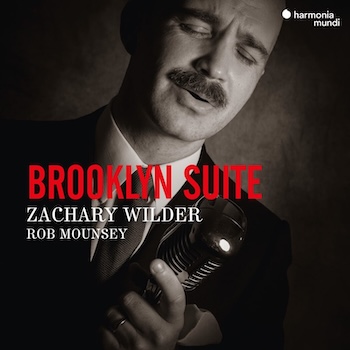
“Serious fun” could be the title of this new album featuring the world-renowned light tenor Zachary Wilder. Best known for his many recordings of music from the sixteenth to eighteenth centuries, in Brooklyn Suite the singer taps into his own family’s traditions of music-making, plus some of his own particular fascinations, all assisted by an alert small orchestra or at times a few jazz musicians (e.g., bassist David Finck).
Wilder’s voice is particularly sweet, solid, and plangent in its upper register, and he sings in multiple languages faultlessly and with keen intelligence.
Wilder has gathered together a cornucopia of songs, mostly from across the twentieth century. He juxtaposes a well-known Schubert song with a Yiddish one whose words likewise evoke a young man by the side of a brook, and he pairs two popular songs about being friends (by Kay Swift and by Paul James). We hear a touching art song by the ever-remarkable Amy Beach, a devastating ballad about love in a time of turmoil by Marc Blitzstein, and a yearning anthem from the musical Man of La Mancha (“To Each His Dulcinea”) that was unconscionably removed from the filmed version starring Peter O’Toole.
Wilder seems a bit of a show-off: he sings, with panache, the tricky right-hand part of Zez Confrey’s novelty-piano number “Dizzy Fingers.” And he offers a tribute to his late grandmother by letting us hear her 1951 on-air recording of a Mozart recitative (made when she was a well-trained voice student at Juilliard), leading into his own recording of a short aria from a different Mozart opera (La Clemenza di Tito). I couldn’t help but reflect on what the music world lost when Renee Weiner—with her exquisite command of vibrato and phrasing—gave up a singing career. But I hope she lived long enough to hear her remarkable, imaginative, and enterprising grandson.
— Ralph P. Locke
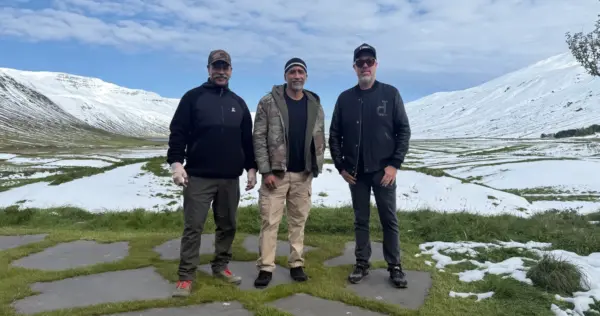
Soulive (left to right: Neal Evans, Alan Evans, Eric Krasno) in Iceland, 2025. Photo: Kim Evans
In 2003, the funk trio Soulive, released a live album that not only caught my attention, but sustained my excitement. But there was no follow up of the same quality — the band drifted off into obscurity, at least to me. I sighted the group’s guitarist, Eric Krasno, when he produced, composed, and played guitar on Aaron Neville’s record Apache (2016). Now, Soulive’s original members, Neal Evans on keyboards, drummer Alan Evans, and electric guitarist Krasno, have reunited to make their first full length record in 11 years — and it sounds like old times. They play some mean funk on their new album, Flowers.
The record kicks off with a couple of tracks that burn from the get-go, “XL” and “Baby Jupiter” The single, “Flowers At Your Feet,” features the singing of guest Van Hunt and it departs from funk genre, delving into some mellow sounds and unusual lyrics. The tune is dedicated to Brian Wilson, Sly Stone, and D’Angelo, who all recently passed away.
The middle section of the record contains some of the freshest funk I have heard in years, beginning with “3 Kings,” a stone cold blues/funk mover and shaker. “East Side” slows the tempo down — it is the closest approach on the album to a ballad. On “Busher,” drummer Evans displays his versatility, shifting the tempo up and down and all around. “Butter Rock” is reminiscent of an early tune from The Meters, and it is beautifully executed. Krasno’s guitar and Evans’ deft organ fills drive the throw-back blues/rocker “Vines.”
Unfortunately, Soulive runs out of steam after that track — the final two tunes, the art rocker “Pikes Place” and the slow jam “Window Weather,” are tedious let downs. Still, 80% of Flowers is fresh. Congratulations E. Krasno, A. Evans, and N. Evans — welcome back.
— Brooks Geiken
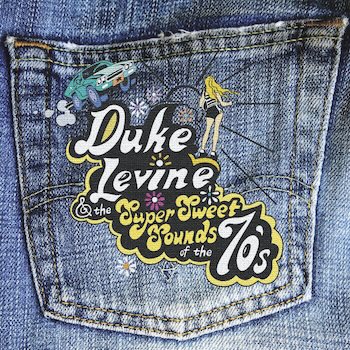
Anybody who’s caught Duke Levine & the Super Sweet Sounds of the ’70s live at Cambridge’s Lizard Lounge (when guitarist Levine isn’t on tour with Peter Wolf or Bonnie Raitt) knows how that vintage-covers crew bends the ear with broad nostalgic echoes. Now Levine has captured several of their diverse instrumental tunes in the studio for a digital release on Bandcamp, CD, and eight-track tape. That’s right, eight-track, and he’s actually sold some of that limited batch.
Levine and his guitar partner Kevin Barry also perform regularly with the more experimental, Moroccan-steeped dub/fusion collective Club d’elf, whose bassist-leader Mike Rivard, drummer Dean Johnson, and keyboardist Paul Schultheis round out Super Sweet Sounds with percussionist Yahuba Garcia-Torres.
But the Super Sweet band’s most adventurous turn on record is a largely acoustic, textural groove through Traffic’s “John Barleycorn Must Die” (augmented by Darol Anger on fiddle and mandola) and a d’elf-like embellishment of Paul McCartney’s “Ram On.” King Crimson’s “In the Court of the Crimson King” also unfolds with a majestic ebb and flow, from an atmospheric setup to its drum- and bass-boosted swells, both laced with the record’s secret weapon: Barry’s mournful lap steel.
Levine and Barry’s biting guitar blend and Schultheis’ sumptuous organ work help Elton John’s “Border Song” cross into intriguing territory and Steely Dan’s “Night by Night” gets a creative mashup with Barry White’s “I’m Gonna Love You Just a Little Bit More Baby.” Super Sweet Sounds’ instrumental treatments inch closer to easy-listening space in an oddly synth-wrapped take on the Band’s “Whispering Pines” and an impressionistic version of Neil Young’s “Only Love Can Break Your Heart” that stretches with deceptive depth. This isn’t elevator music. Merely a drop into earthy, modern arrangements of faves from a musically rich decade.
–Paul Robicheau
Jazz
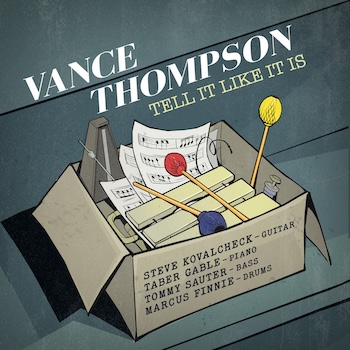 Jazz vibraphonists are having a renaissance right now. Players like Patricia Brennan, Joel Ross, and Warren Wolf are at the forefront of jazz, pushing the music forward. Vibraphonist Vance Thompson isn’t one of them, but he put out a worthwhile album anyway.
While the progressive vibe players are building on the complex harmonic legacy of Bobby Hutcherson and Gary Burton, Thompson is in the Lionel Hampton/Milt Jackson camp. Thompson isn’t as florid as Jackson, not as bluesy, and he plays one note at a time, like Hampton. He leaves the chords and comping to the capable pianist Taber Gable.
Lost and Found (Moondo) is really two albums in one, the first half being original compositions in the hard bop/Blue Note style. Thompson’s melodies are all groovers, and none are particularly challenging. “Tell It Like It Is,” for example, is an up-tempo swinger in the mode of the Jazz Messengers. Otherwise, it’s straight down the middle for the first five tracks.
I would have liked to hear more from guitarist Steve Kovalcheck, who doesn’t get a lot of room here. Tommy Sauter on bass and Marcus Finnieon drums do their jobs and stay in their lanes. Pianist Gable sometimes provides a more elaborate style in contrast to Thompson’s, especially in his solo on “Mixed Feelings.”
The final three tracks (except for the misplaced “Over the Rainbow”) change gears, and the album becomes a tribute to Milt Jackson’s CTI records in the early ‘70s. We get nostalgic electric piano, some thumping electric bass, and those mildly funky drums. Chick Corea’s “Bud Powell” transitions from rock to swing for the solos, a familiar structure from Jackson CTI albums like Olinga or Sunflower.
Lost and Found may not linger in your attention for long once it’s over, but you’ll enjoy it while it’s playing.
— Allen Michie
Art and Design

David Rubenstein Treehouse Conference Center at Harvard’s Enterprise Research Campus in Allston, MA, Exterior. Photo: Studio Gang
A large and unusual treehouse has been built in Allston. Harvard University’s new gateway to its Enterprise Research Campus (ERC), its “front door” so to speak, is the institution’s first university-wide conference center. The David Rubenstein Treehouse was made possible by a gift from the entrepreneur/philanthropist David Rubenstein. The structure’s façade, which makes use of bird-safe glass, is built out of Alaskan yellow cedar, with its large interior “branches” made from mass timber beams. Mass timber, an engineered wood product, is a sustainable, low-carbon alternative to steel and concrete, fabricated by layering wood components together to create large, solid structural panels, posts, and beams.
Created by the visually and structurally eloquent architect Jeanne Gang, founder of Studio Gang, the David Rubenstein Treehouse is the university’s most sustainable structure. The conference center is a key part of “Phase A” of the ERC. In total, the “campus” will consist of 900,000 square feet of mixed-use development, which will include residential areas, office and lab space, a hotel, retail, and publicly accessible green spaces. Affordable housing will comprise 25% of residences.
According to Gang, “The building’s design was informed by the branching structure of a tree, and the experience of climbing up into and inhabiting a treehouse.” This all-electric building receives its power from Harvard’s nearby lower-carbon, climate-resistant District Energy Facility. The building’s roof and bioswales will be used to harvest rainwater, while its state-of-the-art photovoltaics will provide an alternative clean power source.
Billionaire Rubenstein, the founder and co-chairman of The Carlyle Group, for decades has generously supported a number of cultural, research, and educational institutions, including the National Gallery of Art, The Brookings Institution, the Smithsonian, Duke University, University of Chicago, and Harvard. The son of a U.S. postal worker, he was the munificent chairman of the Kennedy Center for the Performing Arts from 2010 until he was replaced by President Donald Trump in 2025.
— Mark Favermann
Concert
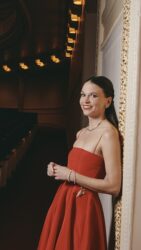
Singer Sutton Foster. Photo: Jenny Anderson
Sutton Foster left it to the next generation of Broadway performers to provide the flair and theatrics in what was an otherwise stripped-down evening at Emerson Colonial Theatre, the first in the An Evening With Sutton Foster series scheduled through the end of March.
Foster’s longtime collaborator Michael Rafter provided accompaniment on the piano, as vocalist sang her way through a varied and random setlist. Simon & Garfunkel shared time with Mister Rogers, Mary Tyler Moore, Jeanine Tesori, and Parry Gripp’s viral internet meme “It’s Raining Tacos,” the tunes interwoven with anecdotes about the joys and challenges of motherhood, family, and loss.
The evening began slowly, as Foster gradually warmed up to the crowd. The staging was straightforward. She stood, almost as if she were auditioning, behind a music stand, though at times Foster would break into silly dance moves between vocal numbers. It was an effective way to suggest that this was a jam session — in a historic theater that seats 1,600.
The appearance of ten-year-old Livia Quist and Emerson College musical theatre freshman Ariana Arocho was the first of a string of surprises. The pair joined Foster to sing the young and teenage Princess Fiona parts in the song “I Know It’s Today,” a role Foster originated in the 2008 Broadway production of Shrek The Musical. After that, the singer was seldom alone on stage. Foster was later joined by dancers from the South Shore Dance Ensemble and Boston Conservatory student Abby McDonough.
Foster was at her flashiest during a tap routine with the young South Shore dancers. Most of the time her performance was no frills; when she addressed the audience, she often talked of the need for community. Near the show’s end, Foster sent out a challenge — reach out to the people you love and tell them that you’re thinking of them.
— Hannah Brueske
Classical Music
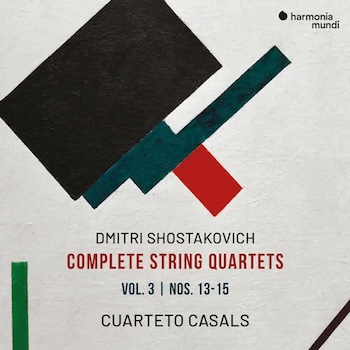
There’s no way around the fact that Dmitri Shostakovich’s late music is bleak. The composer’s frailty—among other things, he had a rare form of poliomyletis that made physically writing music a burden—meant that a textural spareness marks a whole lot of his output from the 1970s. And that’s not even getting into the existential despair that seems to mark so many of his final songs, sonatas, and quartets.
Interestingly, the String Quartet No. 15 wasn’t intended to be Shostakovich’s last: he’d actually planned a set of twenty-four for the Beethoven Quartet. If that had transpired, the Cuarteto Casals’ recording (for harmonia mundi) of the complete cycle would only be at the halfway point. As it stands, though, their concluding installment—of Nos. 13, 14, and 15—serves as a touching journey through some very dark musical valleys.
Given that overarching atmosphere, there’s a considerable sense of freedom and invention that characterizes each of these quartets. No. 13 boasts a weird, jazzy fugue amid hymn-like textures and quietly rocking lyrical bits.
The F-sharp-major Quartet No. 14 offers a ghostly gloss on the composer’s earlier style; there’s a drunken viola lullaby in the Adagio and the finale’s alternations of texture—one moment homophony, the next monody, the next hockets—is wildly jarring. Though No. 15’s unrelentingly slow tempos (six movements, all gradations of Adagio) are nearly overwhelming, there’s a powerful sense of raging against the dying of the light on offer throughout.
The Casals’ performances are admirably rich-toned and impeccably responsive. At times—the opening pages of No. 13, the buzzing unison runs in the finale of No. 15—the four players sound like a single instrument. For character, too, there’s a warmth and intimacy that goes a long way to humanizing music that is hardly easy, but, in these hands, hardly impenetrable.
— Jonathan Blumhofer
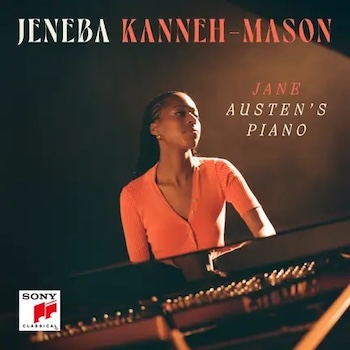 Here’s a welcome change of pace: a recording that celebrates a 250th birthday not belonging to a composer. Instead, pianist Jeneba Kanneh-Mason pays tribute to an author—Jane Austen.
Her’s is an apt concept, given the prominent role music plays in so many Austen novels and their screen adaptations. Even so, Jane Austen’s Piano (Sony Classical) is conspicuous for its brevity: the whole thing clocks in at under half-an-hour.
The biggest single item is Franz Josef Haydn’s Piano Sonata in C, a work that Austen, herself, evidently copied out into a family album. It’s a quintessential Classical fare, lean and focused, hardly wasting a note or gesture, and Kanneh-Mason delivers a gem-like reading. Textures in the outer movements are fresh and crisp but marked by shapely dynamics and a glowing tone. The central Adagio’s lyricism simply floats.
Remaining items by George Kiallmark and Johann Cramer aren’t all at the same level, though Kanneh-Mason delivers them with a similar spirit of understanding. She makes particularly light work of the latter’s Etude in A minor.
A couple numbers by Handel suggest how this album might have been better filled out. The Minuet from his Suite in B-flat moves with sad gracefulness, while Kanneh-Mason illuminates the sinuous Allemande from his D-minor Suite with silky warmth.
Filling out the album is “Dawn” from Dario Marinelli’s score to 2005’s Pride and Prejudice. Familiar as it is, the track holds up well with the rest of Kanneh-Mason’s program.
— Jonathan Blumhofer
Tagged: "All Tied Together", "Collision Drive", "Lost and Found", "Super Sweet Sounds", "The Winter Warriors", "The Zappa House Concert", "What We Can Know", Alan Vega, Allen Michie, Cuarteto Casals, Duke Levine, Frank-Zappa, Hannah Brueske, Ian McEwan, Jeneba Kanneh-Mason, Kai Maristed, Mark Favermann, Nick Caistor, Olivier Norek, Peter Keough, Steve Erickson, Sutton Foster, The David Rubenstein Treehouse, Trevor Fairbrother, Ukraine, Vance Thompson, Ye Vagabonds