
Arts Remembrance: In Memoriam, Christoph von Dohnányi (1929-2025)
By Jonathan Blumhofer
Christoph von Dohnányi was a rare breed: a truly great artist whose mind never rested and whose standards never settled.
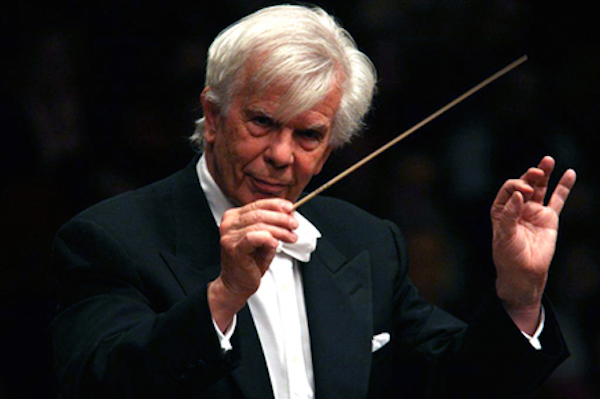
Conductor Christoph von Dohnányi in action. Photo: Wikimeida
“At the moment we have a total entertaining society,” the conductor Christoph von Dohnányi offered to Bruce Duffie in 2005. “Entertainment is everything, and if you read Don Juan in Hell, Bernard Shaw uses the expression, ‘Hell is where there is only entertainment.’ That’s about where we are at the moment…”
Not that Dohnányi was your stereotypically dour German maestro; he was just serious about his craft. “Sometimes it’s fun,” he told Duffie later in that same chat, speaking of his podium work. “But it should not only be fun. It’s something which you have to enjoy thoroughly, and which somehow puts you in a [new] level of life.” That was an attitude which served Dohnányi, who died on September 6, well. Born in Berlin in 1929, he was intimately acquainted with the ups and downs of human experience.
His stock was illustrious. The composer-conductor-pianist Ernö Dohnányi, a contemporary of Bartók and Kodály, was Dohnányi’s paternal grandfather. His father, Hans, was a jurist whose anti-Nazi sympathies led him into Resistance circles—and, ultimately, to martyrdom—during the Third Reich. His mother, Christine, was the sister of the theologian Dietrich Bonhoeffer, with whom Dohnányi later recalled playing chess and soccer; in his will, Bonhoeffer bequeathed his nephew (also godson) his harpsichord.
A career in music wasn’t foreordained. Following World War 2, Dohnányi began by following in his father’s footsteps and studying law. But that field didn’t take and, after winning the Richard Strauss Prize from the city of Munich, he proceeded to Florida State University, where he studied with his grandfather and, later, Tanglewood, where he worked with Leonard Bernstein. Appointments in German opera houses followed, culminating in the directorship of the Hamburg State Opera in 1977.
But Dohnányi’s legacy wasn’t fated to be made just in the theater. Instead, in 1984, he was appointed music director of The Cleveland Orchestra in a partnership that became the stuff of legend. Artistically adrift since the death of George Szell in 1970, the ensemble was revitalized by Dohnányi’s exacting leadership and their recorded legacy—mostly of the standard canon, but also of works by Arnold Schoenberg, Harrison Birtwistle, Charles Ives, and John Adams—is consistently excellent.
Boston audiences had it better than many during Dohnányi’s eighteen years on Lake Erie: he led the BSO at Tanglewood and Symphony Hall on multiple occasions between 1989 and 1998. (By contrast, in Chicago there’s a conspicuous, 20-year gap between his visits to Orchestra Hall in 1982 and 2002; at the New York Philharmonic, the break runs from from 1983 until ‘02.)
As if to make up for lost time, post-Cleveland, Dohnányi was, seemingly, everywhere at once—Boston, Chicago, New York, Philadelphia, Los Angeles. Not one to take it easy in his twilight years, he also signed on for roles as principal conductor of London’s Philharmonia Orchestra (1997-2008) and as chief conductor of Hamburg’s NDR Symphony Orchestra (2004-10).
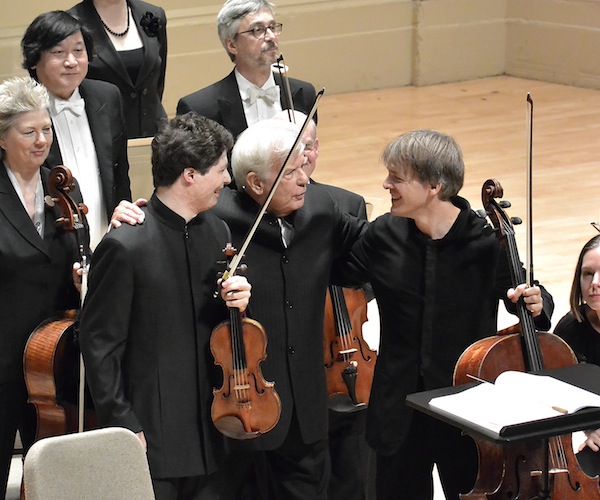
Augustin Hadelich, Christoph von Dohnanyi, and Alban-Gerhardt at the end of a Boston Symphony Orchestra performance of the Brahms Double Concerto. Photo: Stu Rosner.
Though I reviewed two of his Boston performances for the Fuse, a search through the record reveals that I caught a good number more of his concerts with the BSO as a student. That several of them linger in the memory after nearly two decades says something about both the programs and the musicianship on offer: there was a bristling Brahms Violin Concerto with Frank Peter Zimmermann and a staggering Oedipus Rex during a remarkable two-week stretch in 2006. An exhilarating Ligeti-Wagner-Bartók-Tchaikovsky quadruple-bill followed in spring 2007 as did a haunting Lutosławski Funeral Music sharing billing with the dear, departed Lars Vogt playing some Beethoven that fall.
The fact is, while Dohnányi’s musical preferences tended towards mainstream Germanic repertoire, his tastes were surprisingly, appealingly catholic. Who would have guessed that the benchmark recordings of both Philip Glass’s Violin Concerto No. 1 and Alfred Schnittke’s Concerto Grosso No. 5 would have been made under Dohnányi’s baton (and with Gidon Kremer and the Vienna Philharmonic no less)? Or that John Adams’s Century Rolls would find such a sympathetic pair of advocates in the Old World maestro and Emanuel Ax?
No, Dohnányi was a rare breed: a truly great artist whose mind never rested and whose standards never settled.
Granted, to some, his music making was too Apollonian, too cool—very much in line with the man who once claimed that Bernstein’s approach to Mahler was demonstrably “wrong.” Yet I’ve rarely found him that way, either live or on disc, and you can hear some of Dohnányi’s best qualities in a remarkable set of recordings he made in the ‘00s and ‘10s with the Philharmonia for the Signum label. All the selections are canonic and most (I’ll exempt a slightly too-expansive Brahms Second Symphony here) exude the vitality of fresh discovery.
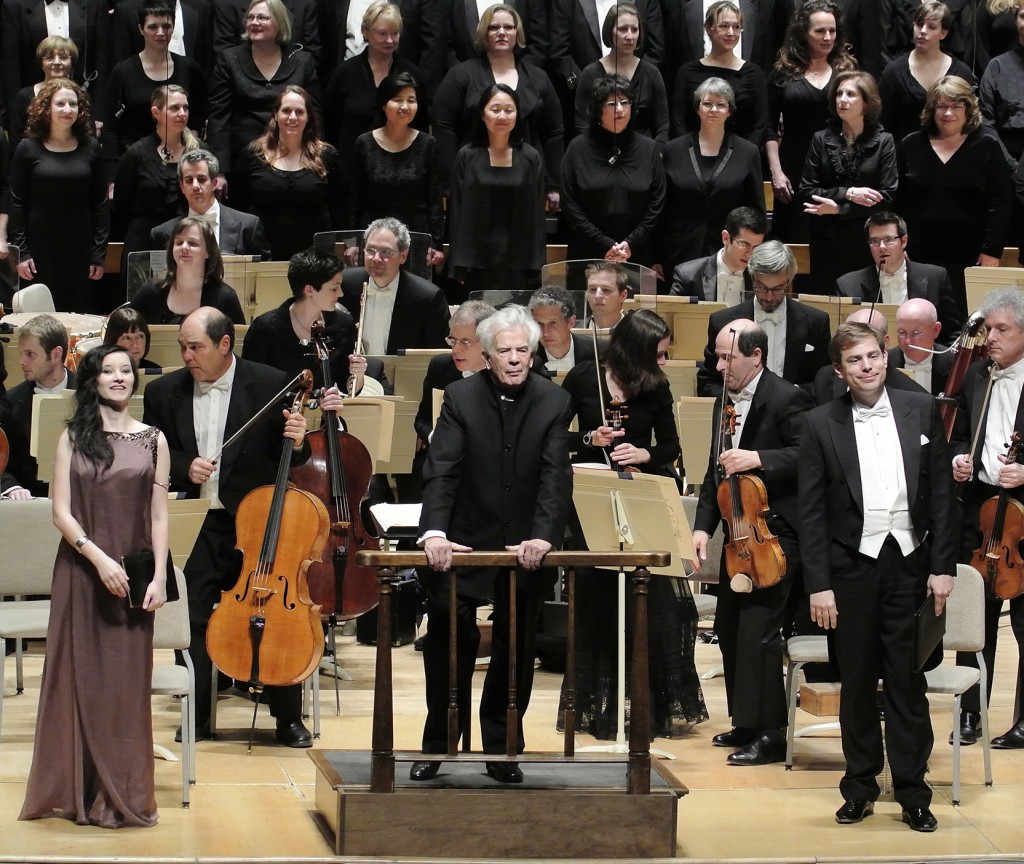
Christoph von Dohnányi and soloists Anna Prohaska and Hanno Müller-Brachmann following the Boston Symphony Orchestra performance of Brahms’ “Ein deutsches Requiem” at Symphony Hall. Photo: Stu Rosner
Who knew, for instance, that the woodwind writing in the first movement of Beethoven’s Eroica Symphony could sing with such beauty and warmth? Or that the bass line in the finale of the same composer’s Fifth Symphony was so commandingly lyrical? Or that the dense textures of Strauss’s Ein Heldenleben could unfold with such shapely clarity? Or that Schubert’s Ninth could rollick with such abandon? That was the magic of Dohnányi, who famously micromanaged the little things in rehearsal so that the end result—lean textured, focused, smartly directed—might, in concert, overflow with moments of illumination.
Of course, none of this happened in a vacuum. “Even as children,” he once told the Wall Street Journal, “we had a very strong feeling about being on the right side” and that tendency held until the end. “I believe it is essential to be interested in what is going on around us,” he noted in an interview in 2002 and, though most of his commentary remained private, Dohnányi periodically responded to global political developments.
How, precisely, these elements fused for him, as they do for any artist, remains open to speculation. But in both his worldview and his music-making, Dohnányi spoke from positions of authority gained by hard-earned experience. In the larger examples he leaves behind—of integrity, wisdom, probity, engagement, curiosity—he fulfilled, much like his father and uncle before him, a prophetic role. To be sure, those are attributes our increasingly troubled era would do well to remember, celebrate, and emulate: as Dohnányi and Shaw well knew, the world is full of many worse hells than those that just feed on “entertainment.”
Jonathan Blumhofer is a composer and violist who has been active in the greater Boston area since 2004. His music has received numerous awards and been performed by various ensembles, including the American Composers Orchestra, Kiev Philharmonic, Camerata Chicago, Xanthos Ensemble, and Juventas New Music Group. Since receiving his doctorate from Boston University in 2010, Jon has taught at Clark University, Worcester Polytechnic Institute, and online for the University of Phoenix, in addition to writing music criticism for the Worcester Telegram & Gazette.