Theater Preview: Beckett, Williams, Beau Jest, and “Last Call” for Provincetown’s Tennessee Williams Festival
By Davis Robinson
When Beau Jest Moving Theatre heard this was to be the last fully-produced year of the Provincetown Tennessee Williams Theater Festival, and that this year’s theme was Last Call — a look at the work of Williams in conversation with the work of Samuel Beckett — we knew we wanted to be a part of it.
Lifeboat Drill and Fin Du Monde by Tennessee Williams, Come and Go by Samuel Beckett, staged by Beau Jest Moving Theatre at the Calderwood Pavilion, Martin Hall, 527 Tremont Street, Boston, September 18 through 20. Then at the Provincetown Tennessee Williams Theater Festival, September 25 through 29.
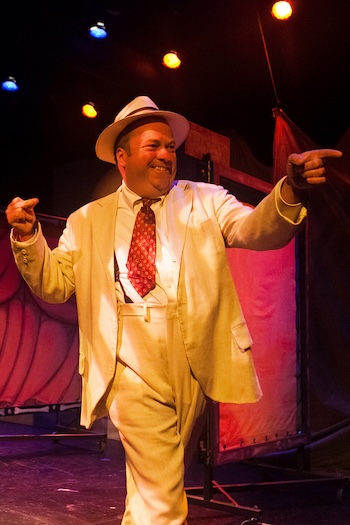
The late great Larry Coen in the Beau Jest Moving Theatre production of Ten Blocks on the Camino Real.
We fell in love with Tennessee Williams and Provincetown in the Fall of 2009 when festival director David Kaplan asked our company to stage an unproduced late play called The Remarkable Rooming House of Madame LeMonde. (Arts Fuse review) This dark, absurd play by Williams required a wild imagination, strong comedic chops, and some challenging staging opportunities that my company and design team relished taking on. It opened up a whole new world for us as we joined the festival’s mission to look with fresh eyes on the late work of Tennessee, work which had been roundly dismissed by critics in the ’60s and ’70s, critics who refused to accept that Mr. Williams was, and had been, an experimentalist; a writer who admired Beckett, Pinter, Ionesco, and other modern writers who challenged the status quo and the traditional realism that Williams’s early work had received so much acclaim for. This led to three other commissions with the festival over the years, exploring different themes and performance locations with two other world premieres – American Gothic and Aimez-Vous Ionesco? – and Beau Jest productions of the seldom seen shows Ten Blocks on the Camino Real and The Pronoun I. (Arts Fuse review)
An important part of the appeal of performing in the festival is the location itself. To be surrounded by Tennessee Williams scholars, actors, and companies from around the world at the tip of Cape Cod in one of the most creative and inclusive communities on earth, where Tennessee himself found great inspiration, is also to be surrounded by limitless vistas of sky, sea, and sand. The National Seashore provides a rich backdrop and a daily opportunity to rest, reflect, and recharge before diving back into the dark, rich humor and humanity of the plays themselves. And Samuel Beckett’s profound work and linguistic precision make a perfect pairing for anyone interested in looking into the abyss while being surrounded by natural beauty and artistic inquiry.
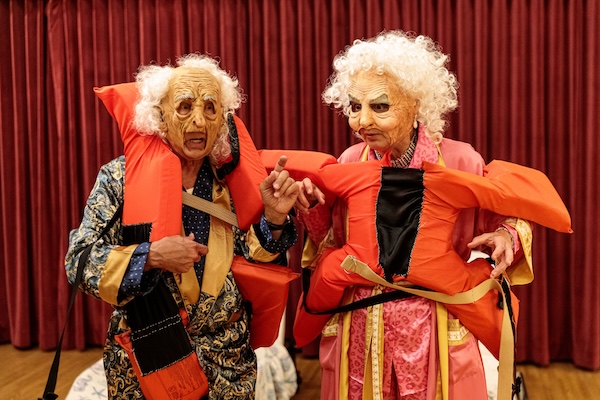
Davis Robinson and Lisa Tucker as Mr and Mrs Taske in the Beau Jest production of Lifeboat Drill. Photo: Benjamin Rose
When we heard this was to be the last fully-produced year of the festival and that the theme of the year was Last Call – a look at the work of Tennessee Williams in conversation with the work of Samuel Beckett – we knew we wanted to be a part of it. I asked David Kaplan if he had any plays he was considering for the Festival and he sent me a few scripts to look at. When we read Lifeboat Drill, we knew we had found the piece that matched Beau Jest’s sensibilities. It’s funny, sad, metaphoric, and full of opportunities for slapstick misunderstandings and physical comedy. As a wealthy ancient couple struggles to get out of bed and into their lifejackets on a luxury ocean liner, the parallels to Beckett plays such as Happy Days and Endgame were obvious. I also knew I had to play Mr. E. Long Taske with Lisa Tucker as Mrs. Taske. As a founding company member who has been in every one of our productions since 1984, the chemistry and history we share from over 40 years of collaboration would be a natural foundation for this end-of-life comedy and the Monty Python-esque humor TW was calling for when he wrote it a few short years before his own death.
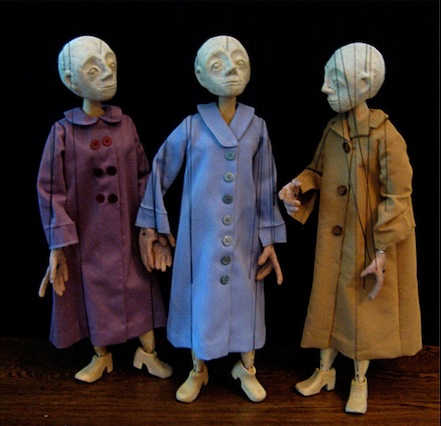
The puppet cast in Beau Jest’s production of Samuel Beckett’s Come and Go. Photo: Libby Marcus
Like Beckett, these are characters who are not asking for pity or sympathy as they face the unknown, the Last Call. These are characters who fight with great strength and deep resilience to face the unknown head-on. We also knew we had the perfect companion piece for this short one act. Our frequent collaborator Libby Marcus, who has designed masks and puppets for Beau Jest and co-directed some of our productions, had staged an evening of Beckett plays using marionettes which she performed solo in Portland, Maine and at the Puppeteers of America conference in Connecticut. Her staging of Come and Go, featuring the enigmatic Flo, Vi, and Ru sitting on a bench and moving through their own gossipy ritual facing the endgame resonated so perfectly with the festival’s theme. David Kaplan loved the idea of the pairing and Libby fortunately was willing to revive the piece and join us on stage. The Beckett estate gave her interpretation its blessing, as long as she didn’t change the gender of the puppets. Libby agreed but did point out to the estate that the characters are, in fact, made of wood.
Rounding out our triptych is an unpublished short story by Tennessee called Fin du Monde, which the festival is focusing on this year prior to its publication next year by New Directions. We present it as a live, audio theater event, reading and acting it out in the dark while the audience wears sleep masks. And that’s the conversation. Hearing a story written in the ’40s about a gay couple in New Orleans dying of consumption, seeing a Beckett piece written in the 1960’s about a trio of old women on a bench performed by marionettes, and a live slapstick metaphor written in the late ’70s a few years before Tennessee’s death. We are going to miss this annual event when it is over, but we are so looking forward to being there for its Last Call.
Davis Robinson is the founder and artistic director of the Beau Jest Moving Theater and is a professor of theater at Bowdoin College in Brunswick, Maine. He is also the author of The Physical Comedy Handbook and A Practical Guide to Ensemble Devising.
Tagged: "Fin du Monde", Beau Jest Moving Theatre, Come and Go, Davis Robinson, Lifeboat, Provincetown Tennessee Williams Theater Festival, samuel-beckett