
September Short Fuses — Materia Critica
Each month, our arts critics — music, book, theater, dance, television, film, and visual arts — fire off a few brief reviews.
Visual Arts
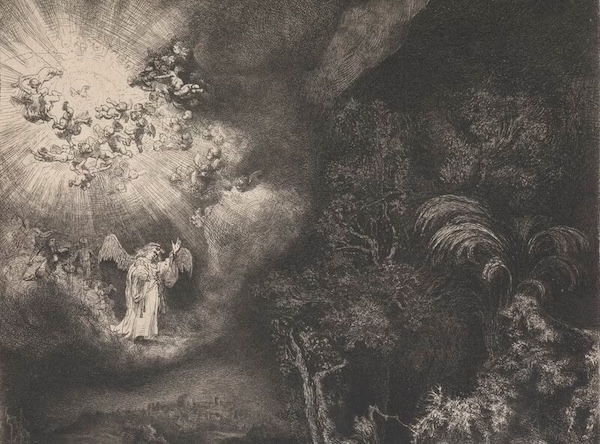
Rembrandt, The Angel Appearing to the Shepherds (Luke 2:8–14) (detail), 1634. Etching, engraving, and drypoint. Photo: Yale University Art Gallery
Arguably the most impressive quality of traditional monochromatic prints is their Biblical ability to separate light from darkness. The effect is an illusion: the “light” is the stark blank white of paper and the darkness and shadow are created in jet black printing ink, skillfully modulated by a long repertoire of printmaker’s techniques and media: etching, aquatint, drypoint, mezzotint, engraving, woodcut, lithograph, and a range of burnishing and scraping.
The remarkably satisfying exhibition Printing Darkness, at the Yale University Art Gallery (through December 7), is a selection of prints by more than 40 artists, skillfully chosen. The show’s organizers say the show “surveys the fundamental role of ‘darkness’ in printmaking from the 16th century to the present day.” But it is also about light and the powerful illusionist, emotional, and symbolic effects light and dark can create. Many of the images are indeed dark: they take place deep at night, against inky backgrounds, or involve war, violence, or suicide. Several involve rape, including Otto Dix’s harrowing etching, aquatint, and drypoint Soldier and Nun [Rape] (1924) and Sue Coe’s furious Woman Walks into Bar — Is Raped by 4 Men on the Pool Table — While 20 Watch (1984).
Others play on the spiritual or mystical qualities of light. In Rembrandt’s The Angel Appearing to the Shepherds (Luke 2:8-14) (1634), a blast of heavenly light in a black sky, like the beam from a spaceship, scatters a group of stunned shepherds below. Examples by Odilon Redon and from Goya’s Los disparates exploit the medium’s limitless capacities for evoking mystery. Still others, like Philip Dawe’s The Oyster Woman (1769, after Henry Robert Moreland), simply delight in the striking illusionist lighting effects a master printmaker can create on a blank sheet of paper.
— Peter Walsh
Classical Music

Francesco Piemontesi studied with Alfred Brendel and, though you probably wouldn’t mistake the younger pianist for the older one, there’s a poetic quality to be found on his new Brahms album that does his former teacher, who died earlier this summer at 94, proud. That’s particularly true of the Swiss-born artist’s account of the Three Intermezzi, op. 117, which are models of warmth, direction, and inwardness.
But a good bit of the approach also carries into his account of the Piano Concerto No. 2, which forms the bulk of the album. Tempos and phrasings are all well-judged and Brahms’s dense piano writing is rendered with impressive tonal and rhythmic clarity. The Andante is impeccably focused, its central Adagio emerging as a model of pristine, otherworldly delicacy.
In the Concerto, Piemontesi’s joined by the Gewandhausorchester Leipzig and Manfred Honeck. Honeck, of course, is one of the most insightful conductors of the repertoire and his collaboration with Piemontesi strikes sparks. Their shared approach lavishes attention on the little things (portamenti, phrasings, tone color) but never at the expense of the big picture. To be sure, the sense of musical purpose on offer in this reading — beautifully demonstrated in, for one example, the Scherzo’s noble, lilting, and unexpectedly songful Trio — is altogether pleasing.
The interpretation more than compensates for periodic moments of imbalance between the resonant piano and the drier-sounding ensemble. Those aside, there’s more than enough here to cause one to look forward to the team’s completion of the Brahms cycle, due out next year.
— Jonathan Blumhofer
 “Luck,” Seneca supposedly said, “is when preparation meets opportunity.” Whether or not the attribution is correct, Antonin Dvorak’s Slavonic Dances bear out the maxim. Written eight years apart, these two eight-movement sets modeled on Eastern European folk dances were both massive financial and musical successes.
That they cashed in on a late-19th-century craze for nationalistic fare may prick modern sensibilities a little. But unlike, say, the Gypsy appropriations of the Hamburg-born Brahms’s Hungarian Dances, Dvorak’s installments were the product of a true son of the country.
Of course, that fact last alone doesn’t guarantee success. But Dvorak’s gift for melody was second-to-none, as was his understanding of drama (lest we forget: by the time he completed the second set of Dances in 1886, Dvorak had written six operas). Most importantly, he was a natural master of rhythm, and these 16 movements trip with grace and spirit.
Sir Simon Rattle’s new recording of the complete Dances with the Czech Philharmonic Orchestra (Pentatone) largely taps into that latter characteristic. In the Op. 46 set, the effect is sometimes club-worthy — check out the throbbing pulses during the sprightly sections of the E-minor movement. At other times, like during the graceful rubato phrasings of the F-major, it’s more subtle and refined. Meanwhile, conductor and orchestra warmly mine the Op. 72 collection’s greater expressive depths.
For a long time, my go-to in the repertoire has been Antal Dorati’s classic recording with the Royal Philharmonic Orchestra. Expectedly, this new edition boasts better recorded sound than that earlier take. If, interpretively, Rattle’s approach to Op. 72 doesn’t quite displace the older conductor’s, his traversal of Op. 46 is just as good as Dorati’s — and, for sheer style, maybe even a bit more satisfying.
— Jonathan Blumhofer

It’s been a good few months for Philip Glass fans. First, Third Coast Percussion brought out an astounding new recording of Aguas de Amazonia. Now, Anne Akiko Meyers offers a fresh take (Platoon) on the composer’s Violin Concerto No. 1.
Written in 1987, the score stands among Glass’s most haunting. Its structure is singular and essentially theatrical: each movement grows in substance, expressive urgency, and duration. The instrumentation, too, showcases how effectively and intriguingly the composer’s singular style of slowly shifting melodic, harmonic, and rhythmic patterns can be applied to the traditional symphony orchestra.
Here, the latter part is taken by the Los Angeles Philharmonic Orchestra and Gustavo Dudamel. Their sympathy with and understanding of Glass’s language is total and the music’s undulating textures unfold with delicate precision.
Meyers floats above and around their accompaniment with becoming warmth and clarity of tone. Her approach is similar, at least in timings, to Gidon Kremer’s benchmark, though she mines the Concerto’s drama — especially the attacks in the outer movements — with a bit more finesse. The violinist impresses, too, in Echorus, a reworking of Glass’s Etude No. 2 for two violins (here, Meyers and Aubree Oliverson) and strings (the Academy Virtuosi from USC’s Colburn School).
Rounding out the album is the premiere recording of the serene New Chaconne, in which Meyers is joined by LAPO principal harpist Emmanuel Ceysson.
— Jonathan Blumhofer
Popular Music
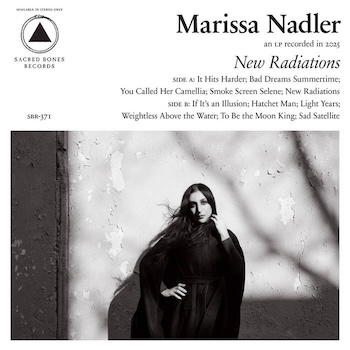 Folk singer Marissa Nadler’s music might seem sparse enough to float into the air, but — as her latest album, New Radiations (Sacred Bones/Bella Union), shows — it has a tough backbone. Her production uses reverb to create a spacey, enveloping effect, setting up subtle drones as her voice lingers. During “It Hits Harder,” the vocalist trails off into a faint but persistent echo. Even her most straightforward songs exude a ghostly ambience. While her acoustic guitar and vocals are by far the loudest instruments on New Radiations, they’re supported by the subtle additions of Milky Burgess’s electric guitar and synthesizer. Critic Olivia Horn accurately summed up her style as a “sparing, spooky goth-folk cabin.”
While Nadler has dabbled in murder ballads (on her 2021 album The Path of the Clouds), New Radiations investigates love and its fraying without giving the listener all the details. The gender of the people in Nadler’s lyrics is indistinct, and they are often just witnesses to other people’s emotions. “You Called Her Camelia” describes a breakup from an unusual second-person perspective. The song addresses a forlorn person: “You know she loved you but it all changed…this wasn’t the deal, her fading away.” The arrangement is sliced down to its bones, featuring aching slide guitar and barely audible organ. Finger-picked melodies are supported by heavier, bluesy chords. Burgess fills out the songs with ominous embellishments, like the noise warbling behind “It Hits Harder.” “Light Years” is also spoken to a “you” that “used to be right there beside her.”
Ten albums in, Nadler is still drawing variety from the same elemental approach. She accumulates small, but enticing, sounds by fusing simple elements with great subtlety. The mood is of a half-remembered dream. On the title track, she sings, “I was retracing the lines of a memory.” New Radiations insists upon its own urgency without raising its voice.
— Steve Erickson
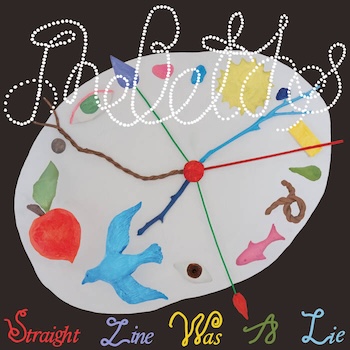
Had The Beths existed in the ’80s, their fourth album Straight Line Was a Lie (Anti-) would’ve been a college radio smash. The New Zealand band specializes in folk rock powered by jangly guitars and four-part harmony: “Metal” follows the path laid down by the Byrds and Television, as well as their country’s Flying Nun record label. All four members met at music school, where they were studying and performing jazz. That background is palpable in the care displayed in singer/guitarist Elizabeth Stokes’s songwriting, which uses group vocals as counterpoint. Drums play an outsize role, whether its the snare fills of “Metal” or the congas of “Best Laid Plans.”
“Mother, Pray for Me” is the centerpiece track on Straight Line Was a Lie. Not only does it come exactly halfway through the album, it breaks new ground for The Beths. Never before have they recorded a song this intensely emotional. Compressing a novel’s depth of experience into five minutes, Stokes witnesses how generations of women have accidentally hurt each other. She urges her mother to reach out in her own terms, despite Stokes’s lack of faith: “if I could be saved one day/Mother, pray for me.” The tune zooms in on the agonies of communication.
The album also looks at a related subject: its main theme is mental health as an up-and-down experience. It was written after a period when Stokes was diagnosed with Graves’ disease, which led to serious depression. On the title track, Stokes sings “I thought I was getting better/But I’m back to where I started.” “No Joy” reaches out despite the numbing trap of affectlessness, though the Beths’ music doesn’t sound nearly as grim as the lyrics would indicate. Straight Lie Was a Lie is about summoning up the courage to get through the worst states of mind.
— Steve Erickson
Jazz
 Bassist Linda May Han Oh has come to be recognized as one of the top jazz musicians in the business. Born in Malaysia and raised in Australia, Oh quickly developed an ear for what the music was all about by studying the approach of Dave Holland and playing in groups led by Dave Douglas. She currently serves on the faculty of the Berklee College of Music as she continues to record top flight albums and tour extensively.
Strange Heavens, her fourth release as a leader on the Biophilia label (as a digital download), is a trio effort. Tyshawn Sorey (drums) and Ambrose Akinmusire (trumpet) join the bassist (on upright bass) in a set of Oh originals based on various literary and historical inspirations. Each member, all in their 40s, has an opportunity to draw on their ever-maturing mastery.
Most of the tracks are only a few minutes in length, which leaves the impression that these are musical scenarios that were made to be elaborated on in more full-bodied arrangements. Still, there’s more than enough here to engage and intrigue the careful listener. The friendly push and pull between Oh and Sorey — as Akinmusire offers melodic release and expressive mood-expanding slurs and sputters — is never less than a treat.
“Portal” opens the album: a bass ostinato is set against punchy percussion that is assisted by virtuosic reflections from the trumpeter. Quick and to the point, the piece suggests what is to follow.
One of the more complete compositions on the album, “Noise Machinery,” is a start-and-stop piece that invites your attention with a funky rhythm and expressive solos from the leader and trumpeter. Likewise, “Paperbirds” bobs and weaves around an infectious shuffle from Sorey.
“Work Song” develops into a prickly minimalist riff grounded by the leader. “Folk Song” is an arco bass outlier that finds interesting ways to bridge the gap between ancient and modern music. “Living Proof” rocks and rambles with Sorey, in particular, showing how it’s done with some of his best recorded work.
The last two tunes cover works by Geri Allen and Melba Liston. Allen’s “Skin” works outside-in to capture the late pianist/composer’s distinctive voice. Liston’s “Just Waiting” offers a bluesy, Ellingtonian harmonic sensibility that knits together the three-pronged talents of Oh and company.
— Steve Feeney
 Miguel Zenón has been among today’s most highly praised jazz musicians. Prestigious awards have been heaped upon him, and his albums often rank high on best-of-the-year lists. They undoubtedly deserve the attention, if only because the Puerto Rico-born star has updated and revitalized the Caribbean influence on jazz.
Yet, after my initial exposure, I have not often returned to listen to his releases. Why does his music seem both fragmented and exhausting? Why does the work of the legendary altoist Art Pepper, who dabbled in Latin sounds, hold greater appeal for me?
Hearing Vanguardia Subterránea, the 48-year-old Zenón’s new release, has helped to set me straight. This, the quartet’s first live recording, contextualizes the saxophonist’s fleet and frequently furious (though in a friendly way) approach to late bop. You can feel the acoustic ambiance of the legendary Village Vanguard surrounding and lifting up the quartet on eight fairly lengthy pieces. Concept and expressiveness gel in this revelatory set.
Popular Latin musical references also heighten the appeal of the saxophonist’s approach. Confined to that tiny club, Zenón and company (pianist Luis Perdomo, bassist Hans Glawischnig, and drummer Henry Cole) power through personal and cultural touchstones in compositions that come off as superior examples of in-the-moment instrumental jazz.
“Abre Cuto Güiri Mambo” opens the disc with the type of bright effervescence that marks Zenón at his best. A sort of melodic maze leads into a post-bop surge that finds the quartet in smooth sync, musically dancing within the piece’s rhythmic churn. A descending montuno gives Cole a chance to work out with a vengeance before the theme returns.
The leader’s fleet fingers make the most of the golden melodic territory of “El Dia de Mi Suerte.” Perdomo follows the saxophonist, unwinding a solo that grows in compelling intensity. “Vita” slows things down for a dance around a sweet melodic line highlighted by a Glawischnig solo and a gently swaying close.
“Bendición” exudes an upbeat warmth, with the leader effusive, but not overbearing, in his variations. Perdomo again excels. “Perdóname” closes the disc with another mix of vibrant virtuosity at the service of performative coherence.
— Steve Feeney
Books
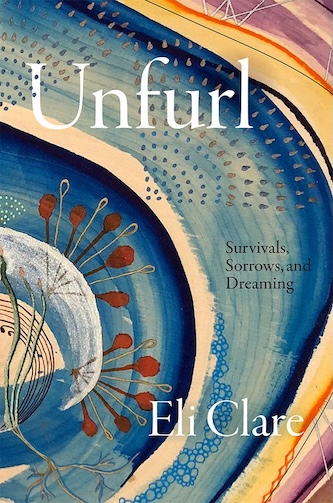
A genderqueer person living with cerebral palsy, Eli Clare uses writing as a bully pulpit against trans and disability oppression. His newest book, Unfurl: Survivals, Sorrows, and Dreaming (Duke University Press), continues his interweaving of creative nonfiction prose, poetry, memoir, history, and advocacy. He touches on various topics: painful flashbacks of childhood abuse are mixed in with erudite critiques of classifications and nomenclature and dreamscapes filled with gorgeous environmental metaphors.
Resiliency and healing are central concerns here. Tender meditations on stumbling strides and crawling across forest floors are used as invitations to others with disabilities to break normative strictures and “scoot, slide, and crawl” with him. Timid teenage poems are reconceived to become examples of empowerment and affirmation. Intergenerational trauma is examined, not to forgive, but to break the chain of “survivor turned perpetuator.”
Clare’s writing is purposely free of academic jargon. A visually compelling format includes notes on historical context, endnotes, poetry placement, and content warnings. These additions help knit the book’s diverse layers together.
Community is also an important value to the author. Lost heroes are commemorated. “Justice dreamers” are acknowledged, part of a focus on the need for collective care and liberation. Equally essential is the writer’s self-caring embrace of the natural world: “Sitting in the woods or at the ocean, I glimpse a world that relishes crookedness, wholeness, and brokenness.”
In this powerful example of mixed-genre writing, Clare provides a roadmap, a way to find joy and freedom in the face of formidable societal repression. His journey is about inventing a path forward: “It is time / to listen to our grief and soothe our jangled / nerves – we must not relinquish imagination.”
— John R. Killacky is the author of because art: commentary, critique, and conversation.
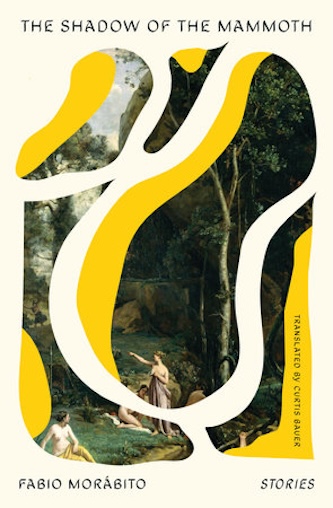
The immigration background of Fabio Morábito is a curious one. He was born in Egypt to Italian parents, moved to Mexico City at age 15, and writes exclusively in Spanish. His new book of short stories, The Shadow of the Mammoth (Other Press, 208 pages, translated by Curtis Bauer), deals with quirky and unusual topics in unpredictable ways. There are 18 stories here, some only lasting a few pages, with the longest one, “The Shadow of the Mammoth,” running just 17 pages.
Morábito has obviously been influenced by the short stories of Julio Cortázar and Jorge Luis Borges, but he has forged his own distinctively spare personal style. “The Great Floating Road” and “Wildlife Crossing” are extremely imaginative stories that resonate with the agile surrealism of Borges and Cortázar — they are rooted in real-life situations but are not quite plausible.
Morábito’s most emotionally direct stories are about families, such as “Landing on the Moon,” where a little boy stays awake while his family falls asleep waiting to watch the moon landing on television. Another such story, “Slow Dance,” is a surprisingly sentimental entry because it highlights the sweet nature of the son, who attends dancing classes with his mother even though he doesn’t want to.
The last story, “The Shadow of the Mammoth,” is the book’s most fantastic and ambitious. The narrative draws on quick shifts between the present day and the antiquity of cave dwellers. Morábito changes temporal gears with ease as the protagonist travels back and forth through time.
The thought-provoking, heartwarming, and fanciful stories in The Shadow of the Mammoth sustain interest throughout. Judging from the strength of the stories here, it is no wonder that Morábito recently received the Xavier Villaurrutia Prize (Mexico’s highest literary award) for his 2021 novel Home Reading Service (Arts Fuse review).
— Brooks Geiken
After his polyphonic, madcap epic Same Bed Different Dreams (2023), Ed Park might have been forgiven had his follow-up collection of stories turned out to be a recycling of slight and diverting bagatelles. Some selections might qualify as such, like the first story “A Note to My Translator,” which, like “The Wife on Ambien” and “Slide to Unlock,” reads like a zanier “Shouts and Murmurs” in the New Yorker, or the overwrought title story about a homunculus struggling for relevance in a dystopic Manhattan ravaged by “the dread virus MtPR, pronounced ‘Metaphor.’”

Yet even in these brilliant fizzles can be seen the underlying layers of interconnecting, dizzying, and elusive meaning, connections that suggest that these pieces in An Oral History of Atlantis (Penguin Books, 224 pages, hardcover) are glimpses of a vast artifice, a submerged continent of metaphors. In “Translator,” for example, the letter is ascribed to a “Hans de Krap” which turns out to be the nom de plume of Joon, the perhaps autobiographical protagonist of “Machine City,” who reminisces about acting in a sophomoric surrealist student film. More to the point, Joon confesses to the Pynchonesque tendency of being “captivated by any work of art that contained a work of art within it” (adds the filmmaker, “I love that meta shit”). This enthusiasm — along with intertextuality, word games, Joycean puns, Borgesian metaphysics, and Olympian glee and whimsy — are hallmarks of Park’s fiction.
As well as an inventiveness of form. “Seven Women” includes thumbnail sketches of the title characters, some living in the same building and several of whom reappear elsewhere in the book. It ends with a first person account of a Korean-American woman in Korea in 1995 who might be the lethal spy protagonist in “Watch Your Step.” “Weird Menace,” the transcript of a voice-over commentary by the director and lead actress (also the proprietor of a steak house in “The Air as Air”) for a DVD of the schlocky sci-fi film of the title, contains references to at least two of the subjects in “Seven Women” and perhaps one of the characters in Same Bed Different Dreams.
One can read and reread the selections here with pleasure, seeking out such links, and connections, with his two novels. But as in “The Air as Air,” about an Iraq War vet struggling against PTSD and confronting a churlish father, what truly marks them as the work of a master is the unsentimental empathy and the breadth of humanity. What matters more than the Atlantean myths are the oral historians who relate them.
— Peter Keough

Through his assaultive use of pen and ink, Robert Crumb strategically elevated comics beyond what was standard fare in the ’60s. He is credited with single-handedly transforming the medium into a place for defiant, rebellious, and even subversive expression. Crumb’s cartoons have been described as misogynistic, racist, sexist, neurotic, subversive, politically incorrect, perverse, grotesque, rough, and compulsive. Adjectives like pioneering, original, provocative, sophisticated, revolutionary, amusing, countercultural, and highly influential have been applied, too. Terms like odd, weird, and eccentric have been used to describe him as well. As an artist and a man, Crumb contains multitudes of parts.
Dan Nadel’s Crumb: A Cartoonist’s Life (Scribner, 458 pages) is the first biography of this master draftsman and distinctively American artist. A writer and museum curator, Nadel took on the role of research scholar when dealing with Crumb’s life and art. The commitment is impressive but, for many readers, the unstinting detailing of decades of old personal conversations and complicated business transactions will be overkill. It turns out that Crumb took voluminous notes since childhood, and Nadel was allowed to draw on them, including their long lists of warts and minor transgressions.
Born in 1943 into a highly dysfunctional lower middle-class family, Crumb was primarily raised in Philadelphia. His father was a strict, abusive military veteran and his mother was a drug-addicted, child-threatening manic-depressive (bipolar). He had siblings who suffered from mental illness as well. Inspired by his high degree of artistic skill and layered visual language, his creative body of work reflects a strong connection to postwar neuroticism and anxiety. He targeted societal norms as he explored some of the darkest corners of contemporary American life. His secret sauce: he used humor and wit to disguise his anger, resentment, and cynicism. In the late ’60s and early ’70s, LSD and marijuana may have also been mixed in.
Crumb’s absurdist counterculture characters — Mr. Natural, the Snoid, Angelfood McSpade, Fritz the Cat, and Whiteman — were metaphors for some of the worst aspects of our culture. Perhaps his greatest, and most troubling — as well as touching — creation was R Crumb, the lanky ectomorph in milk-bottle glasses, festering with resentments and anxieties. Crumb also took comfort by reaching back into the past, referencing 19th- and early 20th- century music, with an appreciative ear for the rare and obscure, as well as for second- and even third-hand clothing and vintage cars. Nadel suggests that Crumb’s ceaseless self-examination drove his anarchistic vision.
Now in his ninth decade, Crumb has turned from a questioning, rage-filled youth into a conservative curmudgeon. But, as Nadel’s narration confirms, we all just need to Keep on Truckin.’
–Mark Favermann
 Dominic Pettman’s Ghosting: On Disappearance (Polity, 122 pages) offers a diagnosis of a disturbing malady in “our age of ever-loosening social ties,” a cancer of isolation whose spread is assisted by technology — the act of sudden, often inexplicable, abandonment. He looks at the various ways one can walk off without a trace, and examines how the digital age amplifies the act of dumping, ranging from the romantic to the familiar and the professional (“quiet quitting”). He provides bits of historical context, glancing back at literature for prescient instances of vamoosing in Charles Dickens, Jean-Jacques Rousseau, and Marcel Proust, at one point suggesting that the French writer saw the phone as aiding and abetting the transformation of loved ones into ghosts hanging on the line.
Pettman is alert to the sadism of gratuitous ghosting, the pernicious brand of paranoia, social and personal, it encourages, and to its links to the selfish satisfactions of domination and indifference. One wishes at times that his tone were a bit less jokey. The air of an academic trying to let his long hair down can feel jarring: “Melancholia is thus a coping mechanism — a kind of reverse exorcism — designed to trap a ghost in the self. Not ghostbusting but ghostswaddling.”
Still, the undeniable symptoms of communal decay are conveyed with efficient power. Pettman concludes with apt alarm: “We postmodern people have become unwitting experts in ghosting ourselves — in leaving ourselves abandoned, forsaken, and alone in The Great Agitated Stagnation zone of contemporary life — even as we spend millions of hours and billions of dollars on creating vaporous digital phantoms to provide at least some kind of simulated spiritual companionship.” Recent stories about people falling in love with AI voices back up his sobering description of our slalom toward terminal seclusion. In the book’s coda, an amused Pettman notes that even the spirits are deserting us. The somewhat-credible British newspaper The Daily Star reported in 2024 that there was a nationwide decline in sightings of poltergeists. Now the ghosts are ghosting us.
— Bill Marx
Tagged: "Crumb", "New Radiations", "Printing Darkness", "Straight Line Was A Lie", "Strange Heavens", "Unfurl: Survivals, "Vanguardia Subterránea", Anne Akiko Meyers, Beths, Dan Nadel, Ed Park, Eli Clare, Fabio Morábito, Francesco Piemontesi, Gewandhausorchester Leipzig, Linda May Han Oh, Manfred Honeck, Marissa Nadler, Miguel Zenón, Philip Glass, Robert Crumb, Sir Simon Rattle, Sorrows, and Dreaming", “The Shadow of the Mammoth"