
August Short Fuses — Materia Critica
Each month, our arts critics — music, book, theater, dance, television, film, and visual arts — fire off a few brief reviews.
Visual Art

Elif Saydam, This Tender That Rent, 2022-2023, Installation. Photo: Lisa Reindorf
My initial impression of Elif Saydam’s exhibition at the Bakalar Gallery in MIT’s List Visual Arts Center (through August 31) was that it was a display of dazzling color and materials emerging from a geometric order. At first, the works seemed very abstract, made up of a gridded pattern of rectilinear shapes. In some works, the wall itself was part of the grid.
But, on closer inspection, elements broke through and overwhelmed the grid: cascades of ornamentation, paint, gold leaf, quilting, collages, and photo transfers, the latter conveying social and political commentary.
Saydam’s work approaches painting as a site for projections of fantasy: not only dreams of power and politics, which the medium has been historically preoccupied with but, according to MIT Curatorial Assistant Zach Ngin, the more mundane longings we encounter in everyday life.
At the heart of the exhibition are large, multi-panel pieces anchored by a recurring concrete block motif. These works symbolize both separation and connection on various levels. The mural-scale installation Beusselstrasse 17 10553 Alt Moabit, is assembled with hand-dyed, stitched panels, which are set against an aluminum-joint scaffolding. The trompe-l’œil cinder-block pattern and collaged hardware tap into themes of home and community space — as well as the limits of barriers and enclosures.
In the mural painting This Tender That Rent, sewn together wax-dyed canvases pay homage to the global tradition of batik as well as to the existence of trade routes and colonization. A geometric pattern of terra-cotta bricks referencing Islamic architecture is overlaid with images of apartments and stores, pointing to issues of housing affordability and commodification.
In addition to exploring the precariousness of urban populations, the show also touches on other important topics, such as gentrification, community spaces, and immigrants and other communities.
— Lisa Reindorf
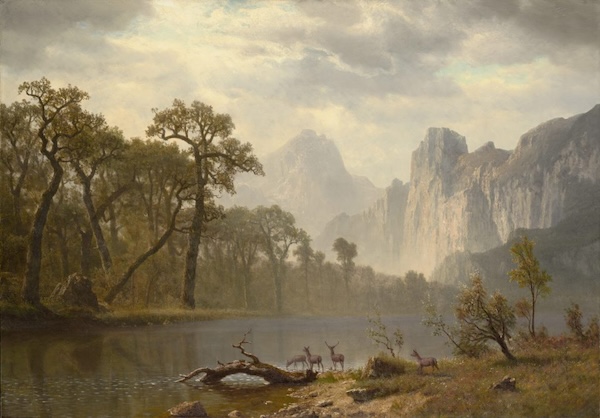
Albert Bierstadt, In the Yosemite Valley, 1866. Oil on canvas. The Elizabeth Hart Jarvis Colt Collection.
There once was a school of thought, promoted heavily especially by the Museum of Modern Art, that labels in art museums should be minimal. Art is a visual medium, the reasoning went. Let the visual speak for itself.
That idea has gone pretty much entirely by the boards. These days, even at MoMA, lengthy text labels tell visitors not only what the art is and who made it, but its position in certain political agendas, the identity or identities of the artist, and how the visitor should interpret what they see.
A case in point: (Un)Settled: the Landscape in American Art at the Wadsworth Atheneum (through September 14). The subject is fascinating but vast. Even the standard art historical narrative encompasses the Hudson River School; the photographers of the American West like Timothy O’Sullivan, Ansel Adams, and Eliot Porter; the urban landscapes of George Bellows and Edward Hopper; the landscape of the American highway as seen by Pop-oriented artists like Ed Ruscha; and a whole lot more. (Un)Settled is not a large show; it must struggle to present the thesis of American landscape before it can introduce the antitheses that are its real purpose.
The presentation is fully bilingual, English/Spanish, and privileges neither. Its thematic sections are introduced by large wall texts. The effect is that text seems to occupy almost as much space as art. The exhibition includes some conventional landscapes, but also pottery, a basket, studio glass, bricks picked up along a river in Rhode Island, photographs of share cropper shacks, and totally abstract work. A visitor who does not read either language might easily miss that it is a landscape show at all; others might perceive the show’s themes only darkly, through a fog of words.
— Peter Walsh
Classical Music
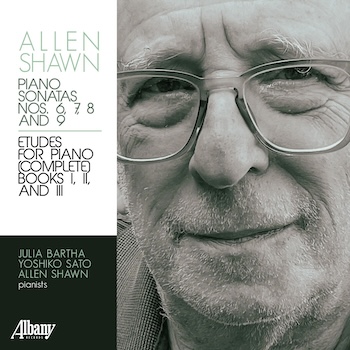
Allen Shawn, who teaches at Bennington College (Vermont) is a quiet person, disinclined to force himself into the public eye. But he recently revealed some of the main themes of his life in music (and the place of music in his life) in a wonderful memoir that I highlighted here two months ago I have been in contact with Shawn on and off for several decades, so hesitate a bit to write in detail about his compositions. But I yielded to temptation about two CDs a few years ago and now want to draw attention to a new release (streaming, download, and forthcoming CD), containing his Piano Sonatas Nos. 6-9 and his Etudes for Piano (Books 1-3).
The performers are Julia Bartha (Sonata No. 6), Yoshiko Sato (Etudes Bk. 2), and the composer (for the rest). All play with vigor, flexibility, and clarity—and never bang, even when declaiming.
Because this is music that can, from one moment to the next, declaim but also whisper, argue, confide…. I find myself continuingly fascinated and surprised, yet always feeling that the next passage to arrive is just what was needed in the work’s thought-flow.
Shawn is keenly attuned to the special capacity of a piano to evoke images in a responsive listener. It helps that the materials that he uses are, if taken individually, memorable in profile: a simple triad with an added tone or two (in the manner of Stravinskyan pandiatonicism), an asymmetrical rhythmic pattern (somewhat like Bartók), a repeated note in the bass…. Yet these graspable units are put into question when juxtaposed or combined: for example, when a major-mode arpeggiation is immediately shaded by a touch of minor.
Vivid recorded sound helps bring these engaging explorations into our loudspeakers or earbuds. How lucky we are to have such an inventive and persuasive crafter of new works in our midst!
— Ralph P. Locke
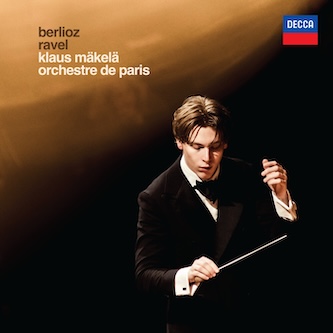
Klaus Mäkelä and the Orchestre de Paris are back with an album that doesn’t venture far from home, consisting of Berlioz’s Symphonie fantastique and Ravel’s La valse.
First, the good news: these are generally fine performances, well played, clean-textured, and tonally satisfying. The orchestra often sounds wonderful. Divisi string writing in the Symphonie, for instance, is thrillingly audible. Try not to revel too much in the climax of the first movement or the violins’ accompaniment of the raucous brass refrains during the “March to the Scaffold,” both of which typically get lost in the mix. Certain coloristic details in La valse—like the trills passed between English horn, oboe, and clarinet in the middle—also pop out nicely.
On the debit side, Mäkelä’s interpretations tend to become muddled. The Berlioz, for instance, often lacks abandon and a sense of freewheeling impetuousness. For all the drive on offer in “Rêveries, Passions,” there’s little urgency in the music’s reflective moments. A similar issue crops up at the beginning of the “Scène aux champs,” which—though delicately played—is listless and a bit gray (however, the buildup to that section’s climax picks up nicely).
Both the march and “Witches’ Sabbath” would benefit from greater dynamic contrasts and heavier doses of mirthful hellfire. In the latter, Mäkelä’s got some engaging ideas about the music, a few of which contradict what Berlioz put in the score. These moments are well-played and exciting, needing only a convincing coda to sell the perspective. Alas, we don’t quite get that here.
The same goes for La valse, which is rather earthbound and not quite so apocalyptic as one might want. Even so, this disc marks a step forward for Mäkelä’s discography, which has yet to match his formidable reputation as a live act.
— Jonathan Blumhofer
1.90.5-FJ5LKVBEDHD7X5GMXZFPTRK2GU.0.1-4
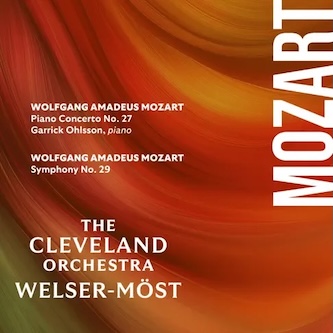
It’s taken a few years, but the Cleveland Orchestra and music director Franz Welser-Möst are finally back with a recording that does them and their reputations consistent justice. That the album in question is a shortish compendium of selections by Mozart is notable in itself: usually accounts of the Piano Concerto No. 27 and Symphony No. 29 that are played with such polish and finesse lack a corresponding degree of vigor.
Not here. Though Welser-Möst and his forces bring considerable tonal elegance to this fare, their performances are impeccably balanced and rhythmically taut. When it comes to the charming A-major Symphony, that’s really all you need—though the Clevelanders add some nicely pointed articulations to the proceedings, especially in the outer movements.
There’s a similarly graceful spirit to be found in the orchestra’s playing across the B-flat-major Concerto (as the violins’ chirping grace notes in the first-movement introduction anticipate). Just as inviting is Garrick Ohlsson’s take on the solo part, which is eminently well-voiced and songful, particularly during the Larghetto and across the rippling developmental passagework in the opening Allegro.
Though sometimes a shade spacious, there’s never a sense of the pianist—or conductor and orchestra, for that matter—stretching the music beyond what it can take or offer. Instead, this is an unabashedly modern Mozart performance that feels and sounds perfectly fresh and natural.
— Jonathan Blumhofer
Popular Music
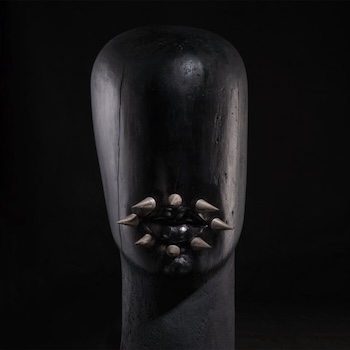
Akira Umeda & Metal Preyers’ Clube da Mariposa Mórbida (Nyege Nyege Tapes) is drenched in dread. Their songs’ simple melodies could’ve been written by a child, but they are tossed around by volcanic spurts of percussion and synthesizer. Synthesized voices—created with text-to-speech software—hover in suspension throughout: they are impossible to ignore or to pay full attention to. (The bass line of “Olhos do Facão” is minimal to an extreme, yet it’s the closest the album comes to supplying a hook.) The pair take advantage of the unsettling potential of sounds that resonate mysteriously—they are half-human yet unintelligible.
The sixth album from the American-British duo Metal Preyers, who comprise Jesse Hackett and Mariano Chavez, is their second collaborative effort, following a project with South African gqom artists Phelimuncasi. This time around, they engaged in a long-distance collaboration with Brazilian producer and visual artist Akira Umeda, who’s been making music since 1997. Hackett submitted audio clips and ideas to Umeda, who remixed them and created his own contributions.
The production takes individual parts—spoken word, field recordings, tuned percussion—and collides them in jarring ways. Even the pretty “Cut Throat Mickey” gives off alienated vibes. Umeda and Metal Preyers bring unconventional approaches to structure. Their songs are built around rhythm and the repetition of loops—yet, somehow, they never just rotate in place. When new elements are introduced, they make the music more dissonant.
Metal Preyers have backed away from the heavy African influence on their self-titled 2020 album. The track “Big Scud” inclines towards the Middle East. The album’s title tune begins with an indistinct drone; other elements of the song emerge as though they are being inserted from a distance. The proceedings never become too noisy, but the overall impact suggests someone trying, unsuccessfully, to hold back their panic. Umeda and Metal Preyers’s playful sense of humor bleeds through, but that topsy-turvy feeling, of threatening anxiety, defines their album.
— Steve Erickson
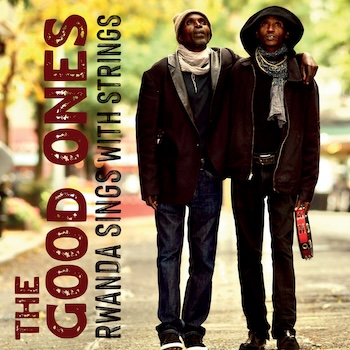 Now reduced to the duo of singer/guitarist Adrien Kazigara and singer/percussionist Janvier Havugimna, the Good Ones live in the Rwandan countryside, without running water or electricity. First formed in 1987, the musicians survived their country’s genocide. Their music’s acoustic nature—and use of household objects as percussion—aren’t entirely aesthetic decisions. Yet the band has reached an international audience. Its 2019 album Rwanda, You Should Be Loved included guest appearances by members of Wilco, Sleater-Kinney, My Bloody Valentine, and TV on the Radio. The Good Ones released an NPR Tiny Desk video last year.
Despite the title, their fifth album, Rwanda Sings With Strings (Glitterbeat) isn’t at all slick. Per producer Ian Brennan’s preference, it was made in a three-hour session. Joined by cellist Gordon Winter and violinist Matvei Sigalov, they recorded the album live-to-tape in a Washington, DC. hotel room. Each song was given just one take, with no overdubs. Despite these recording strictures, each voice and instrument is distinct and carefully separated. The mix makes the spare music sound big.
Kazigara and Havugimna harmonize in a variety of ways, doubling each other at times, as overlapping in a dissonant manner or working in counterpoint. The percussion, created by drumming on boots, cushions, and cups, propels the songs along gently. This provides an effective contrast with Winter’s slow, gently weeping cello. Given the limited instrumentation, the album spans a lot of emotional space within the parameters of its rough sound.
Although their lyrics are sung in Kinyarwanda, English-language song titles provide a guide to the storytelling. The narratives sketch out scenarios of heartbreak and disappointment: “Mediatrice, You Left This World Too Soon,” “One Red Sunday, You Lied To Me & Tried to Steal My Land.” There’s a strong suggetions that Rwanda itself is the unfaithful lover the pair are singing about, but the music’s communal nature supplies a degree of comfort.
— Steve Erickson
Jazz
 Gonzalo Rubalcaba has long impressed with his advanced keyboard technique and flair for performing jazz with an Afro-Cuban tinge. At the age of 62, the Cuban-born pianist has created a considerable discography as a leader and sideman. In the latter category, his work with bassist Charlie Haden was particularly rich and nuanced. His latest disc as a leader is drawn from an impeccably recorded 2022 gig in New York and features lengthy original compositions by each group member plus two classic tunes.
First Meeting: Live at Dizzy’s Club is a fine ensemble release with one caveat (see below). It certainly doesn’t hurt that the pianist has assembled a group of masters of their instruments at a time when each seems to be reaching a mid-career peak.
Larry Grenadier (bass) is well known for his years with the Brad Mehldau Trio. He seems a bit more grounded here than he was with Mehldau’s chatter and roll machine. Eric Harland (drums) was a funky force at the bottom of Dave Holland’s best groups, but plays it more toward the middle here, providing some particularly nice work on the rims.
Another veteran of Holland’s band rounds out the quartet. The tenor and soprano saxophonist Chris Potter has long been deemed a spectacular reedman. Noted jazz critic Nate Chinen has called him “dauntingly proficient.” When hearing Potter perform here, though, one can’t help but think of Miles Davis’s legendary admonition to John Coltrane: he didn’t need to include everything he knew in every solo. Potter, at times, risks dominating the album and exhausting the listener in the process.
That said, the saxophonist contributes one of the recording’s better originals. Potter’s “Oba” employs an Afrobeat as it explores modal territory. He also adds Sonny Rollins-esque allusions to Rubalcaba’s slow-cooking “Santo Canto.”
Several pieces on the disc tend to develop slowly. Harland’s “Eminence” pleasantly takes its time to venture outside its initially sedate harmonies. Grenadier adds a resonant solo to his plaintive “State of the Union” and fills out a lovely trio passage on “Con Alma,” a Dizzy Gillespie classic.
My fave cut, however, has to be the foursome’s take on Chick Corea’s post-bop masterpiece “500 Miles High.” Potter’s seasoned texturing works beautifully in conversation with the leader’s effusive Latinisms. The pair take you ever higher.
— Steve Feeney
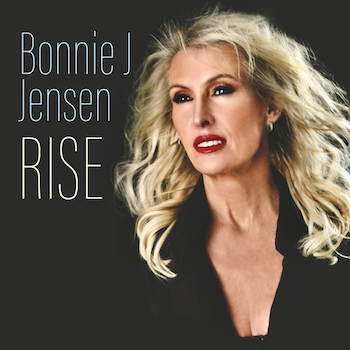
Bonnie J. Jensen is a familiar singer on the Australian scene with the cred to pull together some of the country’s best jazz musicians for her records. Her fifth, Rise (MGM Metropolitan Groove Merchants), has a mixture of small combos and a big band, some originals, and an imaginative selection of covers.
Jensen doesn’t improvise. Instead, she emphasizes storytelling and accentuating the rhythms embedded in the melodies without any excessive theatrics. She is also a fine composer and arranger with an ear for colors and a feel for the blues. It’s not an ambitious album destined to be a ground-breaking classic, but it sticks to your ribs.
I especially liked the selection of covers. The album opens with a slinky vamp version of Stylistics’ “People Make the World Go Round,” a song jazzed by Freddie Hubbard and Milt Jackson. There’s also a sleepy take on James Taylor’s “Don’t Let Me Be Lonely Tonight.” Jensen lets the strength of the composition do its magic. The cover of Sting’s “La Belle Dame Sans Regrets” (thank you for not choosing one of Sting’s overplayed songs) is a mid-tempo samba.
The best of the pop covers is the Little River Band’s “Reminiscing.” It makes you wonder why this one hasn’t been covered by jazz musicians many times before. It’s a lovely melody with a built-in relaxed swing, and the lyrics are charming (complete with a shout-out to the Glenn Miller band). The arrangement here adds some rich harmonies, but nothing is done to mess with the simple appeal of the original. Jensen doesn’t sound like a young girl with a bird-like voice who wouldn’t be able to sell a song like this.
You’ll find other covers from Herbie Hancock, Chick Corea, and Michael Franks on this fine release from an up-and-comer from down under.
— Allen Michie
Film
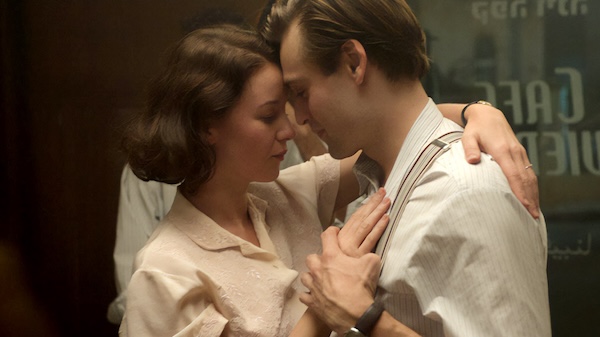
Irina Starshenbaum and Douglas Booth in a scene from Michael Winterbottom’s film Shoshana. Photo: Courtesy of Greenwich Entertainment
For centuries, according to a voiceover of the title character (Irina Starshenbaum) in Michael Winterbottom’s stolid, based on fact historical drama Shoshana (2023), Palestine was just a quiet backwater of the Ottoman Empire with a small Jewish population.
Then Turkey, after being on the losing side in World War I, lost Palestine which became a British mandate. The British, having already stated their intent to establish Palestine as “a national home for the Jewish people” in the 1917 Balfour Declaration, encouraged Jewish immigration—a trend that intensified with the beginnings of the Nazi genocide (a development which, oddly, the film barely mentions).
But after the Arab population staged an uprising in the 1930s, it was clear that the British had not thought things through. Arab violence was met by terrorism from the extreme Jewish paramilitary group the Irgun, who also targeted the British troops and police in a campaign of bombings, assassinations, and robberies organized by the fanatical Avraham Stern (Aury Alby). As Tom Wilkin (Douglas Booth), a British officer in the Palestine police force, explains to his flummoxed superior Geoffrey Morton (Harry Melling), “The problem is that we promised both of them this could be their home.”
Further complicating matters, Wilkin also saw Palestine as his home and was in love with Shoshana, the daughter of the late socialist Zionist leader Ber Borochov. More problematically, she was a member of the Haganah, which, like the Irgun, was an illegal nationalist movement but with a less violent agenda, seeking a utopian state for both Jews and Arabs. Unsurprisingly, their conflicting loyalties put the lovers in an awkward position, kind of like Romeo and Juliet, but without the poetry or passion. In short, their relationship gets lost in the politics, both historically and in the movie.
Morton’s inability to distinguish between the ostensibly good Haganah and the bad Irgun poses dire consequences both for Tom and Shoshana and the future of the Middle East. Be that as it may, the film evokes less the ongoing catastrophe in Gaza than the failed US effort to contain the insurgency in Iraq. Raids, roundups of civilians, the waterboarding of prisoners, IED’s exploding, it’s like a flashback to the Bush administration. As for Shoshana’s idealism, at the end she’s calmly firing a machine gun at Arabs during the 1948 Arab-Israeli War.
Shoshana is screening at the Coolidge Corner Theatre.
–Peter Keough
Books
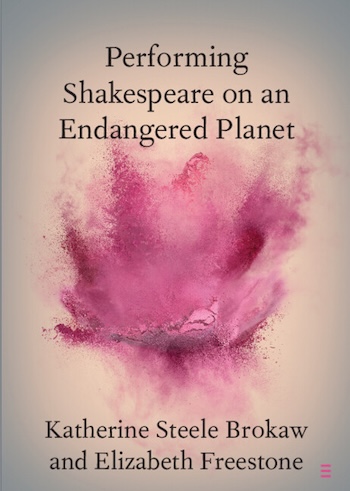
If you accept the consensus of most scientists on climate change, we are in big trouble. Unfortunately, the current U.S. administration is intent on silencing any discussion within its agencies about the climate crisis and its implications. Theatre remains one of the most important places for the public to wrestle with this difficult—and for some, overwhelming—issue.
Two university-based Shakespearian scholars, Katherine Brokaw (University of Texas) and Elizabeth Freestone (University of Birmingham) have thought deeply about environmental breakdown. They have come up with a set of recommendations for concerned theatre practitioners to respond to our situation. Their short book, Performing Shakespeare on an Endangered Planet (Cambridge University Press, 124 pages), is an unapologetic call to arms for enlisting the most canonical writer of the English-speaking world in the fight to save the planet. It also suggests ways that productions of the Bard can serve the cause.
For Brokaw and Freestone, that means muscularly adapting Shakespeare’s language in ways that make his plays relevant to the existential challenge of global warming and environmental degradation. For instance, they suggest “indigenizing” Shakespeare’s references to nature, replacing his dialogue’s Elizabethan flora and fauna with local plants and animals.They also suggest removing or reworking passages that might be irrelevant to a production’s ecologically themed purpose. In terms of genre, they argue persuasively that Shakespeare’s comedies and tragicomedies are better suited to “eco-theatre” than his tragedies.
Speaking of language, Performing Shakespeare on an Endangered Planet suffers at times from academese — a tendency to create neologisms and sentences padded with unnecessary modifiers. Brokaw and Freestone are at their best when they relax to the point of irreverence. They offer this advice to theatre-makers who are hesitant about changing the Bard’s hallowed words — “Shakespeare is super dead: he won’t care.”
— Clark Bouwman
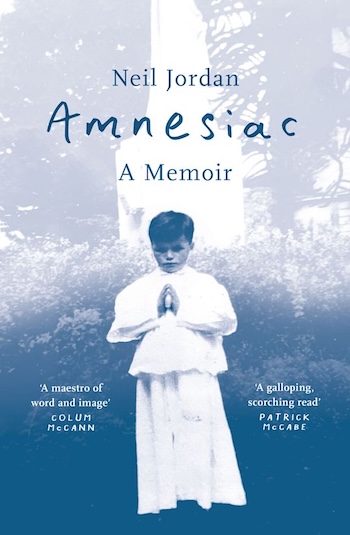
Before he became the masterful director of such films as Mona Lisa (1986) and The Crying Game (1992), Neil Jordan was—and continues to be—an accomplished fiction writer, winning prizes for the short story collection Night in Tunisia (1976), among others. Perhaps that’s why his exhilarating Amnesiac – A Memoir (Bloomsbury/ Head of Zeus, 304 pages) does not resemble the autobiographies of other filmmakers—except, perhaps, for Luis Buñuel’s My Last Sigh (1983)—as much as it does those of literary giants. Comparisons can be made with Speak, Memory (1966) by Vladimir Nabokov and even with James Joyce’s 1916 bildungsroman A Portrait of the Artist as a Young Man (“Has there ever been a worse title for a better book?” asks Jordan in his own paradoxically titled volume).
His approach to memory is contrapuntal, free associative, and filled with uncanny serendipities and seeming trivialities that prove epiphanic. Much of the book revolves around his parents and grandparents. He doesn’t even get to his own birth until about page 40, and not until almost the halfway point does he discuss his debut feature Angel (1982). The first film made by an Irishman in ages, it is about a musician (played by future frequent collaborator Stephen Rea) packing an Uzi in his saxophone case to wreak revenge against terrorists.
A surprise hit in the US, it led to his second film, The Company of Wolves (1984). Here, he combined the horror stories of Angela Carter with the structure of Wojciech Has’s The Saragossa Manuscript and Jaromil Jires’s Valerie and Her Week of Wonders (1970). Highlights included the set designs of Anton Furst. An example of Jordan’s knack for eclectic inspiration, the effort was a surprise hit in Britain, but not in the US. It has since developed cult classic status.
It also figures in one of Jordan’s eeriest, palimpsestic memories. A recurrent motif in the book and in his films is bridges, in particular an old one across the River Nanny near the birthplace of his mother. While shaking the hand of Princess Anne (whom he found curiously erotic) at an LA reception for The Company of Wolves, he found out that his father had died of a heart attack—under the same bridge. His father was a great believer in ghosts—would he one day haunt his son? To find out is just one of many reasons to read this sublime book.
–Peter Keough
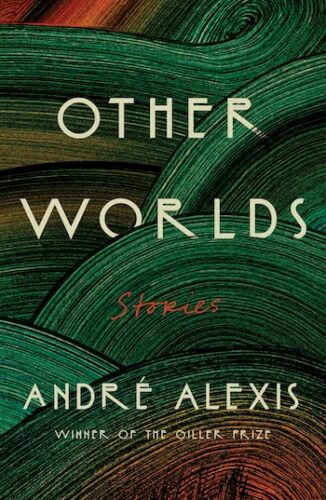 A section of autofiction in acclaimed Canadian novelist André Alexis’s tantalizing story collection, Other Worlds (FSG Originals, 276 pages), contains this confession: “my work is a recreation of the bewilderment that was a dominant emotion of my childhood self—bewilderment and resentment. Rather than directly expressing this bewilderment, however, I have tried to create words in which a sympathetic reader will feel a familiarity while struggling to interpret the appearance of certain things, certain signs, certain utterances.” Alexis’s is a compelling vision of ambiguous intersection, in-between places in which his narrators accept the inexplicable matter-of-factly, a laidback scrutiny that confounds and, at its best, tantalizes.
For example, the yarn “Houyhnhnm” is a deadpan, but somehow poignant, cross between Jonathan Swift and Mister Ed. A son carries on a sophisticated conversation with a talking horse (he likes to be read to) who had begun the dialogue with deceased father. Is this for real? A case of psychological derangement? Mom has heard the animal as well. The magical realist political novella “Contrition: An Isekai” begins in Trinidad: a practitioner of obeah in 1857 dies. His consciousness is miraculously resurrected, a hundred years later, in the body of a seven-year old living in Petrolia, Ontario, who had expired moments before.
Alexis evokes bewilderment beautifully, but he is not always so spot-on regarding resentment, the anger inspired by helpless confrontations with the utterly bizarre, such as corpses who (apparently) climb trees or superrich aristocrats who may (or may not) lead a ring of casual cannibals. For me, the best pieces here dramatize how easily people slide into lives of absurd subservience. Among my favorites is “Winter, or A Town Named Palgrave,” Alexis’s homage to the neglected Italian fantasist Tommaso Landofi. Here, a writer takes on, without much complaint, the duty of caring for the citizens of a small town who go into hibernation each winter — they hang from huge sacks that need to be inspected from time to time. In some worlds, it is an artist finds steady work.
— Bill Marx
Tagged: "Amnesiac – A Memoir", "Clube da Mariposa Mórbida", "First Meeting: Live at Dizzy’s Club", "Performing Shakespeare on an Endangered Planet", "Rise", "Rwanda Sings With Strings", Adrien Kazigara, Akira Umeda & Metal Preyers, Allen Shawn, Bonnie J. Jensen, Douglas Booth, Elif Saydam, Elizabeth Freestone, Franz Welser-Möst, Gonzalo Rubalcaba, Irina Starshenbaum, Janvier Havugimna, Jesse Hackett, Katherine Brokaw, Klaus Mäkelä, Mariano Chavez, Metal Preyers, Michael Winterbottom, Neil Jordan, Shoshana, The Good Ones
2 Comments
Leave a Comment

Wonderful to get a preview of what’s ahead in the arts
I haven’t read “Performing Shakespeare on an Endangered Planet,” but I’m skeptical that it’s proposing any big leap forward. For starters, it’s unlikely that people who oppose environmentalism are going to be converted by watching a Shakespeare play (assuming they’re the types who attend Shakespeare plays in the first place). In fact, the whole thing could backfire. If an audience knows they are being lectured to and indoctrinated, especially at the expense of an otherwise time-tested masterpiece, they’re likely to roll their eyes and get irritated rather than be inspired to spring into social action.
My opinion is that one should tread carefully when selectively leaving out parts of a Shakespeare text that don’t fit neatly with the pre-determined ideology, or worse still, replacing words and phrases with the environmentally correct ones. There’s a delicate chemistry in these plays that make them work. Shakespeare always provides views and counter-views, good sides to bad people, bad sides to good people, and moral complexities rather than simple digestible moral maxims. (See “The Devil’s Party: Critical Counter-interpretations of Shakespearian Drama” by Harriett Hawkins). I’d much rather see a version of “The Tempest,” for example, that emphasizes humankind’s role as manipulators in the natural world, both responsibly and irresponsibly, and the mixed benefits of the “magic” of technology and human connections. You should leave a great Shakespeare production thinking about questions (esp. “Measure for Measure” and “The Merchant of Venice”) rather than confirmed in a crystal-clear political message.