Film Commentary: “Pride and Prejudice” — The Nature of Love, 20 Years On
By Peg Aloi
Joe Wright’s 2005 adaptation of Jane Austen was a cultural tipping point; he was the bold standard bearer for what has become a spirited new form of historical cinema.
Pride and Prejudice, directed by Joe Wright. Playing through Thursday at AMC Boston Common, Alamo Drafthouse, and through Wednesday at Landmark Kendall Square, AMC Causeway, AMC Assembly Row, and other theaters in the Boston area.
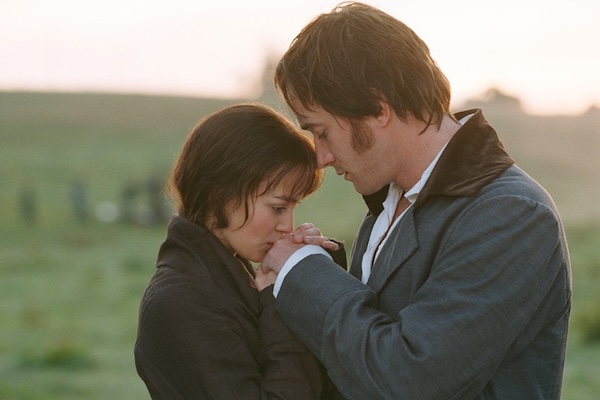
Keira Knightley and Matthew Macfadyen in 2005’s Pride and Prejudice.
Joe Wright’s screen adaptation of Pride and Prejudice is celebrating the 20th anniversary of its release with big screen showings around the country, including a number of cinemas around New England. The film’s brilliant screenplay (by Deborah Moggach, from Jane Austen’s novel) and the white-hot cast sparked plenty of praise, but it was Wright’s distinctively rich visual style that made his feature debut such a stunning triumph. This sumptuously wrought effort boasts exquisite pacing and scale, melding epiphanies and desires in scenes containing tiny, knowing details amid sweeping emotional arcs. But it’s how the film treats nature, as an evocative backdrop and as a prism reflecting character depth and complexity, that reinvents the costume drama as a romantic paean to the senses.
Wright’s second feature, the rather more disturbing Atonement (2007), uses nature imagery to underpin darker themes: betrayal, violence, the cruelty of class privilege, and the dehumanization of war. Here, pastoral green imagery serves as the nurturing backdrop for the blossoming romance between Cecilia (Keira Knightley) and Robbie (James McAvoy), as well as the wild imaginings and petty emotional outbursts of Briony (Saoirse Ronan). Cecilia’s bright green silk gown, worn when Robbie is whisked away after being the victim of a false accusation, is the last glimpse of green we see in scenes set in England. Nature is by turns savage and haunting as the story progresses: Robbie walks through a silent orchard in France in a scene of horrific brutality. Later there is a dreamy fantasy sequence of Robbie in a sunlit meadow dotted with red poppies, the symbol of remembrance in honor of the English war dead. The notion of England as a “green and pleasant land” is undercut by a recurring theme of woe and carnage, a subversion of natural beauty that is striking and haunting.
In Pride and Prejudice, nature’s symbolism embraces lofty as well as pedestrian ideas. Class boundaries are writ large in the vast expanses of fertile wildness that surround the estates of the wealthy. In a gorgeous sequence, Elizabeth Bennet (Knightley) walks to a grand estate to visit her sister Jane (Rosamund Pike), who has fallen ill after going on horseback to a social event at Netherfield, a large manor house and home of Mr. Bingley (Simon Woods), who is smitten with Jane after meeting her at a party. Forgoing hiring a carriage (it’s too expensive given her family’s modest means), Elizabeth walks the three-mile distance. It’s a fair morning; she enjoys the exercise and scenery, free and accessible to all, as long as travelers stay on the public walking paths (still very much a thing in the English countryside, if you visit). When she arrives at Netherfield, Bingley’s sister Caroline (Kelly Reilly) looks aghast at Elizabeth’s dew-soaked skirts and glowing face. She asks, condescendingly, “Good heavens, Miss Elizabeth, did you walk here?” Elizabeth answers “I did,” a twinkle in her eye, perhaps telegraphing the impertinence of the question and her amusement that these people don’t know what they’re missing by not going for a long walk on a lovely morning. It so happens that Fitzwilliam Darcy (Matthew Macfadyen) is visiting, and, despite an initial mild hostility between them at a dance some days earlier, he is, at this moment, smitten by the fresh-faced Elizabeth’s confidence, capability, and care for her sister (not to mention her rosy cheeks and wind-blown hair). Her presence quite takes his breath away.
Some time passes. Darcy, charmed by Elizabeth but unaware that she finds him rude and arrogant, humbles himself by proposing, only to be rejected. Still, Elizabeth is torn. Despite thinking Darcy is unpleasant, she is helplessly attracted. She goes along with her friends the Gardiners to visit Pemberley, Darcy’s grand estate, under the assumption that he won’t be there. As their carriage arrives, alongside a winding road past ponds and hills and forests that open onto a vista of a perfectly straight path through formal gardens to the majestic manse, Knightley’s face skillfully conveys conflicting emotions. She’s awestruck by Pemberley’s grounds, a mix of sylvan wildness and Georgian perfection. Yet, at the same time, she rolls her eyes and smirks with amused self-deprecation — she has stupidly rejected a man who could have given her all this. Moved by joy, wondering if she may have been too harsh, there’s a flicker of doubt in her eyes: could she have been wrong about Darcy all along? Elizabeth goes on to see galleries full of breathtaking works of art that deeply move her; she talks with one of Darcy’s longtime servants, who has only praise for his kindness and generosity. She begins to realize her opinion of him may have been misguided. Darcy, of course, shows up unexpectedly, with his sweet-mannered sister, who further convinces Elizabeth she has misjudged Darcy. Overwhelmed by the charms of Pemberley and what the carefully curated estate says about its owner, Elizabeth is now worried she has lost her chance.
But nature’s mystical power intervenes, once again. Wright crafts a scene of nearly wordless romantic perfection, set in the quiet, hopeful sanctum of an English meadow at dawn. Elizabeth, after a somewhat sleepless night, wrapped in a shawl against the chill, walks outside as the sun is coming up. She runs into Darcy, who has walked (quite a distance!) to her home. He strides across the fields through a twinkling fog, his wool coat sparkling with dew, emerging as if from some sexy Brigadoon, where the men are tall and stride purposefully through nature’s vastness, but at closer range display a vulnerable quiver on their upper lips that belie their proud posture. That quiver is telling: these stalwart lords of Albion are used to getting what they want, but would also give anything, change anything, do anything, to win the love of a strong-minded, sensitive woman beneath their station who, damn it all, has bewitched them, body and soul. And in this moment, hovering between dawn and morning, the liminal place where the heart knows and sees what is true and good, in the green cathedral of trees echoing with birdsong, he asks again, and she answers.
It is perhaps one of the most heart-stopping moments seen on the silver screen (or the flat screen) in the last half century. It became the defining dramatic expression of what is at the center of a story by a great novelist whose subtle social satires were thought in the popular imagination, for too long, to be rather arch and chilly. In the sympathetic, visionary hands of contemporary directors, (Simon Langton, Ang Lee, Roger Michell, and Autumn de Wilde, to name a few), Austen’s narratives have been imbued with heat and color and vitality. Wright’s adaptation was the cultural tipping point; he was the bold standard bearer for what has become a spirited new form of historical cinema. Going beyond the familiar staid landscapes of traditional costume dramas and heritage films, these longing looks at the past are set in a terra incognita filled with primal passions and natural beauty. Darcy walks through a green, misty meadow at dawn, each footstep reminding him of that day he fell in love, bringing him to this moment where he sees her, waiting, and as the rising sun illuminates his soul to her heart, she warms his cold hands with her lips: it is that simple, that sublime.
Peg Aloi is a former film critic for the Boston Phoenix and member of the Boston Society of Film Critics, the Critics Choice Awards, and the Alliance for Women Film Journalists. She taught film studies in Boston for over a decade. She has written on film, TV, and culture for web publications like Time, Vice, Polygon, Bustle, Dread Central, Mic, Orlando Weekly, Refinery29, and Bloody Disgusting. Her blog “The Witching Hour” can be found on substack.