
Film Feature: Talking to the Artists Who Made “Porcelain War”
By Peter Keough
The film is a testament not just to the resilience and courage of Ukrainians in the face of brutal aggression and the threat of genocide but to the power of art to transcend tragedy and injustice.
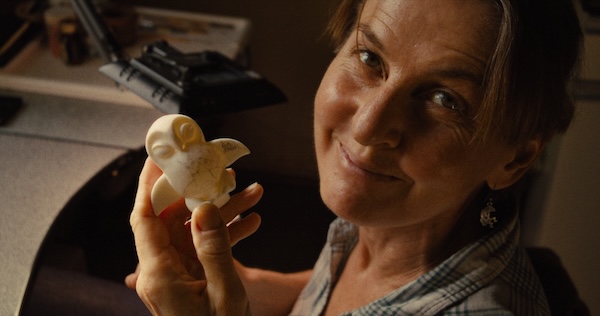
Anya Leontyev is admiring her husband Slava’s latest porcelain creation in Porcelain War. Photo: Picturehouse 2024
One of the few positive outcomes of the Ukraine War has been the outstanding documentaries it has inspired — last year’s Oscar-winner 20 Days in Mariupol and this year’s Porcelain War (one of my top 10 best films of 2024) among them. In a unique, long-distance collaboration first-time filmmakers Brendan Bellomo and Slava Leontyev recorded the latter’s experiences as a porcelain artist (with his wife Anya Stasenko) who remained in the country after the Russian invasion to train civilians to become soldiers. The film is a testament not just to the resilience and courage of Ukrainians in the face of brutal aggression and the threat of genocide but to the power of art to transcend tragedy and injustice.
I had the good fortune to interview Bellomo (recuperating from pneumonia in California) and Leontyev and Stasenko (in Boston fresh from a screening and Q & A at the Coolidge Corner Theatre) via Zoom.
Arts Fuse: How did the screening and Q & A at the Coolidge go?
Slava Leontyev: The audience was amazing. They connected to the movie and the Q & A was powerful.
Brendan Bellomo: We’ve traveled a lot with the film and it’s gotten a deeply emotional response that spans the gamut from people who haven’t been following the conflict, to people that knew about it but felt afterwards that it was more important than ever, to people who are Ukrainian and feel this is the most accurate depiction of what they’ve been going through.
AF: Does the positive reaction to the film make you more optimistic about ongoing American support for Ukraine?
Leontyev: The reaction of American audiences gives me a lot of hope. Anyway, we don’t have a choice whether to fight or not to fight. We survived so far only because of our resistance. We will continue our resistance, but we need your help and we need it now. I can’t predict the outcome, but I feel good about it.
AF: A recent poll reported that 44 percent of Ukrainians trust Trump. Do they know something we don’t know?
Leontyev: I don’t think it’s about Trump personally. It’s more about our trust of Americans. We trust the Western world and the free world.
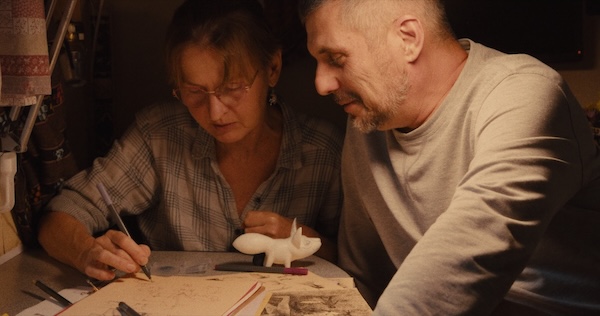
Artists Anya and Slava at work in Porcelain War. Photo: Picturehouse 2024
AF: Let’s hope that trust is not misplaced. So can you talk about how the film came about?
Bellomo: Absolutely. One of our producers, who grew up under Russian oppression in communist Poland, discovered about eight years ago Anya and Slava’s figurines. They deeply moved her because they reminded her of her home. She shared them with me and I was blown away. I just couldn’t believe that something so small could tell such huge stories.
The four of us then began to work together on an animation project, and then Russia invaded Ukraine. We asked Slava, when are you guys leaving? And he said, we’re going to stay and we’re going to keep making our art at night. And I asked, what are you doing during the day? And he told me I’m in the Ukrainian special forces and I’m training civilians to fight. And in this moment, we all realized that their resistance was happening on two fronts, one of them creative, and the other one military in this completely unexpected new reality for Slava and his community.
We discussed how he felt that while it was important that Western journalists were telling the story of Ukraine from outside, that there was another story that wasn’t being told, the one from within, from the perspective of an artist. So we decided to send cameras to Slava. We were 6,000 miles apart. We didn’t speak the same language, were separated by two time zones, two cultures, and we didn’t know how we were going to collaborate at this great distance. And even though Slava’s English now is incredible, at the time they didn’t speak a word of English and we were doing everything over Zoom through an interpreter. We basically set up an impromptu film school where they learned this language of cinema so that they could use it to share their lives with people around the world.
AF: The cinematography by Andrey Stefanov is really astonishing. He wasn’t able to accompany you to the US ?
Leontyev:: Andrey is still in Kharkiv. He’s training civilians. So he’s not a part of this aspect of the journey.
Bellomo: At the beginning of this process I asked Slava, do you know anyone who could even just press the record button on a tripod? And he sent me all of these photographs of oil paintings, and they were stunning. They were filled with such emotions, such beauty. I knew this was a cinematographer. The first shots he filmed on the very first day are in the movie. That’s how powerful he is as an artist.
AF: Did you think about going to Ukraine to collaborate?
Bellomo: We really wanted to empower Slava and Andrey and Anya to tell their own story. In the beginning, we were going to travel there but we decided if we go, it would change this dynamic. It’s all about a perspective. It’s all about creating this aesthetic framework for truth to come to the audience in the correct way that binds together everything. And the other decisions, these can be done remotely. I felt so much for what they were going through and I knew if I was feeling this, the audience could feel the same thing when they saw them on a bigger screen in the cinema.

One of the porcelain stars of Porcelain War. Photo: Picturehouse 2024
AF: How difficult was it to deal with the day-to-day uncertainties of an ongoing war?
Bellomo: It was an immense challenge. We sent 15 cameras to Slava and Andrey and the members of Saigon [a special forces team associated with Slava featured in the film] who had body cams and drones. They shot over 500 hours of footage and we had a huge amount of material coming in but there was constant shelling. In October of this year they had only one night without shelling in Kharkiv. The power, Internet, and water were shut down, and sometimes Slava and Anya and I would be on Zoom and we would hear an air raid. We would lose our connection and we would just be waiting sleeplessly to hear from them the next day.
We also knew we had to protect the footage. So we worked with Homeland Security personnel, military advisors, and cryptography experts to make sure that everything was safeguarded. And in the final release we only used footage of missions that were at least three months old to safeguard the details, locations, and identities of everyone. Plus we made sure that we worked with investigative journalists and fact checkers so that everything was deeply verified.
AF: The film takes us up through 2023 or so. What’s the situation like now?
Leontyev: The war continues and Kharkiv is under bombardment. Andrey is in Kharkiv now and his family is in Luxembourg, where they are safe, but they are separated like millions of Ukrainian families, broken apart now. Every one of my Saigon friends have survived so far. It’s a miracle, because they have fought many other battles since Bakhmut [shown in the film]. Now they are fighting near Kharkiv, near our native city. Anya and Frodo [their dog] and me are now on a journey to support the movie. That is our responsibility.
AF: What are your hopes for the coming year?
Leontyev: We really have no time for predictions. It’s our very crazy and very Ukrainian way. It’s like how we had no time to study in a normal way how to make movie or how to speak English or how to fight. We were just forced to do all these things. We don’t have a prediction about how things will end up but it’s our responsibility here and now to share our movie. It’s our responsibility in Ukraine to continue our resistance and distribute our culture, because our culture is the source of our resilience and our resistance.
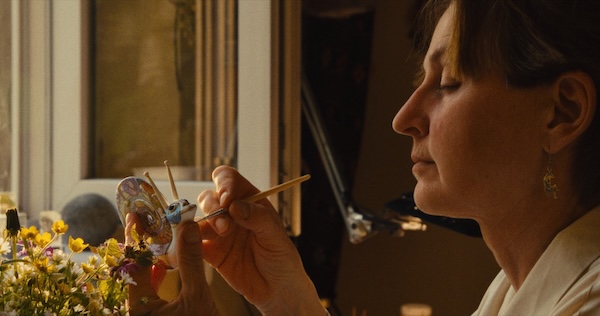
Anya delicately finishes a porcelain snail in Porcelain War. Photo: Picturehouse 2024
AF: Some have criticized the film for having an erratic tone, for juxtaposing beauty with images of devastation. Was this a difficult balance to maintain in the making of the movie?
Bellomo: This balance is not something imposed but is what everyone who’s participating in it is going through every day. Anya and Slava talk about how it’s easy to make people afraid, but it’s hard to stop them from living. They go out, even in the midst of this war, and try to live peaceful lives as much as possible, and seek inspiration for their art and maintain a connection to their culture, to the community, to the nature around them. And then all of a sudden there will be shelling, or they need to leave to go on a mission, or part of their neighborhood is destroyed. And so the contrast that exists is merely the contrast within their lives. And that’s what we’re trying to share with people, this absolute whiplash. It’s not something best observed from the outside, but a story that should be made available to audiences from their perspective.
Leontyev: This balance of beauty and horrible war is not artificial. It’s our personal experience. We don’t focus on destruction and evil because all war looks the same, all destruction looks the same. We are focused on beauty. You have a lot of news footage, but news gets old quickly. But beauty never does, and we were focused on all these beautiful things that may be destroyed because of this war, the beauty of our nature, of our culture, and especially the beauty of our people, who are still able to defend their independence, to distribute their culture, and preserve their humanity even in this dark time.
AF: When this war is over, do you think you can overcome its trauma and forgive Russia?
Leontyev: We are not thinking about Russians too much. We feel this is not like something personal but a disaster like a hurricane or pandemic. It’s not about ethnic origin but a desire to have democracy, to be free, to preserve all those things that a totalitarian government will try to take away.
Porcelain War is screening at the Coolidge Corner Theatre.
Peter Keough writes about film and other topics and has contributed to numerous publications. He had been the film editor of the Boston Phoenix from 1989 to its demise in 2013 and has edited three books on film, most recently For Kids of All Ages: The National Society of Film Critics on Children’s Movies (Rowman & Littlefield, 2019).
Thank you so much for this update. Excellent, informative interviews.
I’ve been wondering how all of these wonderful people have made out.And about how this extraordinary film was made.
I love this film. As a filmmaker myself (Kharkiv, Ukraine, My Beautiful, Suffering City” 2023, and others) I am completely impressed by every aspect of the film’s flawless production.
It is so needed to see positive upbeat imagery and stories to contrast with the war news we’ve been limited to..
I think of all the WW2 films I grew up with inspired by the triumph of Democracy over Dictatorship. Right versus wrong. Patriotism versus evil. We need to see more such stories from the Ukrainian heroes as well as our own such current challenge here at home.