
Classical Album Review: “Piano Heroines” — Claire Huangci Unearths Forgotten Brilliance
By Jonathan Blumhofer
This a superb album, smartly programmed and brilliantly played.
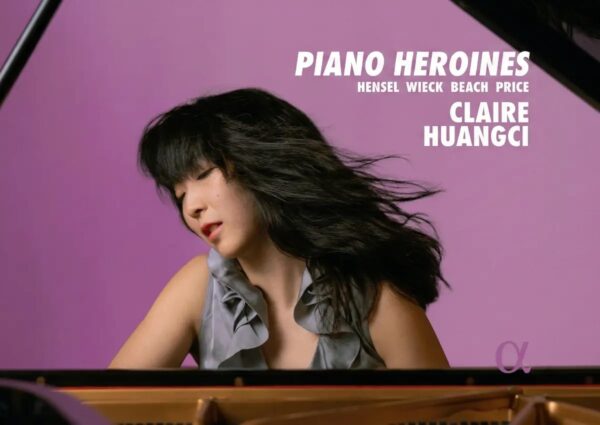
“Where has this music been all its life?” The Washington Post‘s music critic Paul Hume wrote after the first performance in recent memory of Amy Beach’s Piano Quintet. “Why has it never been heard while performances of quintets that are no better are played annually? If the answer is not that the composer was a woman, I would be fascinated to hear it.”
That was in 1974. While the ensuing half-century has seen some steps in positive directions, they’ve hardly been enough to make Hume’s observation passé. In fact, Claire Huangci’s brilliant traversals of music by Fanny Hensel, Beach, Clara Wieck, and Florence Price on the album Piano Heroines bring his questions back to the fore.
Why, after all, does this music only reside on the fringes of the repertoire? Is it unidiomatic? Hardly: all four composers were formidable virtuosos and knew their stuff—Wieck, alone, was among the most important pianists of the 19th century.
Is it poorly written? Again, no. All four composers were trained musicians and, beyond that, highly capable, intuitive writers of music. Look no further than Hensel: her brother, Felix Mendelssohn, had no problem publishing several of her works under his own name.
In fact, on the merits of Huangci’s readings of her Capriccio in B minor and excerpts from Das Jahr, Felix’s older sister might have been the more brilliant composer of the two. She was certainly no slouch as a tunesmith or virtuoso, as the cascading textures of the latter’s “June” demonstrate. The impish “February” scherzo suggests that the ability to craft pristinely wrought miniatures ran in the family, as does the haunting, Schubert-esque “September.”
While Hensel’s career was stifled by social expectations (made more onerous by the responsibilities her family felt as newly assimilated German-Jewish converts to Christianity), Wieck’s marriage to Robert Schumann—and her own deep-seated ambivalence about writing music—cut her compositional career short.
Yet her small catalogue of works is unfailingly strong. Huangci’s readings of excerpts from the Soirées musicales and Quatre pièces caractéristiques are fittingly vital, and the inclusion of the gorgeous “Romanze” from Wieck’s early Piano Concerto (which also features cellist Tristan Cornut) offers ample evidence of the composer’s melodic gifts.
Like Wieck, Beach was a piano virtuoso of note, though her performing career was temporarily derailed by her marriage to a much older, wealthy Boston doctor. To her spouse’s credit, though, he encouraged his wife to focus on composition (so, for that matter, did Hensel’s husband, Wilhelm) and a tremendous body of songs and chamber music, as well as some orchestral pieces of note, resulted.
Huangci’s offerings—the Fantasia Fugata, Four Sketches, and Cradle Song of the Lonely Mother—present both sides of Beach’s musical life in a flattering light. The Sketches are about as fresh a set of piano miniatures as they come, and they’re dispatched here with panache. So, too, the Fantasia, whose materials are supposedly derived from notes the composer’s cat played when it was placed on a keyboard. Meanwhile, the Cradle Song offers a haunting ambiguity that calls to mind Debussy.
Like Beach’s, the Price items showcase a composer-pianist of the first rank. Though her orchestral music has gained much attention lately, the Little Rock native was most impressive when writing for smaller forces, as Huangci’s selections demonstrate.
For fresh lyricism, it’s hard to beat the Meditation or Waltz of the Spring Maid. In Your Hands in Mine, Huangci avoids sentimental excess and ably mines the vim of the jaunty Cotton Dance. Just as impressive is the pianist’s well-directed rendition of the Fantasie Nègre No. 2.
Throughout, Alpha’s engineering is well-balanced and impressively lucid. Though Cornut’s entry sounds a bit pinched, the partnership settles in quickly and satisfactorily.
Taken together, then, this a superb album, smartly programmed and brilliantly played. Let’s hope it can help make Hume’s questions outdated once and for all—and before the next fifty years are out.
Jonathan Blumhofer is a composer and violist who has been active in the greater Boston area since 2004. His music has received numerous awards and been performed by various ensembles, including the American Composers Orchestra, Kiev Philharmonic, Camerata Chicago, Xanthos Ensemble, and Juventas New Music Group. Since receiving his doctorate from Boston University in 2010, Jon has taught at Clark University, Worcester Polytechnic Institute, and online for the University of Phoenix, in addition to writing music criticism for the Worcester Telegram & Gazette.