
Book Review: The Difficult Genius of Stephen Sondheim – Revisited
By Christopher Caggiano
Daniel Okrent’s Art Isn’t Easy is an engaging if familiar introduction to one of theater’s most complex figures — though seasoned Sondheim devotees may find themselves wanting more.
Stephen Sondheim: Art Isn’t Easy by Daniel Okrent. Yale University Press, 325 pages, $35.
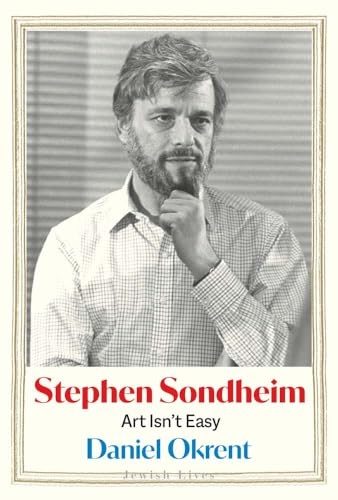 Let’s start with something that is not in question: Daniel Okrent is a terrific writer. A former editor at The New York Times, the author of numerous history books, and a finalist for the Pulitzer Prize, Okrent brings genuine literary skill and felicitous prose to his work. His latest book is no exception. But the question here is not whether he can write. It’s whether this book needed to be written.
Okrent himself acknowledges in his prologue that there is “certainly no shortage of published material about this creative giant.” That is, to put it mildly, an understatement, and it makes it all the more incumbent on him to justify this addition. The book’s title doesn’t inspire confidence. Art Isn’t Easy is an obvious and frankly pedestrian choice, taken from the song “Putting It Together” from Sunday in the Park with George. Plus, that title has already been used in Joanne Gordon’s 1992 study, Art Isn’t Easy: The Theater of Stephen Sondheim. As it turns out, Okrent’s book isn’t all that original either.
The go-to biography of Sondheim remains Meryle Secrest’s Stephen Sondheim: A Life (1998), which goes into deep biographical detail, including lengthy explorations of Sondheim’s relationships with his mentor, Oscar Hammerstein II, and his mother, Etta Janet “Foxy” Sondheim.
Okrent’s book is less about the scenes of Sondheim’s life and more about matters of influence and development. It’s less comprehensive than Secrest’s book, more of an arm’s length overview. For a seeming lack of anything else to say about his predecessor, Okrent resorts to fact-checking Secrest’s conversations with Sondheim against her recorded tapes. He points out that, while Secrest wrote that her subject called Harold Prince’s wife Judy “very very smart,” the tape reveals that he actually said, “very very very very smart.”
Really? That’s all you can come up with: Secrest cut two “verys”? Even Okrent seems to sense he is on thin ice here, acknowledging that Secrest’s “exploration in the mid-1990s of … [Sondheim’s] psychotherapy … will doubtless remain the primary source for anyone delving into her subject’s inner life.”
Beyond Secrest, there have been numerous book-length analyses of Sondheim’s craft, including Mark Eden Horowitz’s Sondheim on Music (2003/2019) and Steve Swayne’s How Sondheim Found His Sound (2005). Okrent engages in occasional armchair musicology, most of which is admirable and apt — but again, there’s plenty of this elsewhere.
So, who is the intended reader for this book? Those looking for an in-depth biography are better off with Secrest. Those looking for detailed insights into Sondheim’s creative process have numerous resources to turn to. Still, at only 230 pages, Art Isn’t Easy makes for a strong Sondheim primer, a big-picture introduction for the reader who isn’t necessarily a theater aficionado and wants an accessible entry point.
The book appears under the aegis of Yale University Press’s Jewish Lives series, which includes biographies ranging from Emma Goldman to Mel Brooks to Philip Roth. Having already published volumes on Irving Berlin, Leonard Bernstein, and Jerome Robbins, the series apparently needed its Sondheim.
This imprimatur, unfortunately, leads Okrent into some of the book’s weakest passages. He engages in unconvincing, at times forced, analysis about the lack of explicit Jewishness in Sondheim’s work. The discussion feels obligatory, as if included to palliate his editors at Yale. He even risibly quotes Spamalot (“You won’t succeed on Broadway / If you don’t have any Jews.”) to make the point that Jewish people and the Main Stem are deeply intertwined.
But one could make the same observation about Sondheim’s sexuality: the only time he ever wrote explicitly about gay characters was in his final full-scale musical, Road Show. Must gay writers write about gay characters? Must Jewish writers write about Jewish characters? Or are they free to write about whomever they choose?
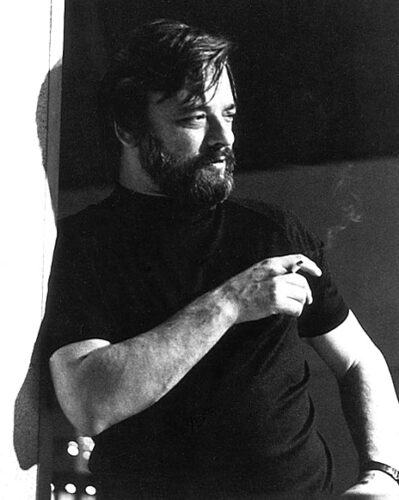
Stephen Sondheim in 1976. Photo: WikiMedia
So, what genuine new ground does Okrent cover? He apparently interviewed more than 30 of Sondheim’s friends and colleagues, including his two most important collaborators in the last 40 years of his life, James Lapine and John Weidman. He draws on a detailed and intimate interview with Sondheim conducted by the Columbia University Oral History Program in 1982, made available for the first time after the composer’s death. And he had new access to letters between Sondheim and Arthur Laurents, illuminating their stormy relationship — what Okrent aptly calls a “sine wave” of friendship and enmity — letters so candid, Okrent suggests, they might be considered “fairly scandalous.”
Okrent’s work occasionally yields genuine, albeit trivial, tidbits. Even though I am a lifelong Sondheim fanatic, I hadn’t known before that he apparently spent three months working with librettist Abe Burrows on How to Succeed in Business Without Really Trying before they mutually decided their visions weren’t compatible. I also learned that Jane Russell — not exactly a figure one associates with the Sondheim canon — replaced Elaine Stritch in Company, the only time Russell graced the Main Stem.
One of Okrent’s more intriguing observations concerns how Sondheim created polished, media-friendly anecdotes over decades of interviews — schtick, essentially. His oft-repeated contention — if Oscar Hammerstein had been a geologist, he would have been a geologist — is a prime example. More provocatively, Okrent questions whether the infamous “Foxy letter,” in which Sondheim’s mother supposedly wrote that “the only regret I have in life is giving you birth,” actually existed. Sondheim trotted the letter out for effect during interviews, but it may be apocryphal. Okrent’s analysis is cogent and philosophical: “But if Foxy indeed wrote The Letter, it tells us a lot about her son’s relationship with her. And if she didn’t, but her son told the world that she did, it tells us just as much.”
Where the book is on firmest footing is in its portrait of the forces that shaped Sondheim as an artist. Okrent gives a well-calibrated account of Oscar Hammerstein’s role as Sondheim’s literary mentor, while not belaboring what is well known. It was Hammerstein, Okrent notes, who “made Sondheim’s lyric voice possible by firmly dismissing some of his protégé’s early efforts for being as sentimental as some of Oscar’s own.” From Hammerstein, Sondheim learned to know how he wanted a song to end before he attacked the beginning.
Less often discussed is the role of Sondheim’s musical mentor, Milton Babbitt, one of his professors at Williams College. Babbitt taught what he called “long-line composition,” which involved establishing a motif that, manipulated along the way, carries the listener to a predetermined end point. “Composition is about development, not about repetition,” Sondheim told an interviewer in 1993. “You move a motive along just the way you move a character.” (That’s a lesson that many people who are currently writing for Broadway would do well to heed.)
Okrent is equally good on Sondheim’s famous self-criticism. Of “I Feel Pretty” from West Side Story — with its internal, polysyllabic rhyme placed in the mouth of an uneducated Puerto Rican girl — Sondheim rendered his own verdict: “I plead guilty to writing one essentially dishonest song.… I’m embarrassed by it.”
More broadly, Okrent nicely illustrates which of Sondheim’s formidable skills he found more rewarding. To Sondheim, “writing music was a calling, a passion; writing lyrics was ’emotionally frustrating’ and ‘bloody hard work.'” Sondheim put it more bluntly still: “Lyric writing is, for me, hell.”
On the Sondheim-Harold Prince partnership, Okrent is characteristically felicitous: “Prince’s theatrical vision and Sondheim’s creative imagination became as connected as language is to thought.” Nice. Okrent also notes that the men were stylistically complementary: “[Prince] was as decisive as Sondheim was ambivalent, as dynamic as Sondheim was passive.”
And Okrent makes the interesting argument that the Sondheim/Prince musicals were largely driven by Prince’s vision, while Sondheim’s subsequent collaborations with James Lapine were “more firmly rooted in Sondheim’s own psyche than any that preceded them.”

Stephen Sondheim in 2014. Photo: WikiMedia
That psyche, as it turns out, was considerably more present in his work than Sondheim ever admitted. He always maintained that the only autobiographical song he ever wrote was “Opening Doors” from Merrily We Roll Along. He bristled — sometimes obstreperously — at any suggestion that revealing aspects of his life were to be found elsewhere in his work.
Frank Rich addressed this idea directly at Sondheim’s 2022 memorial, cataloguing all the characters across the canon — Bobby in Company, George in Sunday in the Park, Sally in Follies, and on and on — all of them isolated but “yearning to connect.” According to Sondheim, any similarity between him and these characters was purely coincidental.
Rich concluded dryly: “That was Steve’s story and he was sticking to it.” It’s an impish observation, but it rings true: these are not merely theatrical constructs, but portraits of a man who spent his life writing, with extraordinary candor, about his own emotional isolation — while insisting all along that he was doing no such thing.
Sondheim freely admits that ambivalence was his primary subject. “Ambivalence is my favorite thing to write about,” he once said, “because it’s the way I feel.” In answer to this, Okrent invokes Goethe: “Every author in some ways portrays himself in his works, even if it be against his will.”
On a historical level, Okrent’s book may also represent the moment when Sondheim’s more problematic qualities are finally being discussed openly — now that the artist is no longer alive. Okrent’s sources describe a man whose “inner wounds could become manifest in occasional expressions of nastiness and verbal cruelty,” whose “snappishness at times suggested he felt superior to his contemporaries.”
I’ve never seen it stated so directly in print that Sondheim was an alcoholic, and apparently no stranger to cocaine and ecstasy either. We knew about the shots of vodka while he was writing lyrics. Now we know that was only the tip of the iceberg.
Okrent also introduces an element of Sondheim’s private life that may come as a surprise to some: the man was a profound slob. As Mary Rodgers reportedly put it, “he was a pig who never washed and never shaved.” Okrent notes that this was likely an overstatement, “but it wasn’t far off.”
The volume is not without its stumbles. Okrent makes the common but egregious error of spelling Show Boat as one word. He claims that the opening scene of Merrily We Roll Along features Franklin Shepard addressing his high school class’s 25th reunion, when, in fact, Frank is addressing the school’s current graduating class.
Okrent describes Sondheim’s use, twice in Into the Woods, of the nonstandard idiom “different than” rather than the standard “different from” as a “syntactical error,” when it is in fact an issue of diction. Syntax refers to word order, not word choice. Oh, and regarding the book’s epigraph, “Only connect,” there is famously no apostrophe in the title of E.M. Forster’s novel Howards End.
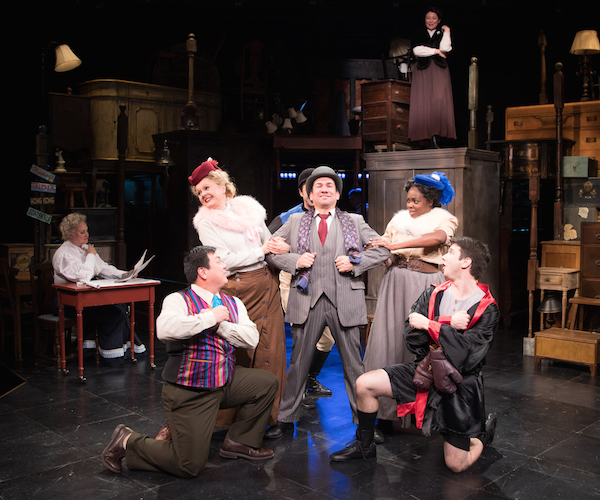
Tony Castellanos and the cast of the Lyric Stage Company’s 2018 production of Road Show. Photo: Maggie Hall
Okrent also has a tendency toward hyperbole. Describing the tortured journey of Road Show through its various iterations and titles, he declares that “no musical could possibly have emerged victorious after so arduous a process.” Um, no. It’s conceivable that some musical could emerge victorious from such a process. It’s just that this one didn’t.
And, when celebrating the recent wave of Sondheim revivals as evidence of a new popular embrace of the man’s work, Okrent somewhat glosses over the fact that the most successful of them — Merrily We Roll Along and Sweeney Todd — were anchored by big-name, ticket-selling stars in Daniel Radcliffe and Josh Groban respectively. Would either production have been nearly as successful without those names? That seems worth interrogating.
In the end, Stephen Sondheim: Art Isn’t Easy is a well-crafted book that adds some new threads, and reinforces some old threads, in our understanding of its subject. For the devoted Sondheim enthusiast, much of the ground will feel familiar, though Okrent’s new sources, sharp prose, and frankly drawn portrait of Sondheim’s character make it worthwhile even for the initiated.
Where Okrent’s book truly shines is as an introduction for the general reader: an accessible, engaging entry point into one of the most complex and consequential figures in American musical theater. Perhaps that is the most honest case for its existence, and, on those terms, it largely delivers.
Christopher Caggiano is a freelance writer and editor living in Stamford, CT. He has written about theater for a variety of outlets, including TheaterMania.com, American Theatre, and Dramatics magazine. He also taught musical-theater history for 16 years and is working on numerous book projects based on his research.
Tagged: "Stephen Sondheim: Art Isn't Easy", Daniel Okrent, Oscar Hammerstein
Thanks for such a comprehensive, knowledgeable appraisal of Okrent’s book and also a fun read. You certainly know your Sondheim! That mean-spirited alcoholic slob!
LOL. Hey, let’s be kind to our friend Steve. He was also ambivalent. 😉
I heard Okrent interviewed by Terry Gross, re the book, and agree with your review above.
I doubt readers care about Sondheim’s grooming habits or that he occasionally makes a grammatical error.
Wonder about your thoughts on his unfinished but recently produced musical, Here We Are?
You know, the thing is, it’s likely that Sondheim deliberately chose the common but incorrect “different than” as a character element. Neither Jack nor Little Red Riding Hood are upper class characters, so Sondheim may have chosen to show their status through diction. Just as he has June and Louise sing “if momma was married” even though the correct form would be “if momma were married.” These kids have never been to school and probably don’t know the subjunctive mood.
Also, here’s my review of Here We Are: https://artsfuse.org/283110/theater-reviews-smash-broadway-revival-of-sondheims-merrily-we-roll-along-and-the-debut-of-his-final-show-here-we-are/
Agree with Ruth Lauridsen. What an excellent review. While Okrent is indeed a fine writer, I found myself wondering more than once why we needed another SJS biography.
I posted this review in a Sondheim group on Facebook. People seemed to agree that Secrest is the OG when it comes to Sondheim bios. But I meant it sincerely when I said the book would be a good primer for Sondheim newbies, I even ordered a few of the other bios from the Jewish Lives series for that very reason.
I can imagine a totally different review, written by you, Christopher, using your words exactly, but reordered so that all of the things you admire are up top, and your criticisms are below. It would amount to a glowing review with reservations.
For very good reason, you admire much about this book, and you detail some of the ways that this book exceeds Secrest (with all due respect.) I’ve read every book about Sondheim’s work, many dissertations, and have done a good deal of original research using primary documents. Okrent’s book contains so much of genuine value that no one has made available. It is a stunning contribution to Sondheim studies.
And yet, I organized my review the way I did for the very reason that I had so many reservations. There is much to admire in Okrent’s book. I wouldn’t go as far as “stunning,” but I genuinely learned a good deal from reading the book.
Christopher, sincere question. What do you make of these comments:
A TERRIFIC BOOK, THE BEST THAT HAS BEEN WRITTEN ABOUT STEVE. It captures him from every angle, and I learned things about him I never knew.”
—James Lapine, librettist, Sunday in the Park with George, Into the Woods, and Passion
“Packed between the covers of this slim volume is THE STEPHEN SONDHEIM I KNEW, evoked with insight, empathy, and elegance. A powerful and compelling read.”
—John Weidman, librettist, Pacific Overtures, Assassins, and Road Show
Well, both of those people were interviewed for, and mentioned inside, the book. I wouldn’t say they had a vested interest in the book’s success, but they are hardly dispassionate observers.
Has anyone ever read a blurb that wasn’t gushing? Other than that, thank you for such a nuanced review — worthy of its subject.
Why won’t the young man he married in his dotage cooperate and speak with the author? Did Sondheim prevent prevent provision from given interviews, even after he died.? I just like to know what they talked about all day and over the dining room table. It is nice to see that Jeff Romley is involved in producing shows now and probably over seeing the SS catalog. But I do not think he needs to remain on mute the rest of his life because it’ll only fuel rumorss that he is hiding something.