
Dance Feature: Finding Comedy in Motion — Sara Juli and Alexander Davis Share the Stage
By Debra Cash
With autobiographical wryness on the menu, Sara Juli and Alexander David is a match made in performance art heaven.
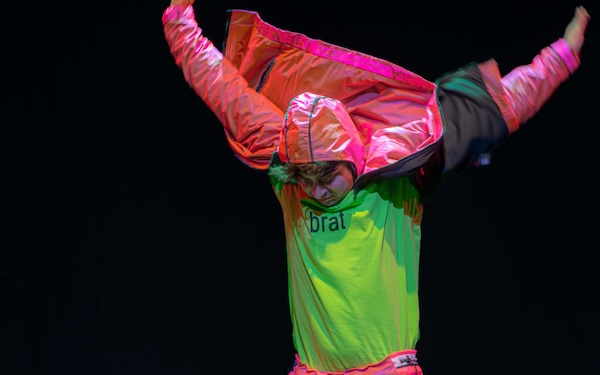
Dancer Alexander Davis. Photo: Nik Lee
Alex Davis is gay guy with Peter Lorre eyes, a dancer who can switch seamlessly from Ethel Merman disco to poignancy, and a textile artist with a penchant for intricate and satiric knitting. Sara Juli is a straight Jewish mother of two from Maine, who routinely says the unsayable, from handing out money to her audiences as she bewails the challenges of finding financial stability, to brandishing a toilet brush as a not remotely compliant suburban wife.
With autobiographical wryness on the menu, theirs is a match made in performance art heaven.
These two New England dancer/choreographer/comedians come to the Dance Complex in Cambridge on March 21-22 in a shared bill.
Dance Complex Executive Artistic Director Peter DiMuro caught them at APAP, the New York booking showcase put on by the Association of Performing Arts Professionals in January 2025. Boston is Davis’s home base, while Juli is returning here for the first time in 10 years. (I am friendly with both of them, Davis as a local dance stalwart and Juli as a generous former colleague when we were both faculty members at the Bates Dance Festival.)
“Neither of us is trying to be fancy,” Juli explained during a recent joint Zoom call. “We overlap in our consideration of the audience, our willingness to break down the fourth wall. It’s what you see is what you get — none of that performative gloss.”
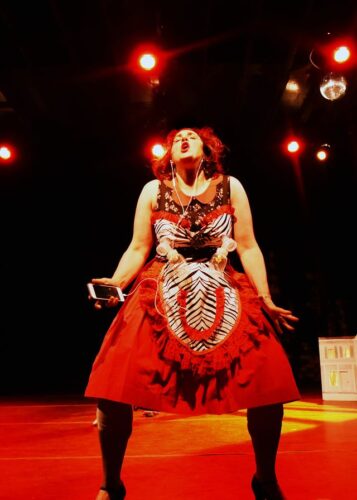
Sara Juli in Tense Vagina. Photo: Heidi Wild
The two met a decade ago when Davis had a gig as the staff coordinator at the American Dance Festival in Durham, North Carolina, and Juli was loading in a performance with another text-heavy dancemaker, Claire Porter. Later, Davis would take Juli’s composition class at Bates where, she now laughs, “Alex was half-teaching it with me.”
They recognized that they shared their working methods: heavy on improvisational process, storytelling, and structured scores as opposed to set choreography. The works they are presenting in Cambridge are in different stages of development: Davis’s evening-length Gay Aesthetics: Based on a True Story had a fully produced premiere in December, while Juli began writing the piece tentatively titled Midseason Mood last fall (she’ll be turning the audiences into instant focus groups as she whittles down her list of potential titles) and assuming her past experience is a guide, will continue to expand it over the coming 18 months.
Midseason Mood, Juli explains, is about middle age, and the social erasure many women experience as they (we) age and “finding your voice when you’re no longer shiny and new and you still have a lot to say.” Her spoken text is performed over Recomposed by Max Richter: Vivaldi – The Four Seasons which, she is well aware, has also been used in rather more spectacular settings, including Crystal Pite’s The Seasons’ Canon for 54 dancers (which Boston Ballet performed earlier this month.)
Davis’s Gay Aesthetics has its source in a 2024 incident, where
a very well-funded, famous-ish person invited me into a rehearsal process and called me and said “I’d love to offer you this job but would you be willing to lose weight to fit the gay aesthetic of this work?” I panic and spiral and say no thank you, and then went deep into trying to figure out why did this make me spiral more than most comments, right? Like, I’m an artist, I get a lot of feedback. Most of the time I’m able to filter out the helpful from the not helpful. But something about the gayness of it really got to me.
I went down a pseudo-academic rabbit hole of where these aesthetic expectations of gay men come from? Where were they established? How were they enforced? And what is my responsibility with them now?
So the piece feels like a very early, very unearned midlife crisis.
I don’t think of myself as a heavy person. I think of myself as a very fit person, I think of myself as a generally unmarginalized, cis-gendered, able-bodied, white gay dude like you’d see in any gay bar in America right now. I’m not asking the audience to tell me that I’m skinny. But when I look at my queer community I see so much beautiful diversity in bodies and of abilities and of shapes.
To be told that even aesthetically that I didn’t fit into a community that I’ve built my life around, my friends, my political beliefs, that is so foundational to who I am, that was really shocking. I thought we were beyond this as a community, but apparently we aren’t.
Performed with live music by Tyler Cantanella — whom some Boston arts folks will recall from his physical theater group, Paradise Moves — and co-written by Jeremy Brothers, who also provided Davis with his first real experience of working with a director, I expect that Gay Aesthetics will be equal parts comedy and provocation.
After our Zoom catch-up, Davis and Juli returned to ADF for a weeklong rehearsal residency to explore how they could make the shared bill more cohesive and spotlight moments of connection. Davis adds, “in this precarious moment” of arts funding and presentation they are hoping this double bill will appeal to other regional and national presenters.
Because these days, we all need a laugh. More than one, actually.
Debra Cash is a Founding Contributing Writer to the Arts Fuse and a member of its Board.
Tagged: "Sara Juli’s Midseason Mood & Gay Aesthetic: Based on a True Story", Alex Davis, Peter DiMuro