
March Short Fuses — Materia Critica
Each month, our arts critics — music, book, theater, dance, television, film, and visual arts — fire off a few brief reviews.
Classical Music
 I have previously praised here several recordings by virtuoso pianist Kenneth Hamilton, including vols. 1 and 2 of his series of 2-CD Liszt recitals.
Here is the third volume, and, like the others, the pieces are linked by a basic concept or concepts: this time, “Demonic and Divine.” The D-words may correctly lead music lovers to look forward to hearing a few familiar items, such as the Mephisto Waltz no. 1 (with the Devil tuning up his fiddle in open fifths) and the two religion-inspired Legends: “St. Francis of Assisi Preaching to the Birds” and “St. Francis of Paolo Walking on the Waves.”
But fewer of us know certain of Hamilton’s other choices, such as several movements from the Harmonies poétiques et religieuses cycle, or, even less familiar, Liszt’s “fantasy-piece” on two tuneful numbers from the oratorio Die sieben Todsünden (The Seven Deadly Sins) by the now-forgotten Viennese-Jewish composer Adalbert von Goldschmidt.
Equally unfamiliar are the harmonically intriguing Scherzo and March, subtitled “Wilde Jagd” (though unrelated to the well-known Transcendental Etude that bears the same title) and several pieces deriving from Gregorian chants.
Three works are connected in some way to Wagner, including an arrangement of an important passage from Lohengrin: the title character’s rebuke to Elsa, after she dares to ask him his name.
One work that is much loved, “Reminiscences of Meyerbeer’s Robert le diable,” is heard here in a version revised by Liszt in 1885-86. Some sections are briefer, others are expanded, and Hamilton takes care to follow Liszt’s tempo indications. For a fascinating comparison, try the famous 1964 recording by Earl Wild, rightly praised by Hamilton in his informative booklet-essay and still available on most streaming platforms.
Throughout, Hamilton plays, as always, with verve, sensitivity, and enviable ease—often with a light touch that helps him avoid bombastic banging.
A delightful ear-opener!
— Ralph P. Locke
Popular Music

Andrea Motis is all grown up now. The 31-year-old singer and trumpet player made an impression at 15 with bassist Joan Chamorro, who discovered her three years earlier in the school band he was leading. At the time, she seemed like the next great hope for pre-bop swing trumpet—it was like hearing Harry “Sweets” Edison coming from the petite frame of this Spanish schoolkid. Her vocals on the American songbook standards, with an endearing Barcelona accent, leaned toward Billie Holiday’s phrasing infused with a casual and youthful (dare I say it?) innocence.
She used to be a trumpet player who did occasional vocals. As collaborations and solo albums followed regularly since 2010, she’s become a vocalist who plays the occasional trumpet (there are solos on only 5 of the 17 songs here). Whereas her 2024 album Febrero has a full orchestra, she pares it down to two guitars on her new album Intimate (Elemental). Her singing is of course more mature now, although she can still access her girlish chirpiness when she wants it. There’s less Billie Holiday and more Katie Melua or Astrid Gilberto in the phrasing. The two guitarists (mostly acoustic), Jurander dã Silva and Josep Traver, are excellent and unselfish accompanists.
To her credit, Motis expands her repertoire to include French chanson, folk songs, and bossa novas in addition to standards. She sings in English, Spanish, Catalan, French, and Portuguese. The tracks are all compact and to the point, and solos, when there are any, are brief. I would have liked to hear her stretch out on more tracks like “De mica en mica,” where Motis sings quietly close to that excellent microphone, like it’s right in your ear, and gets deep into the romantic song with drama and feeling.
— Allen Michie
Books
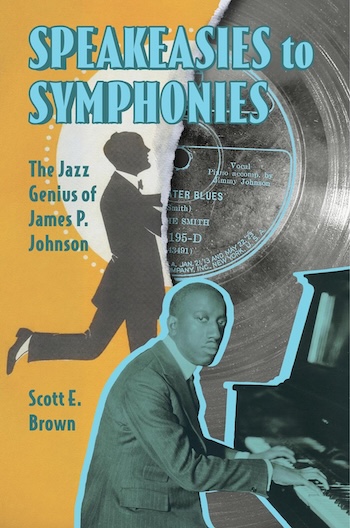
Pianist-composer James P. Johnson’s place in jazz is secure, but it is probably more honored in the breach than in the observance. Scott E. Brown’s Speakeasies to Symphonies: The Genius of James P. Johnson aims to make sure that Johnson’s crucial contribution gets its full due, and it succeeds.
As a child in New Jersey, Johnson sat outside saloons, taking in the singing and dancing, learning the tunes and admiring the piano “ticklers.” Families from the South had brought with them their music and dances, including ring shouts, a ritual circle dance rooted in African and African American spiritual practice. These were important musical influences on Johnson, providing the roots of what would become his most famous song, “Charleston.”
The family moved to Manhattan, and Johnson began to play piano in the cabarets, accompanying films, performing in vaudeville, and at rent parties. There were a number of other excellent pianists around, including Eubie Blake, Luckey Roberts, and Willie “The Lion” Smith. Johnson was a little younger than the foundational stride pianists, but he rose quickly to the top of the heap.
In the 1910s, stride piano was documented only through piano rolls, and Johnson made rolls for several companies that were hugely influential among other pianists. Duke Ellington, for example, learned “Carolina Shout” from Johnson’s 1921 QRS roll by slowing it down, as did Fats Waller. Johnson became Waller’s teacher, mentor, and eventually his running buddy.
The pattern of Johnson’s musical life took shape by the late 1920s. He regularly played with small groups, worked as a piano soloist, wrote for musical theater, and accompanied singers. He also studied classical music and became invested in writing longer-form concert works. The first and most successful of these was “Yamekraw: Negro Rhapsody.” Composed in 1927, it inspired a film that was released in 1930. Throughout his musical career, however, Johnson’s attempts to have his serious works programmed by major institutions were mostly rebuffed or ignored.
The volume’s notes are thorough, but there is no discography. I also take issue with the author’s approach to chronology. Brown will sometimes start a story about Johnson and then interrupt or delay its completion. This strategy leads to repetition: facts end up being restated and information is expanded upon somewhat haphazardly.
That aside, this Speakeasies to Symphonies feels close to being a definitive study. Johnson admirers will be glad to have it as a reference, as will anyone interested in the development of stride piano, the history of Black musical theater, and or those interested to learn about the through-line of older jazz forms across the decades.
— Steve Provizer
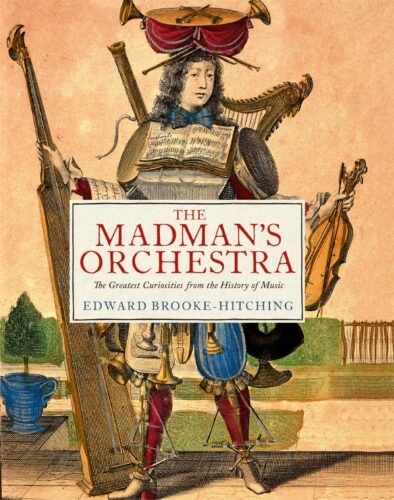
If the Guinness World Record people decided to collaborate with the author of The Hitchhiker’s Guide to the Galaxy, I imagine they’d come up with something like The Madman’s Orchestra—but only if they put in the kind of legwork that author Edward Brooke-Hitching has. It’s difficult to overstate the level of detail and the wealth of graphic illustrations he’s amassed.
The book is a compendium of how music has been understood, misunderstood, created, and abused throughout human history. The dust jacket of the book tells the tale: “Which composition requires four helicopters and a string quartet with strong stomachs to play it correctly? When should you feed your piano hay? What does the ‘cat organ’ sound like, and is it any more pleasing to the ear than the ‘hog harmonium’?”
Some of the ideas in The Madman’s Orchestra never made the cut. Pulling cats’ or pigs’ tails to make music is a nonstarter. Other ideas float around on the periphery, never entirely banished but never mainstream: synesthesia, the viewing of music as colors, for example. Kandinsky, Scriabin, Rimsky-Korsakov, and Schubert are discussed here as part of the small cohort of people who experienced synesthesia. A number of inventions were created to bring the concept to life, including the color organ (a feeble descendant of which one could buy at Radio Shack for $29.95 plus tax). Brooke-Hitching also draws on Pythagoras, Ptolemy, Newton, and others to trace the relationship between music, theosophy, mathematical ratios, and the visual spectrum—and, in so doing, takes the concept to a deeper level.
The oddities pile up. In the USSR, Elvis and Beatles recordings were clandestinely etched on X-ray films—“rib music.” Adolphe Sax, genius instrument maker, had several near-death experiences (and several bankruptcies). The “perfume organ” blasted audiences with the likes of sandalwood and patchouli. Today we have orchestras that use instruments that are made out of vegetables and ice.
This is the third in a series of illustrated volumes, including The Madman’s Library (oddities of literature) and The Madman’s Gallery (the limits of art). I haven’t read them, but if they’re anything like their musical sibling, I bet they’re well worth a look.
— Steve Provizer
 According to Zambian-American novelist and literary critic Namwali Serpell in On Morrison, Toni Morrison’s writing has been viewed, by too many, through a skewed and reductionist perspective. This minimizing attitude posits that her fiction is difficult to read—it is easier for critics to see her novels as didactic commentaries on race. Serpell argues, convincingly, that Morrison’s works are complicated for an excellent reason: they inevitably draw on the complexity of thought and technique—in this case, modernist—that literary masterpieces demand.
For Serpell, criticism is somewhat personal. She reflects on her own experiences, in and out of the classroom, when reading Morrison’s work. Her commentaries can also be challenging; she insists that she will “be as demanding and sophisticated as I want to be, and at the same time accessible.” Besides dealing with “the Black cultural traditions that ground [Morrison’s] aesthetics,” she explores the ideas that made Morrison such a cantankerous thinker—a writer whose prose reflects the powerful intellect of a slow, methodical reader and careful storyteller. Serpell provides incisive scholarly analysis as well as illuminating close readings to back up her high praise for Morrison’s complexities, bringing in evidence gleaned from her teaching of the novels (The Bluest Eye, Sula, Song of Solomon, Beloved, etc.).
Serpell does not use Morrison’s work to try to define what “the Black aesthetic” is, though she does point out references in the fiction—sometimes contentious—to other Black writers such as Ralph Ellison. She probes that concept through incisive observations on Morrison’s novels, criticism, and interviews. Serpell is also unafraid to invoke literary theory when it serves her argument. By the end of her literary study, the critic has succeeded in showing how Morrison’s work must be read—with a healthy respect for the author’s rich but challenging aesthetic agenda.
— Douglas C. MacLeod
There’s a persistent complaint from the left that, despite huge mass gatherings, such as the “No Kings” marches, and regular protests occurring throughout the country on everything from the savagery of ICE to the perfidy of anti-democratic forces, nothing happens. Waves of rage and righteous disdain erupt, but an infernal calm returns—political paralysis continues, no matter how loud or long the collective yelping.
As Anton Jäger puts it in Hyperpolitics: Extreme Politicization without Political Consequences, his incisive analysis of why we are stuck in a debilitating cycle of business as usual forever: the left’s mobilization “detonates like a neutron bomb: a moment ago, thousands of people were protesting in a square—now they have vanished, with the assailed power structure intact.”
What gives the power structure its resilience? In his incisive book, Jäger argues that over the decades a number of forces—economic, cultural, political, and technological—have worked together to systematically break down people’s commitment to community organizations and civil society, both in America and Europe. Individuals can get together and raise hell—but they do not see themselves as committed, with prolonged sweat equity, to organizations, unions, or other kinds of community groups that capable of sustaining pressure.
This atomization has been encouraged by self-interested market forces: “… the constant refinement of personal consumption, like the attenuation of civil society, has appeared as an imperative of capital itself. Collective life had to be thinned out to clear new inroads for the market.” Political parties exploit this fragmentation as a way to maintain power, but their indifference to social civility is leading to their own accelerating dissolution.
The web plays its part: “The life worlds of the online are the primary environment for this sort of deinstitutionalized, impermanent engagement, offering repertories of social expression that require little to no long-term obligation. Atomization and acceleration go hand in hand: people are lonelier in the new century, but also more agitated; more atomized, but also more connected; angrier, but more disorientated.” The atoms fly together in fury and generate explosive heat; then they zip back into their isolated orbits. The vacuum abides.
— Bill Marx
Popular Music

Cover art for I Guess U Had To Be There.
ELUCID & Sebb Bash’s I Guess U Had To Be There (Backwoodz Studioz) justifies its dual billing. A rapper/producer team-up, both artists’ contributions are essential to the music’s full impact. One half of Armand Hammer (with billy woods), ELUCID has established his credentials as a forward-thinking poet: the cryptic density of his lyrics is a major part of his appeal.
Bash’s production combines samples and live instruments, played by himself. He uses sounds that should be comforting and soulful in nerve-wracking ways. His beats begin to crumble even as they’re being constructed. “Cantata” is a prime example, with a woman singing “Who knew?” against piano chords and sharp pieces of noise. He may chop up soul and jazz records, but he puts them back together with stop-and-go rhythms. (Shabaka Hutchings, formerly of the jazz group Sons of Kemet, plays flute on “Equiano.”) The distant handclaps of “First Light” prevent the song from ever finding a steady beat. Near the end of “I Say Self,” ELUCID’s voice instantly cuts out; it simply fades away in “Visitation Place.”
“Strategic, when it don’t rhyme, there’s a reason,” ELUCID declares on “Fainting Goats.” Puzzling out what he’s getting at takes repeat listens. Even when one doesn’t initially understand the rapper, he’s not spitting word salad. His enigmatic references open doors to the persistent legacies of minstrel shows, colonialism, and, above all, slavery. The title “Equiano” pays tribute to an 18th-century abolitionist. The fuzzy, fraying “Parental Advisory” links child abuse to the history of generational trauma. The album’s loaded with spoken fragments that are cut off before they can make clear sense, such as the sped-up voice that runs through “The Lorax.” ELUCID describes what life is like amid the embers of a dying empire, shaped by slavery and colonialism: “the future they might imagine, murder.”
— Steve Erickson
Art and Design

The Noguchi Coffee Table by Isamu Noguchi, Created in 1944, from Herman Miller Company
Why some things literally and aesthetically hit the spot (so-to-speak) and others don’t doesn’t come down to a scientific formula. All designers wrestle with coming up with objects that have functionality, beauty, and charm. Personal “taste,” primitive (intuitive) and educated (trained) guide our choices for what we want to own, and perhaps admire. Pleasure is a subjective response.
If there was a specific formula to create desirability, appeal, positive emotional responses and even aesthetic pleasure, all design professionals would understand this. This is just not always true. It is not necessarily hit or miss, but achieving the goal — that both humble and luxurious objects of desire share — is not always achieved.
The sensational former Apple chief designer Sir Jonathan Ive acknowledged his debt to others (among them the great industrial designers Raymond Lowey, Kem Weber, Norman Bel Geddes and Dieter Rams) when it came to setting what has become the high standard for Apple products. That company’s designers understood the allure of elegance — of form, color, materiality, and physical touch. Each new Apple product strives to fuse aesthetic pleasure with pragmatism.
Geometry seems to be a major aspect of the transmission of design emotion. Minimalism in product design is about the graceful simplification of form. Visual geometric character looms large in that admired approach; primary shapes are often used as the basis for an object or a structure. For example, the iconic Noguchi Coffee Table conceals nothing — its simplicity is utterly transparent. Two elemental, organic, smoothly shaped pieces interlock to form a tripod that supports a .75” thick top of transparent glass. Its elegance compels its appeal. .
Innately, from a very early age, we seem to know what we like, what we are attracted to. The best designs tap into that primal, visceral, and even emotional connection; they were shaped to cast a pleasurable, even seductive, spell.
— Mark Favermann
Tagged: "Hyperpolitics", "I Guess U Had To Be There", "On Morrison", "The Madman’s Orchestra", Andrea Motis, Anton Jäger, ELUCID & Sebb Bash, Edward Brooke-Hitching, Kenneth Hamilton