
Theater Feature: Actors — Still Pursuing Their Passion
By David Greenham
A new year is beginning, so it is as good a time as any to check in with a few actors with Boston roots or performance experience, to explore what it means to pursue the dream of being an actor in 2026.
Those of us who love the theater spend a lot of time focused on producers and artistic directors, who are the ones who select the plays that are produced. We appreciate the merits of the artistic team of directors and designers, who create the world of the production, but we sometimes take the actors in our local theaters for granted.
Perhaps that’s because, in film, television, and even the commercial theater, it’s often the performers who hog the spotlight. Our obsession with popular stars spans from the celebrity magazines of the 1930s to the nearly unlimited avenues for hoopla on social media today. From that perspective, the life of the actor seems glamorous and exciting. It’s little wonder, then, that so many kids take Pinocchio’s advice in the 1940 tune “Hi Diddle-Dee- Dee. An Actor’s Life for Me!”
Of course, reality is more than a little different. The job of being an actor in the live theater at any level requires hard work, is fraught with uncertainty, includes frequent rejection, and is met with nearly endless skepticism from relatives, friends and strangers with ‘normal’ jobs. Each year, acting programs spew out thousands of hopeful performers. Many drift into other professions because it takes a special brand of grit and determination to stick to it, to create a path and a career. As the Player in Rosencrantz and Guildenstern Are Dead comments,“We’re actors — we’re the opposite of people!”
A new year is beginning, so it is as good a time as any to check in with a few actors with Boston roots or performance experience, to check out what it means to pursue the dream of being an actor in 2026.
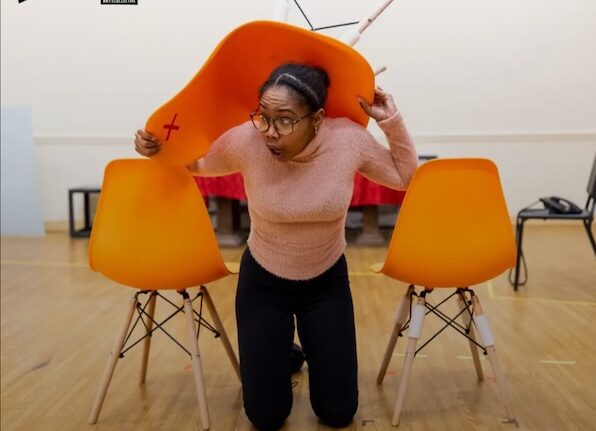
Schanaya Barrows in rehearsal. Photo: SpeakEasy Stage
Dorchester native Schanaya Barrows (she/her) dreamed of a life on the stage as a student at Boston’s famous Uptown Dance Center. “I was a shy kid,” she says, “and Uptown gave me confidence.” The 1997 TV version of Cinderella with Brandy and Whitney Houston inspired her to sign up for the classes. From there, she started doing commercials, modeling, and pageants. She studied acting at Salem State University and graduated during the pandemic.
Burrows immediately worked to make contacts and friends. “This is Boston. We have everything here, but sometimes it’s hard to find,” she says, “it can be a very, very closed space, and it’s hard to find people who look like me.”
She’s been fortunate to find lots of work in the last couple of years, but landing gigs requires plenty of diligence. She’s now at the point that many serious actors eventually get to: she’s deciding whether or not to join Actors’ Equity. “I worry about being able to find enough work in Boston if I join the union,” she says.
Another reality of the business of acting today: the need to diversify. Barrows teaches at Berklee College of Music. She’s also embraced backstage jobs, such as stints as a choreographer. She sometimes does hair design. Barrows still maintains her passion for dance, and training aspiring performers. This year, she’ll be opening, in Cambridge, 888 Dance Collective, part of her long-term goal to run her own business.
Of course, she continues to exercise her theater chops. In March, Barrows will take part in a staged reading produced by one of Boston’s new play companies, Fresh Ink. For Barrows, maintaining a career as an actor means remaining grounded. “My late mother was the one who taught me and made me who I am,” she says, “I always know that I’m what my mama made me.”

Performer DJ Plunkett. Photo: courtesy of the artist
Lynn native DJ Plunkett (he/him) discovered his dream while performing in a couple versions of Christmas Carol at the North Shore Music Theater over 25 years ago. He was determined to be an actor, and performed with a few of Boston’s regional theaters before heading to the prestigious musical theater program at Cincinnati Conservatory of Music.
In New York, he landed the role of Boq in the national tour of Wicked – a big break! But the show was soon shut down after the outbreak of Covid.
The pandemic encouraged him to branch out. Plunkett set up his own studio and started doing voice acting, which has led to voiceover work in commercials and video games. He’s also expanded his toolbox in other ways, including stints in wardrobe and film casting.
Of course, acting is still at the top of Plunkett’s list. Once the Wicked tour resumed, he was back on the road. When that contract ended, we began to find roles in regional productions. He’s now juggling his side gigs with a stint playing Mike Teavee in a production of Charlie and the Chocolate Factory that is touring Asia. The production provides a new kind of challenge.
“All the shows I’ve done have a start and end date – they’re finite. Charlie is an open contract, and I can stay as long as I want.” Plunkett’s home now (the show is on hiatus for a few weeks), but he’ll be heading back in February for a run in Mainland China, then into Singapore in June, and the Philippines in July. The 17-hour flight takes a toll, so he does not come back-and-forth to the U.S. Plunkett likes to travel, and the show is fun to perform. Also keeping things lively: at each stop there are new runners and dressers to train. They don’t speak English, so it’s never boring backstage.
Still, being on the road can be a double-edged sword. “In this industry work begets work. You want to be working all the time, but you also need to be available to take new work.” And there’s also the sacrifice of not being present at home for family and friends. Lots of birthdays, weddings, and funerals are missed. “It’s tough to get a phone call and be across the world and not be able to help,” he says.
How will he maintain his balance over the coming year? “I set little goalposts for myself,” he says. “I check in and if I’m still happy, I stay, and if it’s time to move on I’ll go. It’s all about checking in with yourself.”

Performer Kerry Ipema. Photo: courtesy of the artist
Kerry Ipema (she/her) knows the feeling of being on the road all too well. Hailing from the Chicago-area, she’s lived in New York City since graduating from Indiana University.
Ipema has traveled the world thanks to her gift for satire and comic timing. Her One Woman Sex and the City was a hit on the 2018 fringe circuit, and that led to successful runs in cities through the US and UK. She’s followed that up with other successful projects. Ipema writes, directs, and produces, she’s almost always busy. “Time management is so key to me,” she says, “A lot of times it is feast or famine and writing and producing is hard, but it affords me the time to get on stage,” which she continues to love.
Making connections is critical in the business. She met her first collaborator in a class, and he pitched the concept of the Sex in the City show. “I don’t know why I said ‘yes,’ but I did and that led to a national tour, Edinburgh, and a UK tour.” She’s still amazed at her good fortune: “If you told me ten years ago that I’d be touring all over the world with shows that I helped write and perform in, I wouldn’t have believed it.”
Ipema relishes the opportunity to work close to home. She’s got a show coming up at Soho Playhouse next month and says, “it’s fun to do a show in the city and come home to my apartment at night,” adding, “I don’t mind touring, but I don’t get to show my friends my work.”
Working with collaborators and creating new material is not without its challenges. “You have to let your ego go. Serve the piece. Serve the bigger thing. That’s what’s important.” She adds, “audiences can smell it if you don’t serve the piece.”
When we talked she was particularly excited about the early February performance at the Hanover Theatre and Conservatory in Worcester. She adores audience interaction that sing-alongs encourage. The Worcester performance featured a child in the Make-A-Wish program who has always wanted to conduct a chorus. During the interview she said, “We’ll bring the young person on stage during the show, and they’ll conduct the whole audience of 500 people or so. It’ll be a blast!”
For all of the rewards, the realities of the business are hard. “My goal in 2025 was to get health insurance,” Ipema says, and she pulled it off. “I’m not sure what 2026 will bring, but I’m always busy, so that’s good.”
Hard work is a passion for Gerianne Pérez (she/her). Currently a member of the cast of the Broadway hit Operation Mincemeat — she is the standby for the leading role of Monty — she has been fortunate enough to be working steadily since 2016.
As a kid, Pérez’s family lived briefly in Wayland, before moving to Washington state. Her Boston connections include two stints in the musical Waitress, which premiered at the American Repertory Theater, both on tour and on Broadway. She also enjoyed an extended run as Catherine of Aragon in the national tour of Six, which landed in Boston in December of 2024. Some may even remember her as Rizzo in a 2014 North Shore Music Theater production of Grease.
“I’ve always loved the arts. My parents were scared for me to become an artist,” she says. “I was a very academic kid. I had to focus on the academics so that I could do the extra stuff. For me, it came down to this: do something where I can make lots of money, or do something that will bring me joy. I chose joy.”
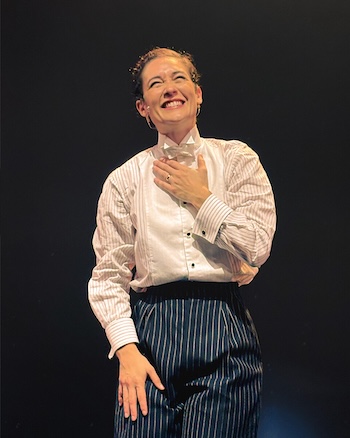
Performer Gerianne Pérez. Photo: courtesy of the artist
The intense schedule of an 8-show week takes a psychological and physical toll. Six, a show known for its high energy singing and choreography, was the closest she’s come to taking on the tasks of a professional athlete, she says. That’s when her health regimen really started. It includes an anti-inflammatory diet, vitamins, hydration, yoga, ice packs, red light therapy wraps, IV drips once a month, and lots of rest. “I’m the self-care queen,” she laughs.
But she loves what she does. “If I have a good quality of life, I’m fulfilled,” she says. “Operation Mincemeat has a great message and it has garnered a really supportive and kind fan base.” Pérez adds, “There’s as an aspect to Operation Mincemeat that draws introverts and shy people. I feel deeply pulled to this group.” She’ll stay on as long as the gig feels right.
When Marie Eife (her/they) was a high schooler growing up in Drexel Hill near Philadelphia, her mother surprised her with tickets to Wicked on Broadway. Eife was already certain that they wanted to be an actor, but seeing the show in person made playing the role of Elphaba one of their theater dreams.
Eife’s always been driven and determined and, upon arriving in New York with her BFA in musical theater from Syracuse, they set out to establish their career. Initially, it was regional theater, including several roles at North Shore Music Theatre and Rhode Island’s Theatre by the Sea. Then on to national tours of My Fair Lady, Legally Blonde, and Fame.
Eife auditioned for Wicked whenever they were in New York and, sure enough, they eventually landed a role in the ensemble of the National Tour — as well as being cast as the understudy for Elphaba. After the end of Covid, they returned to the tour, and in May of 2023, Eife made their debut as Elphaba. They performed the role several times in the next year, including at several scheduled performances in Philadelphia, so that friends and family could attend. Last year, Eife was chosen to be the standby Elphaba for the Australian tour, and performed in the role during the production’s long run in Singapore, performing several times a week.
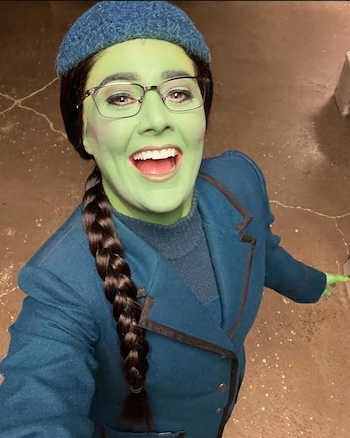
Marie Eife as Elphaba in 2023. Photo: courtesy of the artist
Goal achieved, they could have returned to the on-going national tour but, instead, decided to jump. “Some people thought I was crazy to leave the comfort of a long touring company,” Eife says. “But I chose the scary thing.”
Back in New York, and auditioning “like crazy,” Eife is making the rounds. “I love the hustle. I’ve been living my dream for the past six years, but my inner child never thought beyond that. So now I’m working at developing that long-range plan. Getting older is scary: it teaches you that time is important.” They add, “I’ve learned as an adult that you can have more than one dream.”
Eife still heads out of town once in a while for gigs, They’ve recently performed in Titanic and Fame at North Shore Music Theatre. But most of their time is spent teaching, nannying, dog walking, and serving as a personal assistant, among other gigs. They are jobs that are flexible, so they can still audition, go to classes, and visit casting directors and producers.
“New York brings you things that you don’t really know you needed,” Eife says. “Is more school in the future? Who knows? I’ve had this dream of bringing theater to places where they don’t get much opportunity to do theater. I’ve even been looking into joining the Peace Corps!,” they say with a laugh, noting, “My word for 2026 is curiosity.”
Boston native Kai Clifton (he/they) is also treating 2026 as a year of curiosity. A graduate of Boston Arts Academy, Clifton is classically trained and had planned to pursue a career in opera. He was scheduled to participate in the Assisi Performing Arts program in Italy the year Covid hit.
Instead, Clifton started auditioning and getting cast in shows in Boston. “Surviving as an artist in Boston is hard, but I’m from this city. It birthed my creativity,” he says. “My friends tell me to come to New York, but I love it here so much. Boston still is doing interesting work that inspires me. Every time I think maybe it’s time to pack up and go, there’s a show that comes up that I want to be part of.”
Like their friend Barrows, Clifton worries that Boston actors are often typecast. The offers they receive are less varied than they would like. “I find that I need to go out of town sometimes to be cast in different kinds of roles.” For example, having the opportunity to play Ursula in The Little Mermaid in New Hampshire a few years ago. “One of my dreams is to play Miss Adelaide in Guys and Dolls, but I’m not sure that’s possible here. Boston is tricky, because it feels sometimes that there’s an agenda and it’s easy to be boxed in to one certain kind of role.”
Still, Clifton admires many of the theaters in the city for their willingness to chose bold scripts for their seasons. Company One, Speakeasy, The Huntington Theatre Company, and the Front Porch Collective are among his favorites. “The fact that theaters in town produced A Strange Loop and Fat Ham in a single season is amazing,” he says.
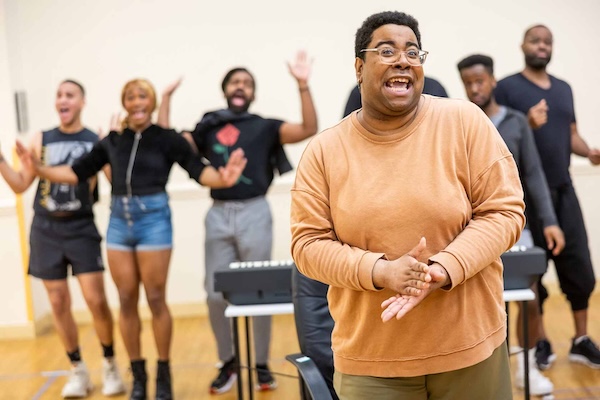
Kai Clifton in rehearsal for A Strange Loop at SpeakEasy Stage Company. Photo: Nile Scott Studios
For now, Clifton intends to stick with it in Boston. “I’m lucky because I work at home and have a flexible schedule,” so he can work in and outside of the city. In March, he’ll be seen in Company One’s You’re Cordially Invited to the End of the World.
Whether you’re in Boston, New York, or any other city, the actors all agree that persistence and making connections is the key to making a career as a performer.
“Building relationships is important,” Ipema says. Clifton agrees, “I’m using my performance skills to build trust. Once people see you can do one thing, they seem to trust you more.”
Despite having to be at the theater for eight shows a week during a Broadway run, Pérez makes sure to keep making new contacts, “I go in for readings and workshops that don’t conflict with my schedule. It’s a great way to meet new people.”
“I’m a person who thinks there’s always room for everything,” Plunkett says. Despite undertaking intensive rehearsals three days before he was to fly to China for months, the actor took a last-minute voiceover gig, “because they could work around my rehearsal schedule.”
In the end, it still comes down to zeal for the work.
“I’m happier than I’ve been for a long time chasing this next goal. I love that challenge,” says Eife.
“I’m a theater lover through and through,” Clifton says, “There’s such a strong sense of community in the profession.”
“I love the energy of live theater,” Pérez says.
Ipema add, “The magic of live theater is that you’re here, I’m here, and we’re sharing the space together. That experience can’t be found by viewing video or film.”
“The passion for this work never leaves me,” Barrows concludes.
David Greenham is an arts and culture consultant, adjunct lecturer on Drama at the University of Maine at Augusta, and is the former executive director of the Maine Arts Commission. He can be found at https://davidgreenham.com/