
Arts Commentary: Rich in Creativity — But Nothing Else
By Debra Cash
Predictably, when you get to the discussion of money, honey, the rubber hits the road.
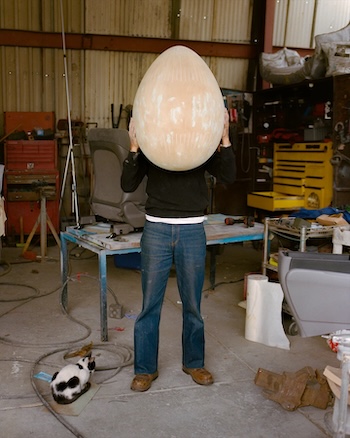
A visit to artist Ryan Preciado’s studio. Photo: Carlos Jaramillo
Want to be as rich and famous as Taylor Swift?
Want to be able to buy your kid a new pair of shoes halfway through the school year?
Sorry, artists. You’re probably out of luck for both.
In the past two weeks, The Mellon Foundation and Theatre Communications Group released separate reports on the state of the American arts landscape – the first drawing from a national sample, the second from theatre artists in New York City. While their reporting tries to look on the bright side, once you get into the weeds, the picture they portray isn’t pretty.
Released on November 19, the Mellon Foundation’s Report: A Window into the Lives of US Artists and Their Livelihoods was commissioned from NORC at the University of Chicago (Gwendolyn Rugg, Jill Gandhi, Michelle L.M. Ernst, and Kevin L. Brown). The authors begin by leaning into artists’ resourcefulness.
Like many workers in the U.S., artists often make ends meet in non-traditional and resourceful ways, holding multiple jobs, cycling in and out of roles, and engaging in artistic practice through self-employment.
Those plucky artists, they figure it out somehow.
These ways of working in turn may limit artists’ financial security and their ability to access workplace protections and employer benefits. To better serve artists, we must see the full complexity and reality of how they earn a living and piece together support for their creative lives.
Their brief was to uncover “evidence to inform smarter investments, public policy, and support systems that can strengthen creative labor for the long term.”
At a time when evidence has been relegated to a partisan word, I respect this. You can’t argue with shoddy research, and this inquiry was conducted by the disciplinary book. The 113-page report includes academic tables, conscientious literature review in the footnotes, and carefully parsed descriptions of how aspects of their data may be less than representative. Plus, there’s a full technical report on the website so that if anyone wants to challenge their results that person can examine the data directly.
The Mellon report authors are hardly Pollyannas. They want to know what artists are doing right now to create their work and get by. But first, they have to figure out who they are talking about, and in some sense this is the most eye-opening aspect of the entire project.
In 2022, using the Current Population Survey (CPS) data the National Endowment for the Arts estimated that approximately 1.6% of the U.S. labor force qualified as an artist. The Mellon study researchers used a series of tiered inclusion criteria for their study. Artists and culture bearers (the term currently being used for artists and craftspeople whose work is primarily based in traditional, culture-specific practices) had to affirm they had a “dedicated, professionalized practice” in order to be eligible for the study. Self-declared hobbyists and students were not included. Nor were those whose only “recognition” of their art was by friends and family. (This – along with never making any money from his art — might have excluded Van Gogh, but never mind.)
The Mellon researchers established that 18% of U.S. adults were qualifying artists for purposes of their survey. That gap itself is worth noting, especially when government folks in a much-to-be-wished-for future administration renew their evaluation of the economic impact of the arts and culture sector, and as grant-making foundations evaluate their internal funding distribution. For those whose funding leans towards supporting community participation, the Mellon research asserts that three quarters of American adults created at least one form of visual art (e.g., painting, photography) in the last year, 63% created at least one form of craft art, and 54% did at least one form of performing art as hobbyists or former professionals.
All well and good. We now know who we are talking about.
Mellon shares descriptive statistics about artists’ survey responses and those are informative. But – as they admit — they skirt analysis. As a sometime researcher and full-time arts and culture worker, I find that disingenuous. My guess is that they are trying to stay on the side of remaining apolitical, as NORC and Mellon both operate in an environment where the arts are particularly vulnerable as a locus of dissent.
While the picture they paint is dire, it’s hardly surprising to anyone who has been paying attention.
They note, for instance, “many artists’ lives are marked by economic precarity, due in part to their tendency to have work arrangements that differ significantly from traditional employment.” What were they expecting, 9-5 ateliers?
I’m being snarky, but I know that this has not escaped any reasonable person’s attention. During the 15 or so years I was a local leader in the National Writers Union, the UAW used NWU organizing as a bellwether to the broader universe of workers who were either self-employed or contingent or both. The Mellon researchers should be aware that, understanding their own precarity, artists and gig workers have been agitating for single payer health care (a version of the easily summarized Medicare for All) and the portability of pensions where such things still exist for decades.
But when you get to the discussion of money, honey, the rubber hits the road.
In the 12 months prior to the Mellon survey, nearly half of the working artists (48%) surveyed had at least one temporary full-time job while just over three-quarters of working artists (76%) had at least one part-time job. For a healthy 70.7% that job was an arts or arts adjacent occupation, and I assume that for many this meant teaching or some version of paid arts administration. (TCG, below, will call this hustle work, “the work that helps meet your material needs and has some alignment with your values and vision. Maybe you wouldn’t choose this work if all your material needs were met, but you feel some pride in it. You may have negative feelings about this work, but positive vibes are also in the mix. It’s a part of your identity, even if it’s not at the core of what you’re about.”)
More than 40% of the Mellon survey artist respondents were living on less than $50,000, even in households with another adult. And how did they make up the difference between what they earned and what they needed? Sixty-two percent were getting by with help from their friends (and family members). 42% were carrying credit card debt. So, the beneficiaries of American artists’ precarity include Citibank and American Express.
More than a third relied on some form of public assistance. Like workers at Amazon or Walmart, creative folks’ sub-living wages and employment precarity are buffered by government benefits. This spotlights the argument for living wage standards and/or guaranteed basic income for everyone.
Yes, some artists do make money from their artwork – more than half of those surveyed did. But if you suspected that only rich people can afford to be artists full time, you may be partly right – the most common other sources of household income mentioned in the Mellon report are one or more sources of “passive income” (41%), which came in the form of income from interest, dividends, or rental assets (24%); royalties and related (19%); or an estate, trust or inheritance (8%).
This grim constellation puts artists behind the financial eight ball.
Nonetheless, in my experience, many artists – no, not everyone, but many — seem to believe that, by virtue of their talents (real or imagined) they ought to be exempt from the maws of American capitalism.
The Mellon researchers write:
For each activity artists participated in, we asked them to think about who their intended audience was for most of their work in that activity […] More than three-fourths of artists created work for themselves (78%) share with people they know personally (75%). Artists commonly regarded their community (69%) or the general public (62%) as an intended audience for their work. Just over half created art for clients (58%).
Remember, to be included in this study at all, the artists had to affirm that they had a dedicated professional practice. Being an artist for one’s own benefit – however valuable that may be – is not the same as generating economic activity. Economic activity has to do with what someone else wants to sponsor or buy. Creating for the “general public” slipped in there (I’m not exactly sure what they mean by creating art for clients – portrait painting? Craft sales?) but you can recognize the lurch from participating in the market economy.
When you connect the dots, it’s clear that the system is broken. Heart, Hustle, Survival: A Survey for Theatre Workers, a new report from Theatre Communications Group reporting from what is probably the epicenter of the American arts ecology, New York City, looked at what this felt like to 188 theatre artists trying to cope, and asked them in very concrete terms what New York and the theatre community at large should do about it.
The headline of the report is the news that 73.2% of theatre workers said they were considering or had already left the field due to financial concerns. But because TCG asked the artists to envision solutions, there was more insight to ponder.
TCG begins its report with a similar glass half full flourish
Playwright Robert Anderson famously noted, “You can make a killing in the theatre, but not a living.” Yet many people do make a living in the theatre—according to TCG’s Theatre Facts 2023, approximately 53,400 workers are employed full-time at U.S. not-for-profit professional theatres. An analysis of TCG’s Salary Survey 2022 found that the median annual salary for theatre workers employed full-time at participating institutions was $57,065—slightly higher than the $56,420 for the median full-time worker in the U.S. Bureau of Labor Statistics. There is indeed a living to be made in theatre.
But it’s hard when the average union actor works only 17 weeks a year.
Their comments put flesh on the statistics:
“I am lucky I get a lot of heart work [defined as passion driven art-making] however, the pay for this work is small. So I am often looked at as a prestigious part of the theatre community but I can’t afford groceries and I’m behind in rent.”
“My health insurance premiums for myself and my child cost over $1600 per month, which is more than my rent. I have no choice but to pay exorbitant premiums because I am self-employed.”
But these artists have ideas, too
“Grants that are restricted to artist pay would allow theatres to increase pay.”
“Start reaching out to small companies around the country that are considering, or are in a position to build a new theatre development. Help them access HUD funds to help offset capitalization and operation cost, and orient that affordable housing to artists.”
Creativity takes work.
But the structures of the creative industries and America’s extractive and winner-take-all market economy shouldn’t make it so much harder.
Debra Cash, a Founding Contributing Writer to the Arts Fuse and a member of its Board has spent many decades doing more than one job at a time.
Tagged: "Heart Hustle Survival: A Survey for Theatre Workers", "Report: A Window into the Lives of US Artists and Their Livelihoods", Mellon Foundation
Just want to underline one of the distressing findings in both studies — that the gap between have and the have nots in the arts reflects what is happening in society:
According to the TCG report of theater workers: Only 26.5% of respondents believe they have Usually or Always been paid an equitable wage over the last 5 years.
As Debra writes, neither report wants to talk about ameliorating harsh realities because it will disturb feathers on the left (the philanthropic class) and the (libertarian) right, but it is getting harder for those on the bottom, as for the rest of those in society, to survive because they have no way to exert pressure (unions, political representation) for higher wages.