
Theater Interview: Kai Maristed on “Paul and Émile” — The Vicissitudes of Friendship
By Bill Marx
“If my work does have a recurrent theme, it is the pressure of the political/historical moment on individual choice.”

Author Kai Maristed. Photo: courtesy of the author
Arts Fuse book critic Kai Maristed is an accomplished author, with three novels and one short story collection to her credit, and another volume of short stories, The Age of Migration, scheduled to be published in 2026. She is also a dramatist, and Wellfeet Harbor Actors Theater is giving theatergoers an opportunity to take in a world premiere production of Maristed’s historical drama Paul and Émile (directed by Sasha Brätt, through October 12).
The Paul and Émile of the title are the painter Paul Cézanne and novelist Émile Zola, and the script focuses on a fictional rapprochement between the two artists at the turn-of-the-century in Cézanne’s studio in Aix-en-Provence, in the south of France. The pair had been close childhood friends, but their relationship ended with the publication of Zola’s 1886 novel The Masterpiece.
Maristed mines the artists’ memories of their youth and passionate tensions between them, touching on recriminations and regrets. She also notes the strengths they displayed in their final years: Zola’s courageous open letter (“J’Accuse…!”) in defense of Captain Alfred Dreyfus, a Jewish army officer falsely accused of treason, and the daring freedom of line and color, the mastery of light, in Cézanne’s last oil paintings.
At one point in the script, Cézanne says that “age melts some people like wax, while others emerge from the fire as their true selves.” Beyond being a deft study in an interrupted friendship between two geniuses, Paul and Émile is a moving look at a pair of maturing artists trying to make sense of how they have been transformed by life.
I sent Kai some questions via email, about the play and her upcoming short story collection.
Arts Fuse: What inspired you to write this play?
Kai Maristed: On a hot, boring summer day in Aix-en-Provence I decided to climb the steep hill to Cézanne’s last studio, a squat little tower facing Mt. St. Victoire, kept much as it had been in his lifetime. There were no other visitors. I sat on a bench for a good hour, while the place seeped into me. I left determined to better comprehend his painting. I began by standing in front of his paintings in various museums, to let them, too, work into me. I had no idea yet of writing a play. It was only a month or two later, on reading his letters, and his contemporaries’ accounts, that the innate drama and mystery of his close friendship and later estrangement from Zola took hold. I heard their voices in my head.
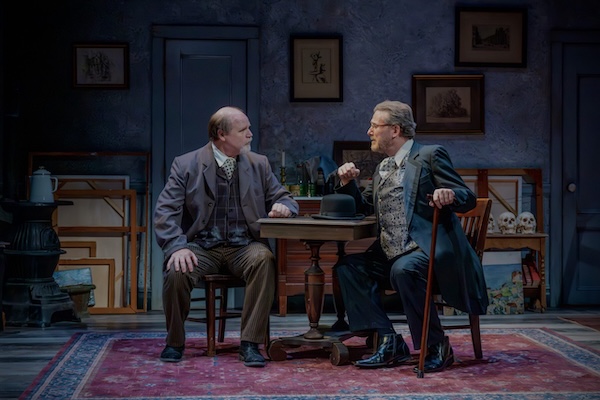
Todd Scofield as Paul Cézanne and Abe Goldfarb as Émile Zola in Paul and Émile. Photo: Michael Karchmer & Michael Kerouac
AF: What was your research process like?
Maristed: Blissful and moderately exhaustive. I’m fluent in French and German, so I went to original sources, mainly, rather than academic papers, of which there are many, and many at odds with each other. I tried to go light on art history, for fear of weighing down the reality of the moment. Read correspondence, as mentioned. Newspaper articles. Friends’ commentaries. Artists can be great gossips. Rilke had a lot to say.
AF: How much do audience members have to know to appreciate the relationship between Zola and Cézanne in your play?
Maristed: Someone who knows nothing or very little can still enter into their world. This is not a test. Enjoy the play!
AF: Watching “artists behaving badly” is standard fodder in countless movies and plays. This play appears to be a self-conscious departure from that approach. Am I correct?
Maristed: Well, not correct in the “self-conscious” part. I’m not a fan of standard fodder; who is? It’s not a thing I thought about. My intent was to create characters as true as possible to what I know, or think I perhaps know, of their complex real-life models. This goes for the historical background, as well. That said, the play itself is a fiction rather than a documentary, and the female character, while carefully researched, is entirely my creation.
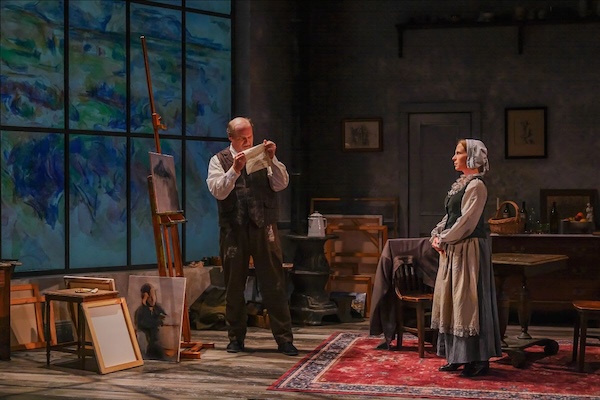
Abe Goldfarb as Émile Zola and Anna Marie Sell as Mamselle in Paul and Émile. Photo: Michael Karchmer and Michael Kerouac
AF: What did you discover about the play during the rehearsal process?
Maristed: One of the delights of collaborating in theater is discovering through excellent actors how certain spoken lines can be replaced by action. In fact, isn’t that what “dramatization” means? The process is liberating and illuminating. Beyond that, I discovered that elements of this play — as any imaginative work — came about on a subliminal level. There are parallels and echoes one doesn’t, cannot, plan for, as a writer. To be the “audience” is, literally, an eye- and ear-opening experience.
Speaking of which. Last night, opening night, brought the audience to their feet for a standing ovation. Bravo, brava, the actors!
AF: You have a collection of short stories coming out soon — talk about that volume. And do they carry on any of the themes in Paul and Émile?
Maristed: Thank you for asking! The Age of Migration, which won the inaugural Kevin McIlvoy Prize for fiction, is due out from WTAW Press in April 2026. Joan Silber, one of the three judges, who has a richly layered new novel, Mercy, out this season, called the collection “worldly in all senses. These are remarkable stories, full of beautiful urgencies, with indelible characters who get themselves in trouble all over the globe. A terrific book.” That said, there’s not an obvious artist in the lot.
If my work does have a recurrent theme, it is the pressure of the political/historical moment on individual choice — this is central as well in Paul and Émile. Beyond that, much as Emile roams about Paul’s cluttered studio, I like to roam. For example, my next play will probably be about a precocious statistical mathematician. As Émile chides Paul in the play, “But really, isn’t it a bit pigheaded to paint the same motif over and over? When so many subjects clamor for your genius?” Not to claim for myself any genius — that blessing, that curse! But you get the drift. And thanks again. Paul, Émile and I are grateful for this chance to meet your readers.
Bill Marx is the editor-in-chief of The Arts Fuse. For over four decades, he has written about arts and culture for print, broadcast, and online. He has regularly reviewed theater for National Public Radio Station WBUR and The Boston Globe. He created and edited WBUR Online Arts, a cultural webzine that in 2004 won an Online Journalism Award for Specialty Journalism. In 2007 he created The Arts Fuse, an online magazine dedicated to covering arts and culture in Boston and throughout New England.
Tagged: "Paul and Émile", Anna Marie Sell, Emile Zola, Paul Cézanne
I saw Paul and Emile last night at Wellfleet Harbor Actors Theatre. It was a splendid production of one of the finest new plays I’ve seen in recent years. This is a production not to be missed. The standing ovation was richly deserved. Readers in the area should head over to WHAT before it closes next month.
Many thanks, Diane. So glad you enjoyed it!