
Theater Interview: Provincetown Tennessee Williams Theater Festival’s David Kaplan on “Last Call: The Final Fall Festival”
By Robert Israel
“For this season, I did not want us to do a ‘greatest hits.’ I did not want to limp away. This is our last full and robust season, but not our last time producing plays.”
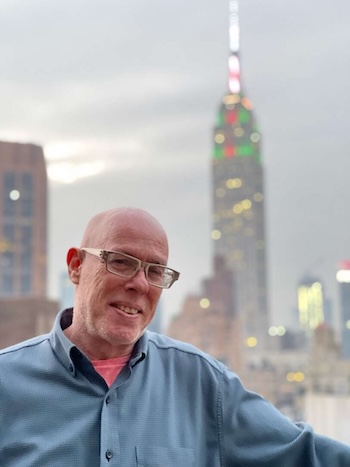
David Kaplan. Photo: Debra Roth
Twenty years ago I arrived in Provincetown for the first of what would be many return trips to review productions that were part of a festival devoted to the works of Tennessee Williams. My initial response was skepticism. I knew that Ptown had nurtured the talent of a young Tennessee Williams decades before, and that, even earlier, Eugene O’Neill had been among the first playwrights produced by Provincetown Players, which was founded in 1915. Could this new festival rekindle — perhaps even advance — that long-ago literary history? Would audiences support it? After all, Ptown has a reputation as a destination for adults seeking out bawdy “theme” festivals, not serious dramatic stage productions.
Turns out, theatergoers championed the Provincetown Tennessee Williams Theater Festival early and often, clamoring to see the productions at various venues — hotels, galleries, a warehouse on MacMillan Wharf, the local high school auditorium, private residences, guest houses, barrooms, and the dunes. They flocked to workshops, parties, and other events, attending coffee klatches with writers John Guare, Lanford Wilson, John Lahr, and many others. The community gave generously of their time as volunteers and sponsors, many providing housing for visiting troupes.
David Kaplan — curator, director, theater teacher/scholar, and writer — was at the helm of this dedicated staff, the resilient visionary force behind the PTWTF. I’ve often compared him to Sol Hurok, the late Ukrainian-Jewish purveyor of artistic talent who brightened concert halls and stages in NYC with daring and exceptional productions in the 20th century. Kaplan has similarly scouted and lured talent from all corners of our globe and nation, enticing theater artists and acclaimed companies from South Africa, Europe, China, and beyond to perform in Provincetown. Kaplan embodies Hurok’s indefatigable energy, charisma, and chutzpah.
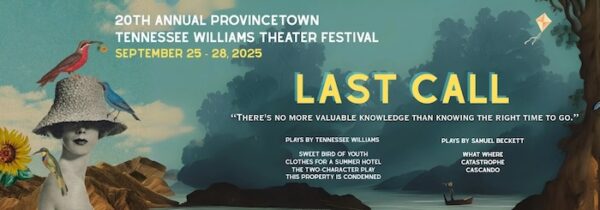
In a telephone interview from New York, Kaplan shared insights into this year’s 20th Festival, whose title is Last Call: The Final Fall Festival, which runs September 25-28.
Arts Fuse: Why are you calling this the “Final Fall Festival”?
 David Kaplan: As Alexandra DeLago, a character in Williams’s play Sweet Bird of Youth, puts it, “There’s no more valuable knowledge than knowing the right time to go.” We’ve enjoyed our run: productions of over a hundred different plays by Williams from Adam and Eve on a Ferry (2008) to Will Mr. Merriwether Return from Memphis? (2018). We’ve done it from A to W, if not quite A to Z.
AF: What can audiences expect during the Festival’s 20th season?
Kaplan: The season will feature a daring new production of a classic play by Williams, a fresh take on a rarely produced late play by Williams, a new adaptation of a text by Williams, and several short plays by Williams’s peer, Samuel Beckett. A highlight will be a production of Williams’s classic Sweet Bird of Youth.
AF: What connects these works thematically?
Kaplan: There is a similar approach to the performances of the texts that make up the roster. Williams’s The Two-Character Play displays our tactics clearly, beginning with its title. At some point, during any of the 2025 shows, two characters, in view of the audience, shine with the iridescence of multiple identities. They are simultaneously two characters moving along within the plot of the play; at the same time they are two characters not moving along at all but commenting on the play or their predicament in it. Simultaneously, they are two people, no longer characters, who are reciting lines and consciously, or not, commenting on the play; and also, importantly, they are, when it comes down to it, two people standing up (or dancing, or for that matter, reclining) who embody a vision of two souls meeting in the otherworld. For what is the stage, after all, if not a vision of a world other than our own?
AF: How does Samuel Beckett’s work align with Williams’s work?
Kaplan: In Cascando and the other short plays by Samuel Beckett included this season — Beckett called Come and Go a “dramaticule — Beckett reduces the circumstances of the stage as otherworld to an essence: a voice speaks out of the dark, for a brief time in the light. Williams embodied that same brief time in the poetry of his theater as a candle sure to be blown out, in the sparkle of glass soon to be broken, or the whoosh and sudden flash of a skyrocket. For Breath, written in 1969, Beckett honed the sounds of transience to a breath between the cries of birth and death.
Lush or spare, these two great writers share a similar design: an entrance implies an exit. As a character named Bom concludes in Beckett’s What Where: “Time passes. That is all. Make sense who may. I switch off.”
Exits in the short Beckett plays are often succinct: the lights do switch off or fade out. The physical performance is no illusion, but rather a demonstration that when it comes to what happens after the life we know, there’s nothing we can know except that we don’t know. Godot or God? Paradise or Hell? Or nothing?
AF: Many theater troupes are understandably worried about cuts to their funding sources. Is that one of the reasons this Festival is being titled “Last Call”?
Kaplan: We do what we do because of the audience — there are Tennessee Williams festivals in St. Louis and in New Orleans, but we have always been different. We take different risks. We exist because of the generosity of our community. We have never been supported by the grant organizations. We’ve never depended upon reviews. We do not buy into political agendas. Theater is something that is always going to be produced whether you’re doing it with flashlights or pie plates. And for this season, I did not want us to do a “greatest hits.” I did not want to limp away. This is our last full and robust season, but not our last time producing plays.
AF: What’s up next for the Festival? For you?
David Kaplan: We plan on doing pop-up events in Provincetown and throughout the world: Mexico, maybe? There’s more material than can be fit into this year’s Festival that’s well worth presenting. And as for me: I’m writing a book about Tennessee Williams and science fiction, a spin-off from the research for our 2023 season. Oh, and I’m directing Listen to Me, a play by Gertrude Stein — a circus play with live horses, and Kathleen Turner as Gertrude Stein.
Robert Israel, an Arts Fuse contributor since 2013, can be reached at risrael_97@yahoo.com.
Tagged: "Last Call: The Final Fall Festival", David Kaplan, Provincetown Tennessee Williams Theater Festival, samuel-beckett
In both NYC and LA, Dr. Larry Myers (award-winning international playwright & Williams intimate) plans TENNESSEE WILLIAMS SYMPOSIUMS. Myers is in contact with the Williams Estate as he own various unpublished Williams works & letters & photos