
Art and Design Commentary: Art Deco at 100 — Happy Birthday!
By Mark Favermann
Still fresh today, the Art Deco period — which influenced the construction or fabrication of buildings as well as luxury décor and functional objects — is considered one of the finest moments in design history.
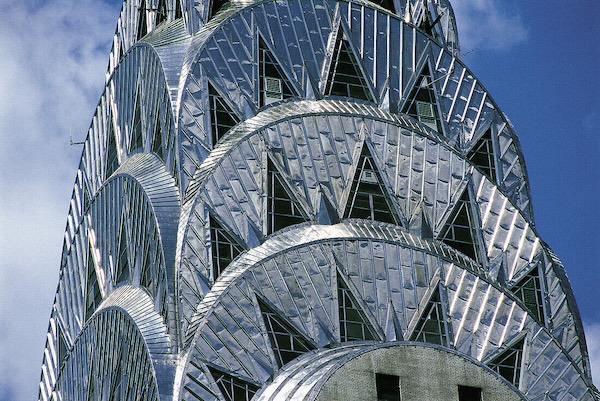
Detail of Chrysler Building, 1928, by William Van Allen, New York, New York. Photo: New York Historical Society
This year, 2025, marks the 100th anniversary of the world introduction of the global modern design style called Art Deco. Originating just before WWI in Paris, Brussels, and Vienna, the label groups together several related styles of buildings, objects, graphics, and artworks that were deemed “modern.” Of course, there were many ideas, then as now, regarding what “modern” should look like. A seminal exhibition — in the mode of today’s Venice Biennale, Berlin Biennale, or myriad other major art and design exhibitions — L’Exposition Internationale des Arts Decoratifs et Industriels Modernes set the visual parameters of early Art Deco in Paris in 1925.
Still fresh today, the Art Deco period — which influenced the construction or fabrication of buildings as well as luxury décor and functional objects — is considered one of the finest moments in design history. Initially, Art Deco drew on earlier, neoclassical styles, but applied to them exotic motifs, such as flora and fauna. A contemporary spirit was combined with fine craftsmanship and rich materials. During the ’20s, Art Deco represented modern luxury, glamour, sophistication, and faith in social and technological progress. Its manifestation in ’30s America was more pared down, simplified, streamlined, and focused on affordable consumer products.
The Paris multipavilion exhibition was planned, designed, and sponsored by the French government to highlight the modern style of architecture, interior decoration, furniture, glass, jewelry, and other decorative arts in Europe and the world. Its purpose was to celebrate the WWI victory of the Allies in Europe. The United States was invited to participate, but the then Secretary of Commerce, Herbert Hoover (a staunch Republican), refused the offer. Regrettably, the conservative cultural bias and aesthetic blindness never seems to change. Germany was not invited to participate, because the country had lost the war. The Soviet Union was offered a slot. At the exposition, many ideas championed by the international avant-garde in the fields of architecture and applied arts were presented for the first time to a massive public audience. The event was visited by an estimated 16 million people. Luckily, many prominent and emerging American architects and designers visited the exhibition, observing and sharing the success of which helped make Art Deco design prevalent throughout the world.
The term “Art Deco” was first popularized by British art historian Bevis Hillier in his 1968 book Art Deco of the 20s and 30s. The term was inspired by, or you could say appropriated from, the 1925 exposition. Prior to Hillier’s book, Art Deco was most often referred to as “Style Moderne” or “Jazz Moderne.” It was also given other names, such as Modernistic, Machine Age, or “Style Contemporain.”
For many years, I thought that there were just two types of Art Deco: a highly stylized, elaborate, and quite luxurious European style and a simplified, often streamlined, functional American style. I was sort of correct, but not entirely. Like its immediate major predecessor design style, Art Nouveau (1890-1914), Art Deco embraced several varieties of approaches and methods of expression. In Art Deco architecture, for example, there are three subcategories of Art Deco style. Zigzag Moderne is also known as “Jazz Moderne,” and is primarily characterized, in skyscrapers, by its stepped or tiered appearance. Classical Moderne blends Art Deco with classical elements that feature symmetrical designs and decorative motifs. Streamline Moderne, which developed during the Depression, emphasized smooth, aerodynamic curves and horizontal lines. Each subcategory influenced and enriched furniture, décor, and functional objects.
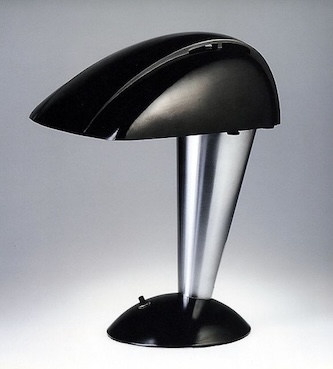
Polaroid Desk Lamp by Walter Dorwin Teague. Manufactured by Polaroid Corporation, Cambridge, MA, 1939. Photo: The Metropolitan Museum of Art.
Contrary to what is often assumed, Art Deco was a reaction against the organic curves and flowing naturalism of Art Nouveau; it emphasized angular and geometric elements — including spheres, polygons, and rectangles. Symmetrical patterns predominated, with vivid use of sharp, high-contrast, vivid colors, and the use of modern materials, such as steel, aluminum, chrome, and even plastics in product and architecture designs.
Among the design styles that inspired Art Deco were aspects of the Austrian Wiener Werkstätte, the Dutch De Stijl Movement, Geometric Cubism, machinelike Constructivism, and Futurism. Historical motifs were also drawn from Egyptian, Classical Greek, Mesopotamian, Aztec, Mayan, Chinese, and Japanese influences. The initial visuals reflected the economic boom of the ’20s. When the roaring ended with the Great Depression, there was a shift away from luxury products to affordability. Art Deco became a mass-consumed style, influencing the design of transportation, vehicles, appliances, and graphics, as well as the look of new technologies such as radios and vacuum cleaners. Art Deco was part of the glamour of Hollywood and was used to accent the allure of current events, such as coverage of the discovery of King Tut’s tomb.
Thematically, Art Deco suggests optimism about the future, a belief propelled by a sense of progress. Key characteristics of the style include: heavy utilization of geometric forms like chevrons, zigzags, sunbursts, and stepped patterns; the use of luxurious, sometimes exotic, materials particularly during the ’20s; streamlined, aerodynamic shapes, particularly during its “Streamline Moderne” phase; an openness to diverse sources, including ancient structures as well as contemporary movements; a celebration of the progressive spirit of the machine age, embracing mass production and modern technologies; an emphasis on making utilitarian objects beautiful.
Art Deco buildings were designed to be multidimensional, to make a 3D impression via roof lines with parapets, spires, towers, and geometric cornices. These impressions were emphasized by setbacks, sharp angles, and a wide variety of ornamentation, symmetry, and detailing. The latter often included bas-reliefs, ornamental fascia and friezes, murals, and statues.
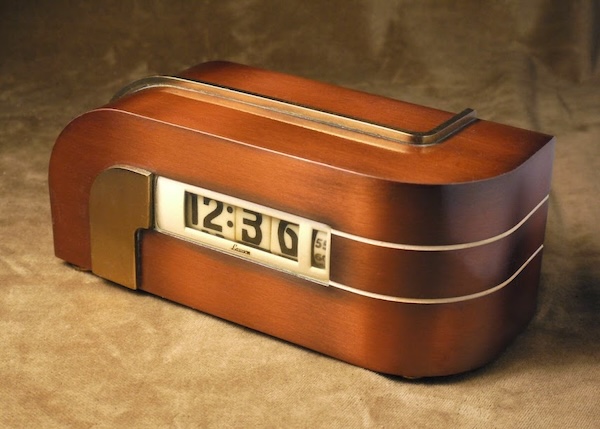
Zephyr, clock, attributed to Kem Weber. Lawson Time Inc.,designed c. 1934. Photo: The Metropolitan Museum of Art
Graphic patterns and motifs became a hallmark of the era, and zigzags, pyramids, chevrons, and other geometric shapes, as well as sunbursts and stylized florals are among the most recognized Art Deco patterns on buildings. Often striking, elegantly ornamented but never fussy, Art Deco is considered to be the first modern interior design style. The interior of the title detective’s flat in PBS’s Agatha Christie’s Poirot television series is a wonderful illustration of this look.
Art Deco’s continuing visual and cultural legacy were showcased at last year’s Paris 2024 Olympic Games. The “Look of the Games” design was infused with the elegance and vitality of Art Deco. Closer to home, in the last quarter century, Brookline, Massachusetts, has been home to the award-winning (and iconic) Coolidge Corner Theatre marquee, which pays homage to the independent cinema’s 1933 origin.
Happy Birthday Art Deco!
Mark Favermann is an urban designer and planner with a practice focusing on human scale issues. In 2024, he received APA/MA’s Journalism and Communications Award for his decades of writing on the built environment. From the Mass Cultural Council, he is a recipient of the Creative Individual Artist Award 2025 for his sculpture.
Great article about a truly creative design movement. The author, however, fails to credit the designer of the iconic Coolidge Corner theater marquee. The designer is Mark Favermann.